
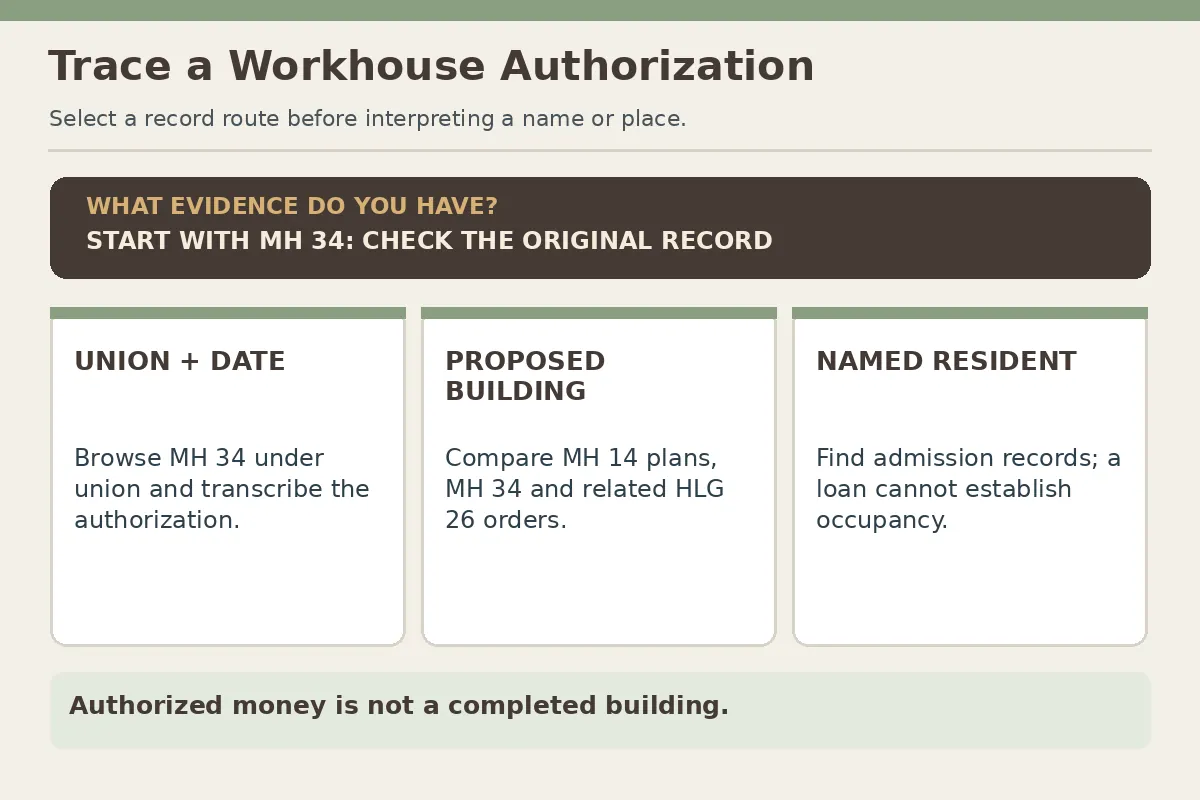
MH 34 is a financial route into the history of Poor Law buildings. The National Archives describes registers authorizing expenditure for workhouse purposes, arranged alphabetically by union and recording details such as loan amount, lender, security and order date. These entries can document an administrative authorization. They do not, on their own, prove that money was drawn, a contractor was paid, a building was completed or a family lived there. The correct research product is an authorization-to-construction chain with every step independently dated.
Find the Historical Poor Law Union First
Start with the name of the Poor Law union that governed the site when expenditure was proposed. Union boundaries and names can differ from modern local authority districts and from the settlement where a workhouse stood. If you know only a building or village, identify the relevant union through contemporary directories, Poor Law maps or surviving administrative records. Record spelling variants and changes of union name so a search in an alphabetically arranged register is not aimed at the wrong heading.
The National Archives describes MH 34 registers as arranged alphabetically by union. That creates a practical first step: choose a documented union, then look for its expenditure authorization entries. A familiar town name in the modern address may not be the filing name. Create two fields in your notes, site location and administering union, and never merge them merely because one appears near the other on a map.
Transcribe What the Authorization Actually States
The National Archives identifies the amount of the loan, lender, securities and date of the authorizing order among MH 34 register details. Copy the original headings and wording before interpreting these fields. An amount authorized for a particular purpose does not establish the date cash was received or the sum ultimately spent. A security may refer to pledged rates or a formal legal arrangement; do not turn that mention into a named private donor without documentary support.
Record the order date separately from any later account or building date. Some projects change after initial authorization, and a register entry cannot be presumed to summarize every subsequent amendment. If a number appears in the margin, copy it exactly before deciding whether it points to a related order. The key historical question may be whether the guardians obtained authority to incur a debt, which is narrower than whether building work was finished.
Match the Register to an Order in HLG 26
The National Archives suggests using MH 34 as a route to Poor Law Board orders in HLG 26. Match the union, relevant date, reference and purpose instead of assuming any similarly dated order concerns the same building. The register and an order are two records from related administrative stages. Their existence may strengthen proof of authorization, but they do not amount to a completed-works certificate. Record exact file and page references so the connection can be independently reproduced.
If the order alters or conditions a proposed expenditure, include those restrictions in the timeline. If the register and order differ, do not quietly select the larger amount or the date that supports a preferred narrative. Investigate whether a revised proposal, transcription issue or second authorization explains the discrepancy. The word “approved” should always refer to the particular approval described by the surviving document, not to an invented global approval of construction.
Compare Plans and Building Accounts Carefully
Architectural plans can show an intended enlargement, new block or internal rearrangement; the presence of a plan is not evidence that the design was built. The National Archives identifies workhouse plans in MH 14, with some also in HLG 6, and indicates that drawings may survive among correspondence. Compare those plans to dated local guardians’ minutes, tenders, contractor accounts, survey reports and later physical surveys where such evidence exists.
Do not treat a proposed wing’s drawn date as its construction completion date. A later map showing the same footprint can support a stronger building-history inference, but the editions, survey dates and scale should be checked. If only one part of a scheme went ahead, cite which component is evidenced rather than calling the entire workhouse “rebuilt.” A documented building program can have several stages that are invisible in a single financial entry.

Separate Authorized, Borrowed and Paid Amounts
A useful financial table has separate columns for authorization, recorded borrowing, contract value, payment and final reported cost. MH 34 may inform the first column, but the other columns require their own sources. A project may have been funded partly from rates, local reserves or subsequent advances. Do not calculate a final cost from the approved loan alone. If later accounts use a different money basis or fiscal year, preserve the original units and date labels.
If the lender is named, this can help locate relevant lending board or local financial records. The entry itself does not prove that each planned installment was advanced. Investigate cancellation, redesign, delay or budget revision where later records indicate an unresolved scheme. The most valuable conclusion sometimes is that approval existed but implementation remains unverified. That is a meaningful finding for a family historian researching a local institution.
Use a Fictional Expansion as a Proof Test
Suppose a local history says a workhouse infirmary was built in 1888 and an MH 34 entry indicates an authorization near that year. Create a separate row for the local claim, the register date, the relevant order, an architectural drawing and a later inspection or annual account. Only the later evidence can carry the building-completion question. Do not infer patient occupancy from an order for an infirmary even if the project was eventually constructed.
The infirmary scenario is fictional; it models the difference between authorization, design and actual use. If a parish ancestor appears in a guardians’ minute book, do not link that person to the proposed new ward without a dated institutional or personal record. The authority to spend belongs to the union administration. A building’s use and a person’s presence are separate factual propositions and should remain separately sourced.

Document the Site and the Full Citation Chain
Cite the MH 34 piece, union heading, order date, entry details and page or folio if known. Then cite each HLG 26 order, plan or local account on its own line. Do not replace this chain with a summary phrase such as “the archives show the workhouse opened.” An audit trail should state exactly which document establishes the loan authorization, which establishes a building stage and which, if any, identifies occupants.
The National Archives’ Discovery catalogue descriptions may not contain individual register entries. Note whether you read an original image or only a catalogue description, and use the stated access process when a visit or copy is needed. A negative search for completion requires knowing which local minutes or accounts survive. Where they are missing, leave the building’s implementation unproven instead of treating administrative authorization as a substitute for a construction record.
More House and Local History Guides
How We Research This Archive Series and Verify Its Limits
We anchor the series description to The National Archives research guidance and use additional official guidance to test the difference between cataloguing, surviving documents and interpretation. The evidence trail follows the record creator, exact series and piece, original wording, historical jurisdiction, and a separate corroborating source for any person-level or outcome claim. We label illustrative scenarios as fictional and do not treat absences from poorly indexed collections as evidence of nonexistence.
An archival catalogue entry is not a substitute for reading a page. Availability, description detail and access conditions can differ by item and change over time; check the current record page before making travel, copying or subscription plans. We do not infer a paid relationship from archive references. Our affiliate disclosure explains site-level disclosure principles. The methods here are for reconstructing historical evidence, not for locating or revealing sensitive information about living people.
No. The registers document authorizations; construction requires separate building, account or inspection evidence.
The National Archives identifies loan amount, lender, securities and authorization order date among its fields.
The research guidance says they are arranged alphabetically by Poor Law union.
The National Archives points researchers toward related Poor Law Board orders in HLG 26.
No. For residents, consult surviving admission or relief records tied to the person and date.