
Find the Poor Law Union Before the Building
MH 14 contains plans of Poor Law Union workhouse buildings for 1861–1918. A plan can be powerful evidence for the design or alteration of a historic institution, but it is not an admission list and does not name the people who slept in its rooms. Begin with the union that administered the workhouse in the relevant year, not just a modern town name. Poor Law unions included multiple parishes, and an institution could be in a different locality from its administrative union.
The National Archives poverty and Poor Laws guide gives the example of Eton union operating a workhouse at Slough. This illustrates why locality and union should occupy separate fields in a search log. Confirm the historic union, county and approximate building date with reliable local material before using a national catalogue search.
Most working records created by unions and workhouses are held by local archives, not The National Archives. MH 14 is central administrative architectural evidence. The plan may be indexed under a union name or a box-level description rather than an architect, building nickname, or later street address. Record unsuccessful searches under both the institution name and administrative union.
Distinguish Proposed, Altered, and Completed Layouts
The National Archives dates MH 14 from 1861 to 1918 and cautions that many boxes are simply described as union plans; some later material concerns a particular issue for a named union. When examining a sheet, record its own title, scale, date, approving authority, annotations, revision marks, and any indication that it is a proposal or an as-built drawing. A ground-floor plan dated in 1887 is not automatically proof that the pictured rooms existed unchanged in 1891.
Plans can show circulation, ward names, service spaces, infirmaries, entrances and boundaries when those details are actually drawn. Do not infer a resident’s age, medical condition, sex, or identity merely from a room label. Labels describe architectural or administrative intended uses, not admission records or a specific person’s life.
If two plans disagree, create a version table identifying their dates and marks rather than selecting whichever looks more complete. A room added in a later drawing may not have been built; an area missing from an early proposal may have existed in an adjoining structure. The archival task is first to establish what each document claims and then search for corroboration of physical completion.

Cross-Check Plans With Spending Authorizations
The same official guide points to MH 34 registers of authorization for workhouse expenditure. These are arranged alphabetically by union and may give the amount of a loan, lender, security and date of the order authorizing spending. An authorization is financial or administrative permission; it is not a completion certificate and may refer to works later changed or delayed.
For more context, use MH 12 correspondence concerning a union, where sketches of workhouse buildings may also occur. Parliamentary reports sometimes printed model workhouse designs, while HLG 6 holds some additional workhouse plans for 1862–1914. These are supplementary choices with different origins: a model plan should not be passed off as a measured plan of the particular workhouse.
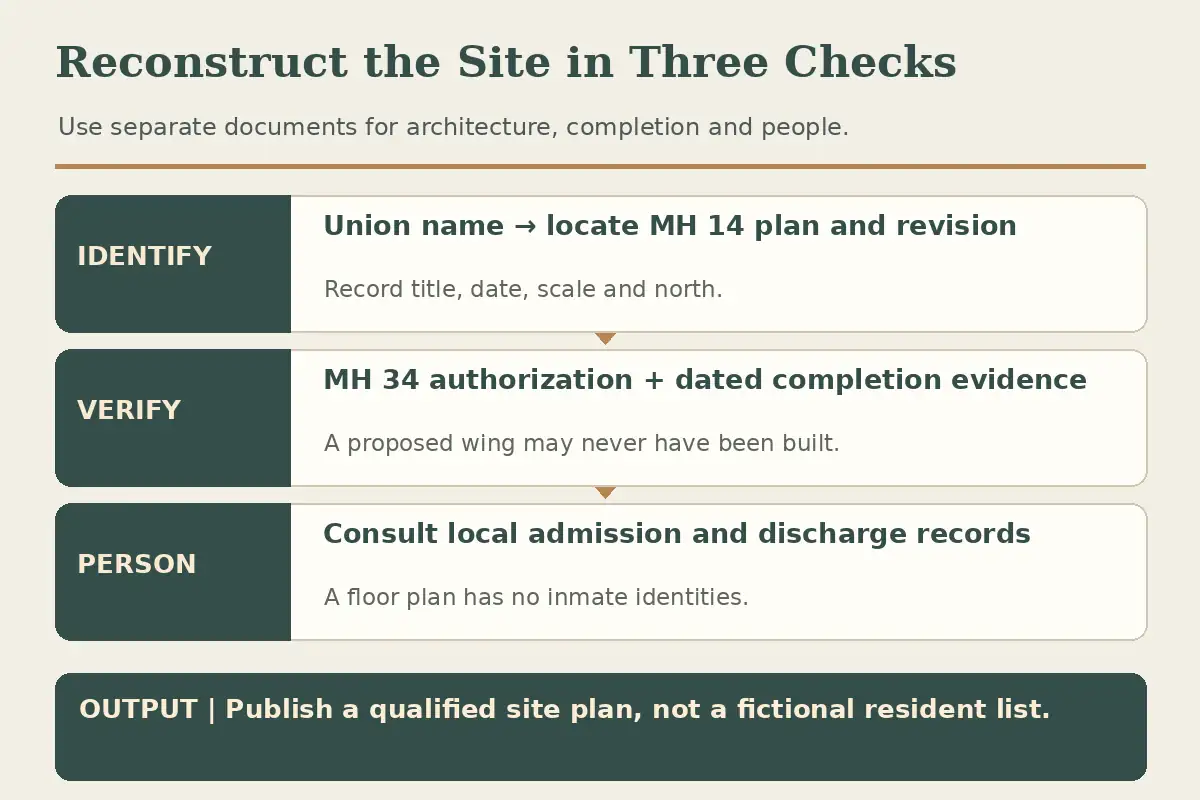
Build three evidence columns: MH 14 DESIGN, MH 34 AUTHORIZATION, and INDEPENDENT COMPLETION EVIDENCE. Leave the third blank until a dated photograph, local minute, inspection report or other original source supports construction. A visually impressive drawing alone should never close the gap between permission and completed brickwork.

Place the Building in a Local Timeline
Trace the institution’s name and address through historic maps, local council material and surviving local archives. Boundaries and road names can change, so pin the historic site using features that can be tested independently. Do not overlay an old plan on a modern satellite map without accounting for orientation, scale, enlargement, demolished wings and shifted streets.
A relative’s known appearance in a census near the workhouse is not proof of admission. Find the household schedule, resident category and, where available, an actual admission or discharge register. The National Archives distinguishes MH central records from the operational records of the union, typically in local archival custody. That split should direct your follow-up request.
Likewise, the workhouse’s architectural categories cannot establish a diagnosis or treatment history. Even a clearly identified infirmary shows the role of a space, not that a particular named ancestor was admitted to it. Treat historic institutional labels with care and avoid drawing personal conclusions about vulnerable people from building plans.
Publish a Documented Site Reconstruction
For each drawing, keep the original MH 14 piece, plan date, any visible revision, direction of north, scale and descriptive title. Annotate a modern map only after matching several fixed points. Keep speculative edges labelled “approximate” and distinguish a proposed wing from a built one. This enables family historians to understand a place without inventing the lives of its residents.
A successful reconstruction can say that a named union submitted or held a particular plan in the 1861–1918 series and identify what the drawing depicts. It may also show an expenditure authorization in MH 34. Whether the work was built and who lived there are separate questions requiring separate records. Maintaining these three levels of evidence is the chief practical benefit of an MH 14 search.
More House and Local History Guides
How We Research the Archival Evidence
Our method begins with the repository’s description of each series, its date limits and its known gaps. We compare record purpose with the question under investigation and distinguish direct statements in an original document from the cataloguer’s summary, a family tradition, and inference. The examples and record-class distinctions in this guide derive from the official sources listed below; they are guidance for finding and evaluating a document, not proof that any particular family member appears in it.
Official references checked on October 29, 2026: poverty poor laws. architectural drawings. We recommend recording retrieval dates and consulting the original image or physical document when possible. See our affiliate disclosure for site-wide relationship information; no paid relationship is implied by these archive links.
No. Match the person across independently dated records using place, role, age when available, associates and documented relationships. A name hit is only a research lead.
A catalogue or printed calendar can locate a record and supply context, but summaries may omit wording and qualifications. Inspect the original before making a strong personal claim.
No. A series may have coverage limits, losses, poor indexing or alternative filing. Record the years, references and spellings actually searched before describing a gap.
Keep the complete archival series and piece, item or folio where available, document date, repository, image or physical access route and the exact claim supported.
Write a precise hypothesis and find an independent record of the relevant person, place or event. Keep unverified relationships and movements clearly labeled as unproven.