
Use BT 26 when an ancestor arrived in the United Kingdom by sea between 1878 and 1960 on a voyage originating beyond Europe and the Mediterranean. The National Archives holds this inward passenger-list series; searchable images are offered through commercial partners. Record the ship, arrival port and arrival date, then inspect the passenger entry rather than copying an index’s name alone. BT 26 documents an arrival aboard a particular vessel, not citizenship, permanent immigration, or ownership of the address supplied. See the official passenger research guide and our affiliate disclosure.
Decide Whether BT 26 Covers the Voyage
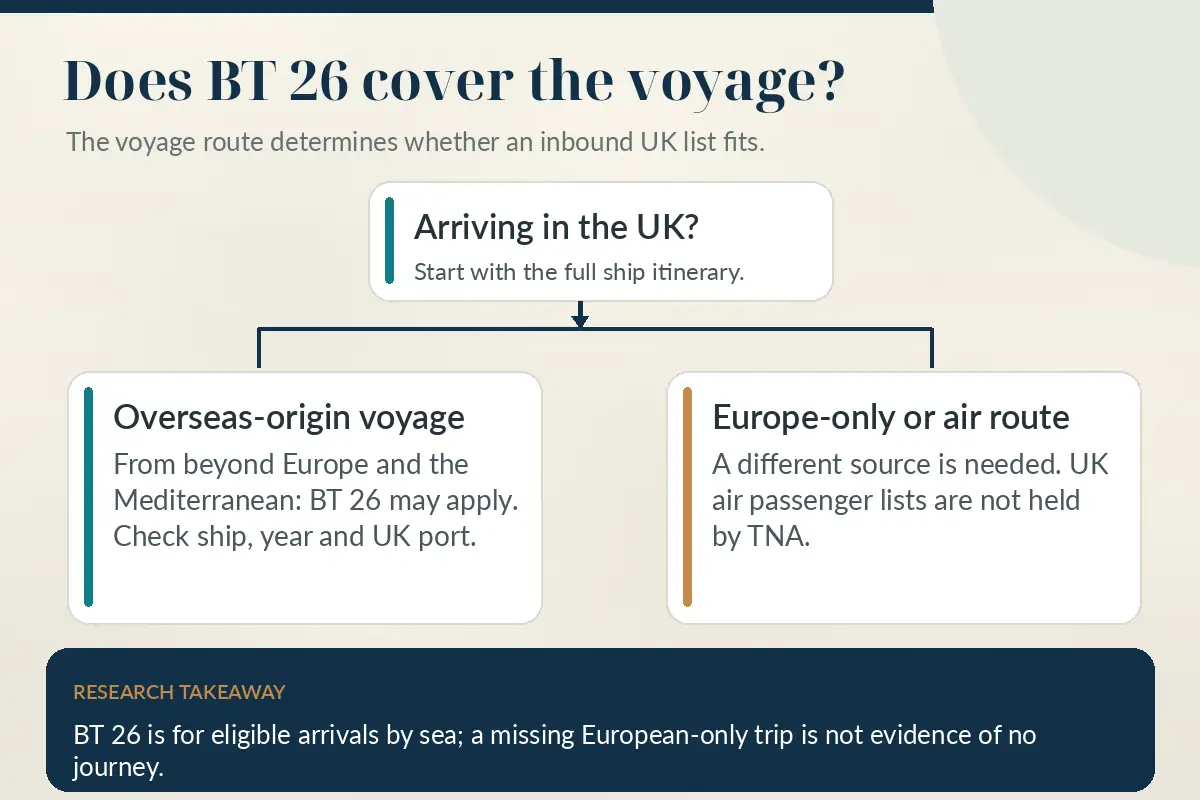
The first filter is direction of travel. BT 26 is inward to the UK; BT 27 is outward from the UK and Irish ports. A family tale about sailing from Liverpool to New York points toward BT 27, while a return from New York to Liverpool may fit BT 26. Do not search both as though their gaps were equivalent. An arrival after a continental voyage may also be absent for sound administrative reasons, because lists did not routinely capture journeys solely within Europe or the Mediterranean. The ship’s full route, not a traveler’s nationality, decides whether the inbound series is a sensible target.
The National Archives dates BT 26 from 1878 to 1960; earlier passenger records there are few, and the archive does not hold post-1960 air passenger lists. Surviving early coverage should not be assumed complete for every route or port. Find a time window from a dated letter, residence record, newspaper notice, passport or arrival at a destination on the other side of the ocean. An arrival statement in a later census is only a lead. Search a range of dates because the departure month may differ from the UK arrival month, especially on long or interrupted journeys.
Build a Ship-and-Port Search Before Looking for a Name
Start with a surname and several spelling variants, but move quickly to vessel and itinerary clues if the index returns many names. Record the year, possible arrival port and any ship-name variation; search the original list using the provider’s available filters, then check the header rather than trusting a catalog description alone. If the family may have traveled together, compare adjacent passenger rows and ages; a shared surname can describe unrelated passengers. An accurate search log should state whether a candidate was excluded because of age, address, route or a clearly incompatible date.
Read Each Passenger Entry as a Voyage Record
An inward list can report names, ages, occupations and an intended or recorded address in the UK; the information and arrangement vary with the form and era. The UK government historical-records guide specifically mentions occupations, UK addresses and arrival dates. Transcribe what the column actually asks, including any abbreviated heading. A UK address might be a temporary destination, a relative’s house or a hotel. It is not a deed, a declaration of domicile or proof that the traveler remained at that address. Test the address independently with directories or household sources.
Read the page at its original resolution and capture the entire citation: BT 26 piece or digital collection reference where available, vessel, arrival port, date, page and row. Distinguish printed form headings from handwritten responses. Check whether an age was entered as years or whether a blank is truly empty; neither condition warrants inventing a birth year. A passenger may appear more than once across separate voyages. If two matching rows occur years apart, document both trips separately instead of treating the second entry as an indexing duplicate without inspecting it.
Compare Incoming, Outgoing, and Ship Registers
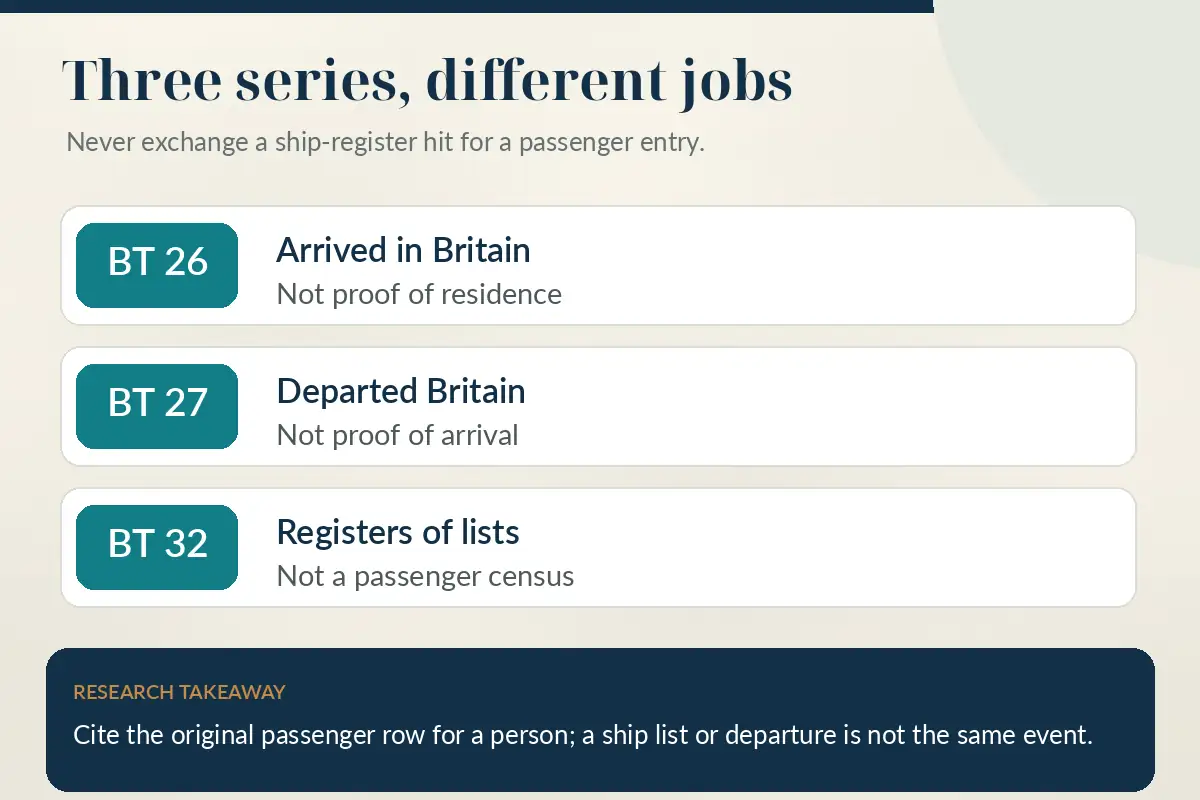
BT 27 can corroborate an outward journey, but cannot serve as evidence that the traveler returned on a particular ship. BT 32 comprises registers of passenger lists rather than a second complete person-by-person passenger census; it may help trace a ship or list when the name route fails. The official digitized-list guide distinguishes the two main searchable passenger series. Crossing the archive categories is useful only if you keep the administrative purpose of each one in your evidence table. Same vessel name and similar dates may refer to different sailings.
A practical comparison uses three matching keys: exact or approximate travel date, ship and ports. Add passenger identity information only after those keys are plausible. For example, a Liverpool family resident in Canada might show a Canadian departure, an Atlantic sailing and an arrival in Britain. A separate Canadian outgoing or inbound record can support the itinerary if its dates are compatible. A perfectly matching name in a BT 27 departure does not, on its own, prove that the corresponding BT 26 arrival names the same person or even that the planned voyage was completed.
| RECORD | PRIMARY QUESTION | NOT ESTABLISHED |
|---|---|---|
| BT 26 inward list | Who arrived on this vessel? | Citizenship or settled residence |
| BT 27 outward list | Who departed the UK or Irish port? | That the traveler later arrived |
| BT 32 ship register | Which ship/list is indexed? | A complete passenger identity |
Resolve Missing Names and Repeated Travelers
When no name appears, test the series boundary before expanding wildcards. Did the vessel travel only from a European port? Was the supposed trip by airplane or after 1960? Was the event actually the ship’s departure rather than its arrival? Could the passenger have embarked at an intermediate port on an overseas-origin voyage? Record each answer, and avoid calling the absence proof that the individual never traveled. Next check newspapers, shipping advertisements, family correspondence, contemporary registration and passenger lists at the foreign port. Their survival and access rules differ from BT 26.
For repeated names, build a candidate table with age range, occupation, named companions, reported UK address and independently known residence. Reject a candidate if several high-value fields conflict. Be cautious with common occupations and broad regions: ‘laborer’ and ‘England’ do not identify a person. If a note says ‘visitor,’ cite it as a reported status on that record and seek follow-up evidence from a residence register or local archive. Preserve a transparent ‘unresolved’ result when the list gives only name and age. A family history should not transform a transit stop into permanent migration.

Test a Hypothetical Returning Passenger
Consider a hypothetical person called Mary Ellis, thought to have returned to Southampton in 1924 from Canada. A BT 26 name hit for Mary Ellis of a plausible age is a candidate, not a conclusion. Inspect the original ship header and compare arrival date, port, occupation and any address with separately dated letters. A person appearing on another ocean voyage in 1926 might be the same traveler or a namesake. If an overseas departure record reports a different age, record the conflict rather than silently changing either entry. This example illustrates method, not a real family claim.
A compact research log should keep one row for every search combination: provider, series, direction, date range, port, ship and name variation. For positive hits, add the original page citation and notes about each field; for failed searches, state what was actually covered. Work backward from proven UK residence dates to plausible ship arrivals, not from a list of every matching surname. Separate the ship’s itinerary from the passenger’s later address, and use unrelated contemporary records to test any intended settlement. Always preserve the literal column wording where it affects interpretation.
More Records and Archives Guides
How We Research British Inward Passenger Lists
We check the custodial distinction in The National Archives guidance first, then independently compare the name index with the surviving page image and its vessel heading. The research output consists of a voyage statement, exact citation, match-and-conflict ledger, and a short list of unresolved alternatives. We do not call an arrival a naturalization, or infer kinship merely because two travelers were listed together. Paid access through a third-party platform is a viewing condition rather than evidence quality; the original series and page remain the source that must be cited.
The National Archives series of surviving inbound ship passenger lists for eligible UK arrivals between 1878 and 1960.
Not usually if the journey was only within Europe; examine the ship’s entire route before excluding a candidate.
No. It records a voyage and may name an address, not an enduring legal status or settlement.
No. BT 27 records eligible outbound voyages and is distinct from incoming BT 26.
Check ports, dates, spelling and journey coverage, then use shipping notices or the foreign port’s records.