
An ancestor who paid for passage to Queensland may be missing from the state’s familiar assisted-immigration index. Queensland State Archives explicitly warns that its records generally concentrate on immigrants receiving assisted or free passages or land-order benefits; a self-funded traveler may not have a corresponding entry. Find the likely arrival port, ship and voyage window first, then search surviving passenger lists, shipping notices and holdings at the National Archives of Australia. A failed surname search is a prompt to change record classes, not evidence that the journey never happened.
Identify the passenger class before trusting an index
The Queensland State Archives immigration collection guide points to its assisted immigration records for 1848–1912 and various regional and later indexes. The word ‘assisted’ refers to an administrative scheme, not whether a family eventually became prosperous. A paying passenger, a crew member, a coastal traveler and a nominated migrant might be represented differently. Do not search a government subsidy register as though it were an every-passenger census of arrivals.
Start a profile with the earliest secure Queensland appearance, last secure overseas or interstate appearance, expected route and whether any family document suggests the fare was paid or sponsored. Record this as a working hypothesis; a migrant’s later occupation alone cannot establish ticket type. If an index entry is found, open the source description and confirm whether the name comes from a genuine list, a later administrative register or a nomination that might never have led to travel.

Match Queensland arrival port to the appropriate custodian
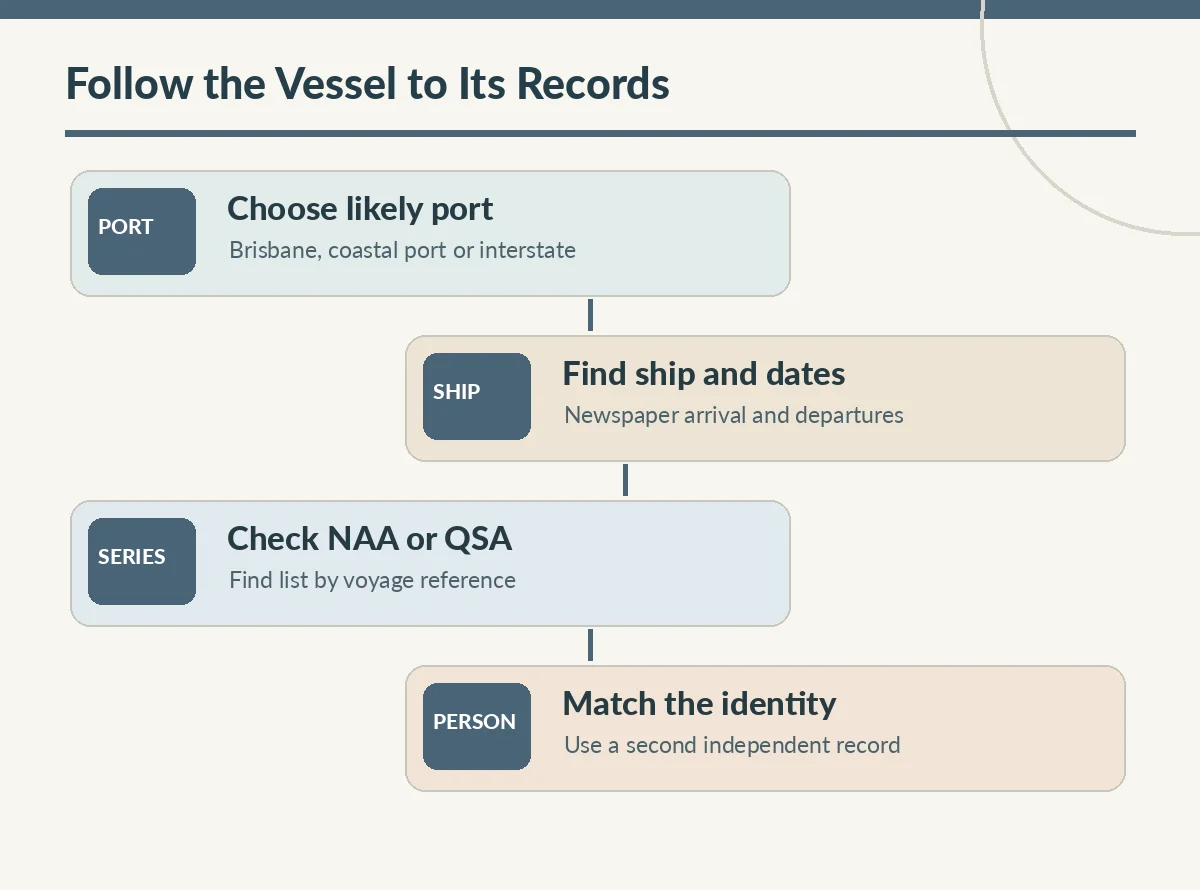
The National Archives of Australia Brisbane passenger-records fact sheet describes inward and outward passenger lists for Queensland ports, with Brisbane material beginning as early as 1852. The listings are arranged by date, ship name and port. Some early material may survive as originals and some only as microfilm; not every journey appears in a modern name index. Search the NAA series description before assuming an item can be viewed as an online image.
Passenger administration changed at the Commonwealth level from 1924, but NAA also holds selected older records for Queensland. For a voyage before 1924, check QSA and the NAA port-specific series instead of following a simplistic ‘state before, federal after’ rule. After locating a ship date, record the collection series, voyage span and image or box identifier; never substitute the arrival of a similarly named vessel in a different year. For the fuller picture, see our guide “Tasmania Passenger Arrivals, 1803–1900”.
| Route | First research stop | Key caution |
|---|---|---|
| Assisted arrival 1848–1912 | QSA immigration indexes | Not all paying passengers |
| Other early port or ship list | NAA Brisbane port holdings | Many arranged by voyage, not name |
| Arrivals from 1924 | NAA passenger collections | Series and access vary by date |
| Intercolonial movement | Departure or coastal records | A Queensland index may be silent |
Use shipping newspapers to recover ship and date
A contemporary shipping column can report vessel, arrival date, departure port, cabin passengers, master and destination. The National Library of Australia notes that newspapers often printed names of saloon passengers while giving only aggregate counts for steerage. Browse the local paper around the family’s first proven Queensland appearance and search the vessel name, not only the ancestor’s surname. If OCR misses a ship, inspect the shipping column in page images across a broader date window. For the next step, our guide “South Australia Assisted Passage Certificates, 1862–1885” explains how to check nominees.
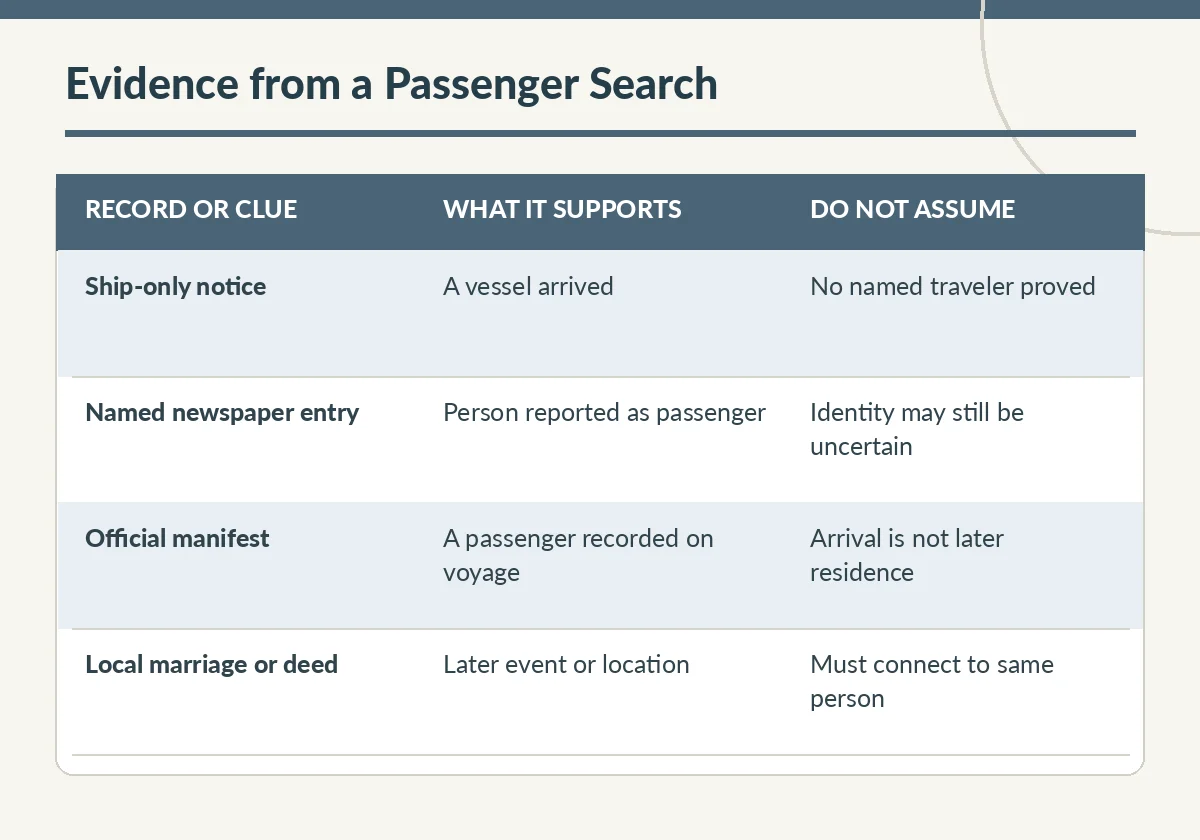
Be explicit about evidentiary strength. A newspaper notice that a ship reached Brisbane does not show that a particular unlisted traveler was aboard. A named cabin list may establish a reported passenger but still requires a contemporary manifest or independent family link for identity. Record the newspaper title, publication date, page and the date the notice says the ship arrived—these can differ. Then take the verified ship/date clue back to the appropriate archival series. Our guide “Victoria Outward Passenger Lists, 1852–1923” covers a related question.
Account for floods, coastal moves and foreign ports
Queensland State Archives warns that many lists before 1893 were damaged or destroyed in the 1893 floods, and some rewritten records contain errors. It also cautions that an immigrant who landed in another Australian colony and later entered Queensland may be absent from its direct-immigration lists. When the first proven Australian residence lies in another state, switch to that state’s passenger and shipping collections rather than stretching a Queensland arrival theory to fit a name match.
The same collection guide says its early lists focus chiefly on European migrants. Travelers coming from Asia, Africa, New Zealand or the Americas may not appear in the relevant administrative lists. Do not turn that omission into evidence of ethnicity, citizenship or legal status. Check nationality and migration documentation only where a surviving primary source explicitly supports the assertion, and handle historic classifications critically.
Compare a ship match with an independent identity test
Suppose a newspaper lists a passenger called Ellen Moore on an arriving ship. A Queensland marriage certificate for an Ellen Moore, from a broadly compatible era, is not automatically hers. Compare stated birthplace, age, spouse, parents where reported, known occupation and later address. If the newspaper lists only first-class travelers, verify whether your Ellen plausibly used that route. An unrelated same-name passenger is a very real possibility on heavily trafficked routes. For the fuller picture, see our guide “Queensland Nominated Immigrants, 1905–1928”.
A useful decision ledger marks the ship evidence as either person-named, ship-only or inferred, then ranks candidate identities as supported, contradicted or still possible. Keep old hypotheses instead of erasing them when a new arrival record emerges. The central question is not whether some ship made the journey but whether the specific traveler can be connected to that voyage by independently sourced details.
Record unsuccessful searches so the route can be repeated
Search one port series and defined date range at a time. Write the catalog search terms, variant ship spellings, port, inward or outward direction, and which images you inspected. ‘No online hits’ does not necessarily mean the archive holds nothing; NAA records may be organized by ship and date, while QSA may have only a name index to selected schemes. Also search an outward departure record or an Australian newspaper for a known voyage where no local manifest survives. Our guide “NSW Unassisted Passenger Lists, 1826–1922” adds more detail on this.
Do not present a fictional ship manifest as an original source. Cite series and item identifiers with the issuing institution and the copied page or fiche. When there is a gap, say exactly which date and port list does not survive or was not found in your search. This makes a no-result search useful without turning it into false proof of an unrecorded immigration. For the fuller picture, see our guide “Western Australia Passenger Lists”.
More Records and Archives Guides
How We Research Unassisted Queensland Arrivals
We checked QSA’s live immigration collection descriptions against the NAA Brisbane factsheet and the National Library of Australia’s passenger-research guidance. The method focuses on the significant index bias toward assisted migrants and uses a ship-and-port-first alternative. The example is intentionally hypothetical, and no voyage or personal identity is claimed without a passenger-level source. Port and date holdings can change with new digitization and descriptive catalog updates.
We do not sell tickets, records searches or copying services and have no affiliate travel links in this guide. See our affiliate disclosure for the site’s general policy. Readers should verify current archive reading-room and copy procedures with the actual custodian.
The index describes assisted or otherwise administratively recorded immigrants. A person who paid their own fare may be outside its scope, and early records have gaps.
No. QSA identifies substantial early losses and damage, especially associated with the 1893 floods.
Use likely port and arrival date to inspect NAA passenger series, QSA holdings and contemporary shipping notices.
NAA holds national passenger arrival records from 1924, but also holds selected older records for Queensland and other ports.
No, not unless it names that passenger and the identity can be corroborated; a vessel-only notice proves no passenger identity.