
A South Australian assisted passage certificate documents a government-subsidized migration arrangement, not automatically a completed voyage. State Records of South Australia identifies GRG 35/39, two volumes spanning 1862–1885, with applicants, certificate numbers and financial details; some later entries distinguish the person who paid or applied from the nominee expected to travel. A gap in routine assistance between July 1867 and June 1872 complicates chronological searches. Read the certificate schedule as evidence of an application or arrangement, then look for a ship-level passenger record and later local evidence to establish who actually reached South Australia.
Define the person you are trying to find
Begin with the name of the person said to have migrated, an approximate departure period, possible sponsor or family member in South Australia, and any ship named in family letters. An ancestor might have been the nominee rather than the applicant: the applicant was involved in arranging or paying for the passage. Keep both roles on separate lines. Do not infer parent-child or spouse relationships from the word ‘nominee.’ Record how the proposed relationship is supported in independent family sources before adopting it.
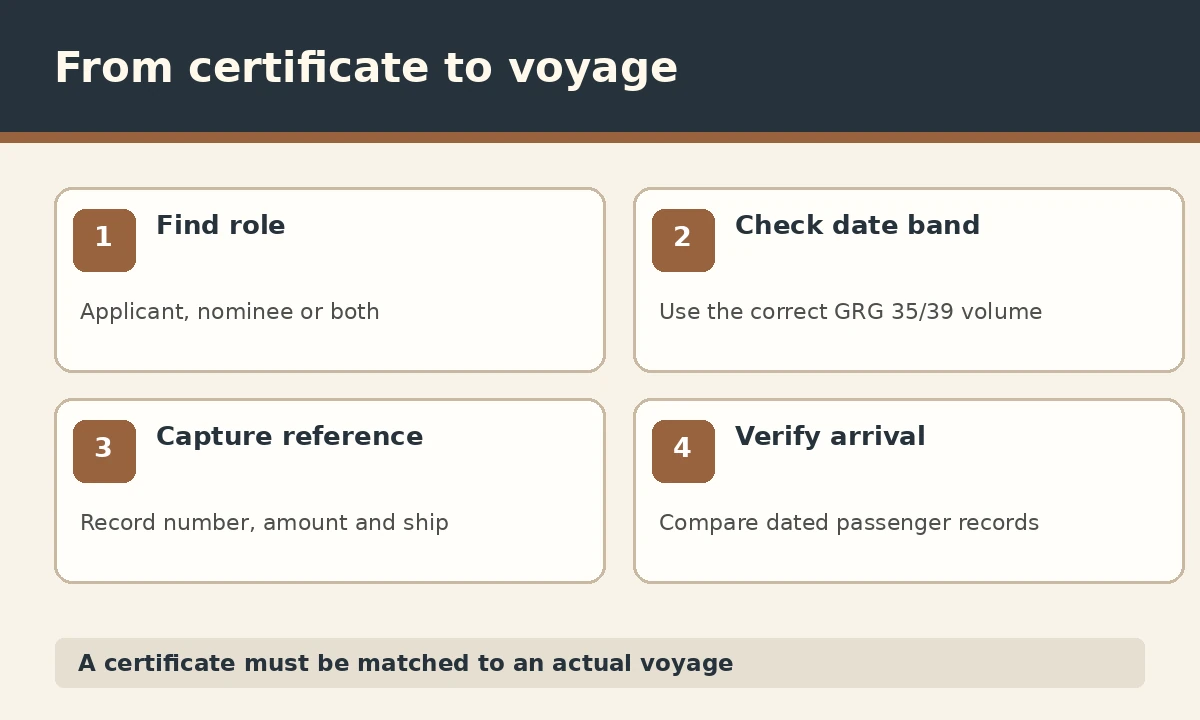
Understand the GRG 35/39 certificate schedules
The archive’s catalogue describes two volumes of certificates issued under Assisted Passage Regulations: the first covers 1862–1867 and 1872–1878, and the second covers 1878–1885. Entries are ordered by certificate number, with published name indexes to help locate them. The regulations governed assisted and some full passages; the catalogue records that the second volume includes named nominees as well as applicants. Search the period appropriate to the suspected voyage, rather than interpreting the whole 1862–1885 range as one continuous unchanged form.
Search volume 1 without assuming a nominee column
Volume 1 generally notes applicant, number, payment amount, payment date, nationality, statute adults and remarks; a ship name may appear in the notes. Its recorded categories differ from the later volume. Because the name of a head-of-family nominee is not uniformly recorded, a search for the passenger’s surname may fail even when a sponsor obtained a certificate. Try the paying relative, employer or household contact if independently documented. Never turn a count of ‘statute adults’ into an exact count of named passengers or family members.
Use volume 2 to connect applicant and nominee
The later 1878–1885 schedule can include the applicant, nominee as head of family, certificate number, amount paid, date, nationality, statute-adult count and ship. Transcribe each field with its role label. The applicant and nominee may be different people; identical surnames alone do not prove their relationship. If a ship is listed, use the name and date range as a lead to the official passenger lists. A certificate number is an administrative identifier; it is not a voyage number or evidence that passengers boarded.
Treat the 1867–1872 pause as a coverage rule
State Records reports that assisted immigration was suspended from July 1867 to June 1872 except where earlier payments had already been made. A researcher who expects a new ordinary subsidy certificate in 1869 should first verify the claim and the possibility of an earlier payment arrangement. This is not a ban on all migration to the colony. Unassisted arrivals, different schemes and older commitments still require searching. Record the gap as a rule affecting one series rather than as evidence that a person did not arrive.
Compare these record types before drawing conclusions
| Record | Useful question | What it cannot prove |
|---|---|---|
| GRG 35/39 volume 1 | Who paid and when? | That a passenger arrived |
| GRG 35/39 volume 2 | Who was nominated? | A family relationship |
| Ship passenger list | Who appears on an arrival? | Who paid for passage |
| Newspaper notice | What voyage was reported? | Complete passenger identity |

Cross-check the passenger against a ship list
Use the State Records passenger-list guide, organized by arrival year and ship, to look for a documented disembarkation. The archive holds digitized passenger lists from 1845 to 1940; those documents can vary in completeness and recorded details. Compare passengers’ names and party composition with the certificate schedule, but allow for spelling variation and changes to plans. If the schedule names a vessel yet the corresponding list lacks the person, investigate cancellations, diversions and transcription problems rather than inventing an arrival.
Keep payments, departures and arrivals on distinct dates
A certificate may record when money was paid, while a newspaper may report a ship’s departure and a passenger list may give its arrival. These are three different events and sometimes different people. Build a compact chronology with record class, date, named individual, ship and direct quotation of the relevant field. If one date seems incompatible, check whether it belongs to the applicant or nominee. No single entry should be silently rewritten into a claimed migration date simply because it best fits a family story.
Test a fictional sponsor and traveler
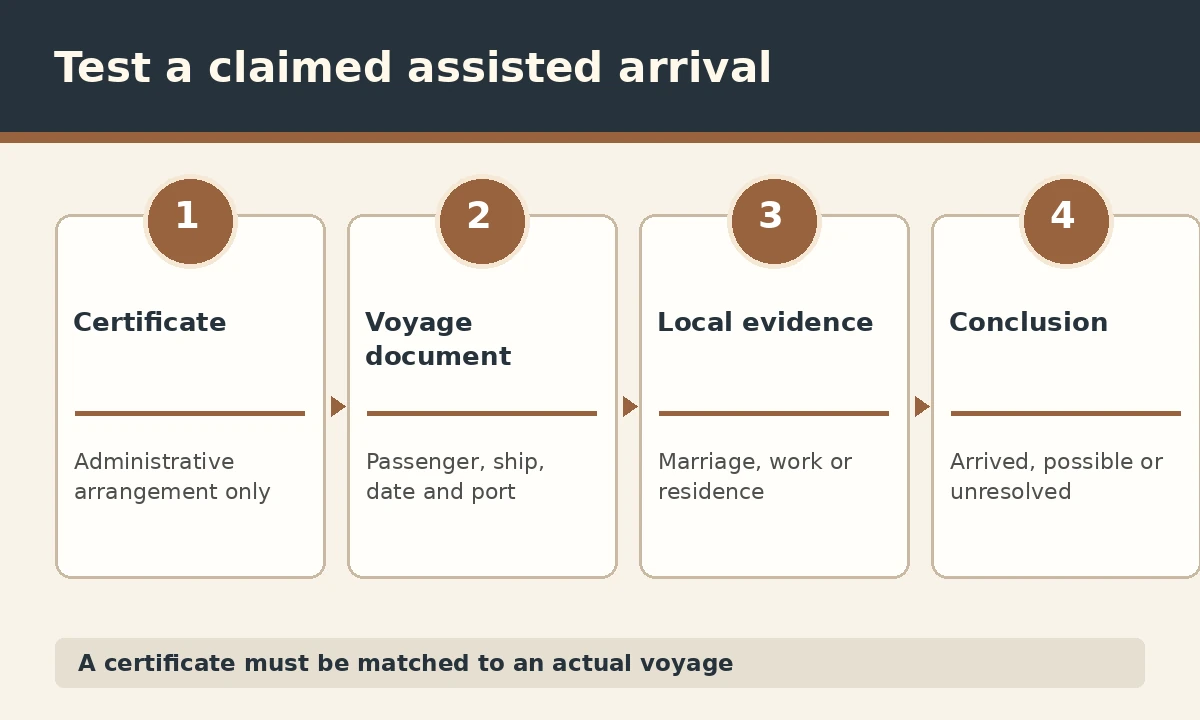
Imagine a fictional applicant, Margaret Ellis, paying for a certificate in 1881 while her cousin Daniel Ellis is named as nominee. A family account asserts that Margaret sailed with Daniel. The schedule establishes the administrative roles, not that both traveled. Search the ship list for Daniel and Margaret separately, compare age and origin, then look for their subsequent local marriages or addresses. If only Daniel is documented arriving, the correct conclusion is not that Margaret remained abroad: her own travel remains unverified.
Document an unsuccessful search accurately
When a name is absent, log which volume, letter range, alternative spellings and role were searched. Note whether the period fell within the suspension, whether an index was available, and whether you consulted the schedule or only a guide. Another immigration scheme may be more appropriate, especially if someone traveled with full fare or under a later Commonwealth administration. Negative findings are meaningful only within a clearly described surviving collection. A broad search-box failure is not proof that the person never migrated. For the fuller picture, see our guide “NSW Immigration Deposit Journals, 1853–1900”.
Cite the administrative record and the voyage separately
For GRG 35/39 give the creating agency, series number, volume, certificate number, names as written and page or image details. For a passenger list cite ship, arrival date, port, page and the actual holding series; a newspaper notice needs its newspaper title and issue. Keep the source references linked in your research log but do not collapse them into a single citation. This separation permits another researcher to verify both the proposed arrangement and the completed journey independently.
How We Research South Australia Assisted Passage Certificates
We reviewed the cited official archival guide and series descriptions on October 22, 2026, checked their date spans and limitations, and compared this topic with prior GenHis package subjects. The sample names in this guide are fictional and are not transcriptions of an ancestor’s original record. No claim is made that all related images are digitized, that all series are complete, or that the examples establish anyone’s family relationship. Recheck the current archive catalogue, fees, privacy limits and access rules at the time of your search.
More Records and Archives Guides
Archive catalogues and source guides for south australia assisted passage certificates
State Records of South Australia: assisted scheme indexes, date gap and fields (archives.sa.gov.au).
Official catalogue for GRG 35/39, its two volumes, number ranges, scope and access (catalogue.archives.sa.gov.au).
Official passenger-list guide for testing actual arrivals separately (archives.sa.gov.au).
Editorial and affiliate disclosure: This article is independent educational research and does not claim sponsorship or an affiliation with the archives named above. No paid partner links are used in the guide. Historic registers may contain sensitive allegations or private information; follow current access conditions and avoid sharing details about living people. See the affiliate disclosure for GenHis’s general commercial-link policy.
Use State Records of South Australia’s immigration-schemes guide and GRG 35/39 catalogue.
Routine assisted immigration was suspended from July 1867 to June 1872, with an exception for prior payments.
No. The certificate labels a role, not a proven relationship.
No. Confirm arrival in an independent passenger list or another dated source.
Volume 2, 1878–1885, is described as recording both categories.