
If an ancestor taught at a Victorian government school, the Public Record Office Victoria’s VPRS 13579 service record books may reveal a career that changes across schools and years. The documented range is 1863–1959, and PROV gives a searchable series-number route rather than requiring you to know every school posting first. These are government-teacher histories, not registers of pupils and not proof that a privately employed teacher worked for the Education Department. Start with a name or maiden name, inspect the digitized entry, record the numbered schools and dated appointment authorities, and verify each transfer independently.
Choose government service before searching by surname
A family story that someone was ‘a teacher’ may refer to a government classroom, a religious school, a private tutor or a short-term appointment. PROV describes VPRS 13579 as working histories of teachers in government service. Before you search, list the suspected employer, district and date, and any school name from a marriage announcement or directory. An entry in a government series should not be forced onto someone who taught only in a denominational or other non-government institution. Establish the employment category first.
Search VPRS 13579 by its actual series number
PROV’s teacher-records guide instructs readers to use Record Series No. 13579 when searching for these records. The books were begun by the Board of Education in 1863 and continued under the Education Department from 1873, until transition toward a card system in 1959. A digitized record may be available through the catalogue, but the search result must be connected to the correct name in the actual volume. Record volume and page or image together with the series number; an isolated screenshot loses context.
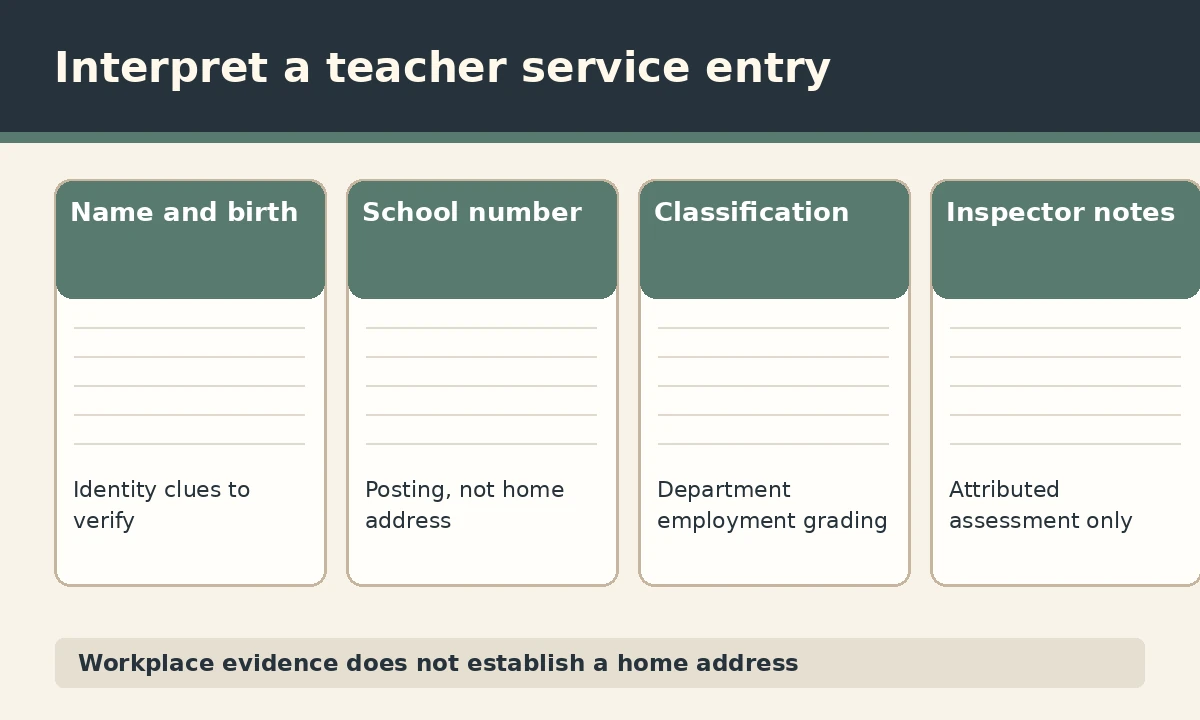
Read names and birth details as reported evidence
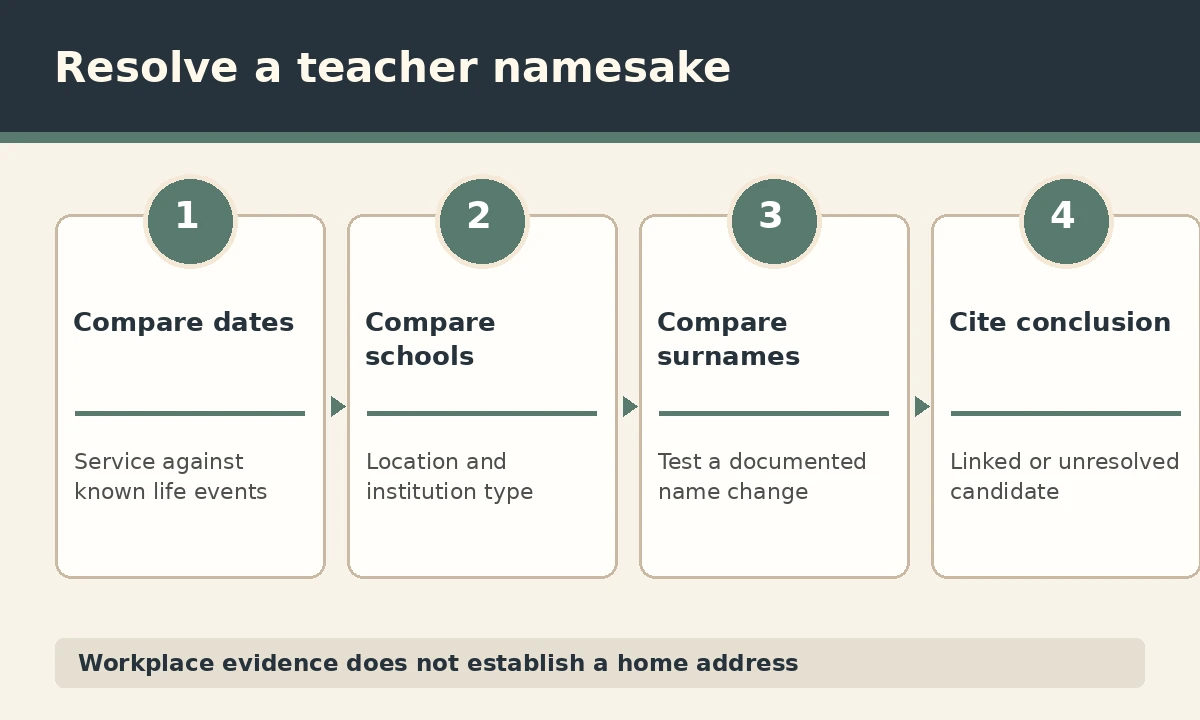
Teacher records generally include the individual’s name and date of birth and can sometimes provide birthplace or qualifications. Check whether the written name uses initials, a changed surname or a spelling variant. Use the reported date of birth as an identity clue rather than unassailable birth proof; compare it with a contemporaneous birth record. If a teaching entry appears under a married name, seek a marriage certificate or department correspondence to substantiate continuity with the earlier surname. A workplace link alone does not prove kinship with another teacher.

Follow school numbers instead of guessing a town
VPRS 13579 identifies schools taught at by school number. This can remain more stable as an archival cross-reference than a remembered informal school name. Record number, name if independently identified, beginning date and the specific line where it appears. Do not translate a historic number into a current campus without checking institutional history: schools can close, relocate, merge or be renumbered. Compare appointment or transfer notes with contemporary school records to determine whether the teacher actually served at the location claimed by descendants.
Interpret classification and authority columns carefully
PROV explains that the classification entry describes the teacher’s standing under the education administration, while an authority column gives the date a person commenced at a school and a reference to supporting correspondence. Classification is not necessarily a degree, and authority may refer to an appointment or transfer decision rather than the date of household relocation. Copy headings and original abbreviations before expanding them. If a dated move is important, inspect the related school or employment correspondence when it survives.
Compare these record types before drawing conclusions
| Field or source | Potential clue | Verification limit |
|---|---|---|
| School number | Specific government posting | Modern school identity needs check |
| Authority date | Reported start of assignment | Not necessarily residential move |
| Classification | Department assessment | Not a university qualification |
| VPRS 10061 | Private-school registration | Not ongoing service proof |
Use inspector remarks without treating them as objective facts
The books may contain inspectors’ remarks and sometimes assessments. These are observations made within the employer’s evaluative system, not independent character judgments or medical diagnoses. Quote sparingly and attribute the speaker or creating office. A critical assessment can show administrative friction without proving an entire biographical story. If two records conflict about suitability or rank, note the dates and purposes of each appraisal. Do not make personal claims about living descendants based on a historic employment notation.
Separate government service from VPRS 10061
For non-government teachers, PROV has a distinct guide to VPRS 10061, created by bodies evaluating and registering private or non-government teaching. Such applications and registrations are not the same as a continuous history of employment. A person listed in the private-school registration records may have applied for permission and never taught at a particular institution. Conversely, the government service books need not include everyone who worked in education. Select the record class according to the specific family question before deciding a missing name is significant. If that is your next decision, our guide “Victoria School Pupil Registers” explains how to find closed-school records at PROV.
Build a fictional two-teacher comparison
Suppose two fictional teachers called Sarah Bennett appear in district histories. One has VPRS 13579 postings at school numbers 317 and 805; the other appears in a non-government registration register. A family letter refers to Sarah at a government school near Ballarat in 1897. Test school number, date, reported birth details and marriage surname separately. If the record’s service dates are incompatible, retain both candidates in the worksheet instead of assigning the first indexed name. Add an independent address or wedding record before identifying the teacher.
Check 1959 onward with a different custodian
PROV describes the end of the VPRS 13579 books in the transition to staff cards from 1959, and directs people seeking their own later employment records toward the education department. The availability of digitized nineteenth-century books does not imply that recent personnel records are openly searchable. For a post-1960 teaching relative, respect privacy requirements and use permitted institutional channels. For an earlier teacher absent from the books, check spelling, non-government service and the possibility of a discontinuous career. Our guide “NSW Teachers’ Rolls, 1869–1908” covers a related question.
Create a reproducible career citation
Cite Public Record Office Victoria, VPRS 13579, the unit or book, entry name, page or image, and every dated school posting used. Where you identify a historic school number, cite the separate source supporting the location. Save a table of claim, employment-record wording and corroboration. If you consulted only a catalogue record, identify it as catalogue evidence rather than a transcription of the service file. A repeatable trail can demonstrate employment without inventing a household move or family relationship. For the fuller picture, see our guide “Victoria Police Employment Records, 1853–1973”.
How We Research Victoria Teacher Service Records
We reviewed the cited official archival guide and series descriptions on October 22, 2026, checked their date spans and limitations, and compared this topic with prior GenHis package subjects. The sample names in this guide are fictional and are not transcriptions of an ancestor’s original record. No claim is made that all related images are digitized, that all series are complete, or that the examples establish anyone’s family relationship. Recheck the current archive catalogue, fees, privacy limits and access rules at the time of your search.
More Records and Archives Guides
Archive catalogues and source guides for victoria teacher service records
Public Record Office Victoria: VPRS 13579 online records and fields (prov.vic.gov.au).
PROV: non-government teacher registrations in VPRS 10061 differ from service histories (prov.vic.gov.au).
PROV education records gateway for additional school and employment context (prov.vic.gov.au).
Editorial and affiliate disclosure: This article is independent educational research and does not claim sponsorship or an affiliation with the archives named above. No paid partner links are used in the guide. Historic registers may contain sensitive allegations or private information; follow current access conditions and avoid sharing details about living people. See the affiliate disclosure for GenHis’s general commercial-link policy.
PROV provides a digitized search route for VPRS 13579 covering 1863–1959.
No. Teacher service books document employee careers, not schoolchild enrollment.
It identifies an administrative school entry that should be matched to a historical school directory or record.
Not comprehensively; PROV describes VPRS 10061 for non-government teacher registration.
PROV notes a move to a card system and points later employment inquiries toward the education department.