
The National Archives lists a Secret Service series titled “Description and Information of Criminals,” 1863–1906, with indexes, in Record Group 87. Despite its historical title, an entry in this series does not by itself show that a named person was convicted. The series belongs to an investigative record group. A description may help identify someone mentioned in an inquiry, but the legal result must be established through a distinct arrest record, court record, or other documented disposition. Start by describing what the record says rather than adopting the label as your conclusion.
This distinction is essential in family history because copied lists often lose the context of the original source. A surname in an index might lead to a person with a similar name, an alias, or an allegation that was never sustained. NARA also lists special investigation reports, arrest and conviction record books, and photographs of suspects under RG 87. Those are different evidence types, not alternative names for the same book. Build a chronological case worksheet before deciding whether the entry concerns your ancestor.
Find the Description Series, Not a Modern Name Database
Begin at the NARA Guide to Federal Records, RG 87, section 87.2.2, and quote the exact series title and inclusive years in a research request. The Guide identifies indexes, but it does not promise that every entry is digitized, alphabetized as a modern search engine would expect, or complete for every locality. Check the current Catalog for a series description and whether an item or container identifier is available. Record the repository and access restrictions rather than assuming the material can be opened online.
Search using the stated surname, alternate spellings, initials and any known alias, but keep each hit separate until you have an original page. Capture neighboring entries, column headings and a source citation. A nineteenth-century reporter may have spelled a name phonetically or used a place of residence that differs from the birthplace. The index can direct you to evidence; it cannot resolve identity or the eventual legal outcome by itself.
The record group covers the agency’s counterfeiting-enforcement work before the modern Secret Service identity was formalized. Its early institutional history is not interchangeable with current protective duties. When comparing dates, distinguish the date of a purported event, the date an agent recorded it and any later date when a report was copied or indexed. An index date may reflect filing rather than the original occurrence.
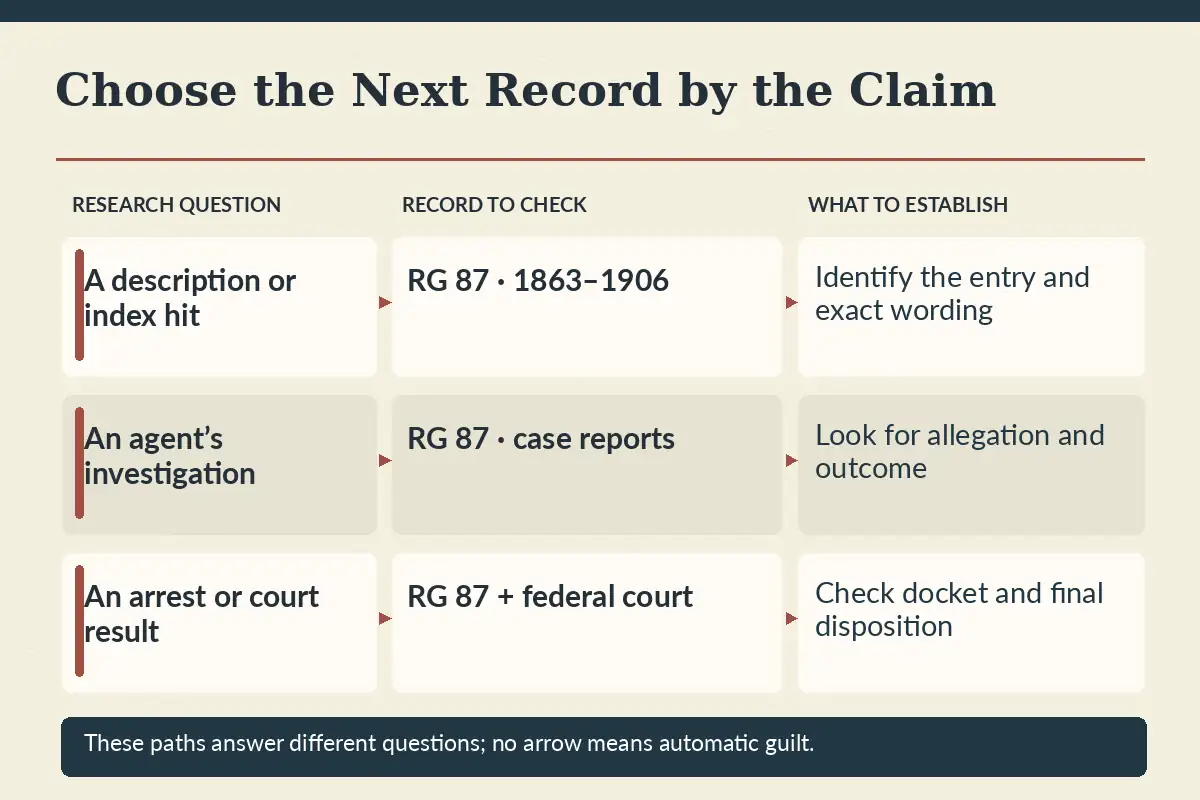
Keep Suspect, Arrest, and Conviction as Separate States
Use three columns in your case worksheet: descriptive or reported information; documented enforcement action; and judicial disposition. A suspect description belongs in the first column. A referenced arrest belongs in the second, and only a court judgment or another clearly identified legal record belongs in the third. NARA’s RG 87 description lists arrest and conviction books separately, which is a direct warning against collapsing these stages into one event.
If the entry says “wanted,” “reported,” or uses another qualifying word, transcribe it exactly. Do not change its grammar to “was arrested” or “was found guilty.” Equally, a report that names a companion or witness does not establish that person’s guilt. Note what the original document expressly attributes to an individual and what comes from an officer, informant or later compiler. A historical allegation may be inaccurate even when the document itself is authentic.
When a person appears in several records, check whether their occupations, addresses, ages and movements can coexist. A repeated name does not prove repeated misconduct, and two records with the same locality might still concern different people. Explain unresolved conflicts in the final family narrative rather than selecting a convenient description merely because it resembles a photograph or family anecdote.
Follow an Investigation Into Its Court Jurisdiction
NARA describes separate investigative files in RG 87, including an alphabetical file beginning in 1871 and a decimal file for 1906–1920. Their arrangements and dates matter: a reference from one series should not be treated as the page number of another. If an investigation cites an arrest, court, city or federal district, search the corresponding judicial records. NARA’s court guidance explains that court holdings include case files, dockets, indexes and minutes, each with its own function.
A docket can establish procedural events even when a case file is incomplete. A charging paper shows that an accusation was filed, not that it was proven; a verdict, dismissal or other disposition must be read in context. Identify the court and year before ordering material, especially when boundaries or court names changed. Note whether you inspected an original or relied on a catalog description, newspaper article or derivative transcription.
Negative results require restraint. An unlocated docket may mean the search used the wrong district, an alias or an incomplete index; it does not erase the initial Secret Service record. Conversely, locating a name in a newspaper criminal column should not be used as a substitute for the judicial disposition. The safest result is a source-by-source statement that leaves uncertain steps explicitly unresolved.

Test Identity With Independent Everyday Records
Once you know the year and place, compare the candidate against city directories, census records, occupations, known household members and records created outside the investigation. Those sources can corroborate residence or age, but they do not decide a criminal case. Build an identity table with literal statements, agreement and contradictions, so a convenient surname match does not outweigh a mismatching birthplace or implausible chronology.
If a historical description includes a photograph, check the image’s original caption and provenance rather than trusting a modern online label. NARA lists suspect photographs from 1888–1931 as another group of records; the photograph range is not the same as the 1863–1906 description-book range. Do not imply that every description has a portrait or that a portrait necessarily connects to the earlier series. Their relationship must be demonstrated in the actual records.
For sensitive material, make the narrative proportionate to the source. Use attribution such as “an RG 87 entry described a person under this name,” followed by the date and archive reference. If identity is uncertain, say so prominently. The value of the record is that it documents what an agency recorded at a moment in time, not that it authorizes an unqualified moral judgment about a family.
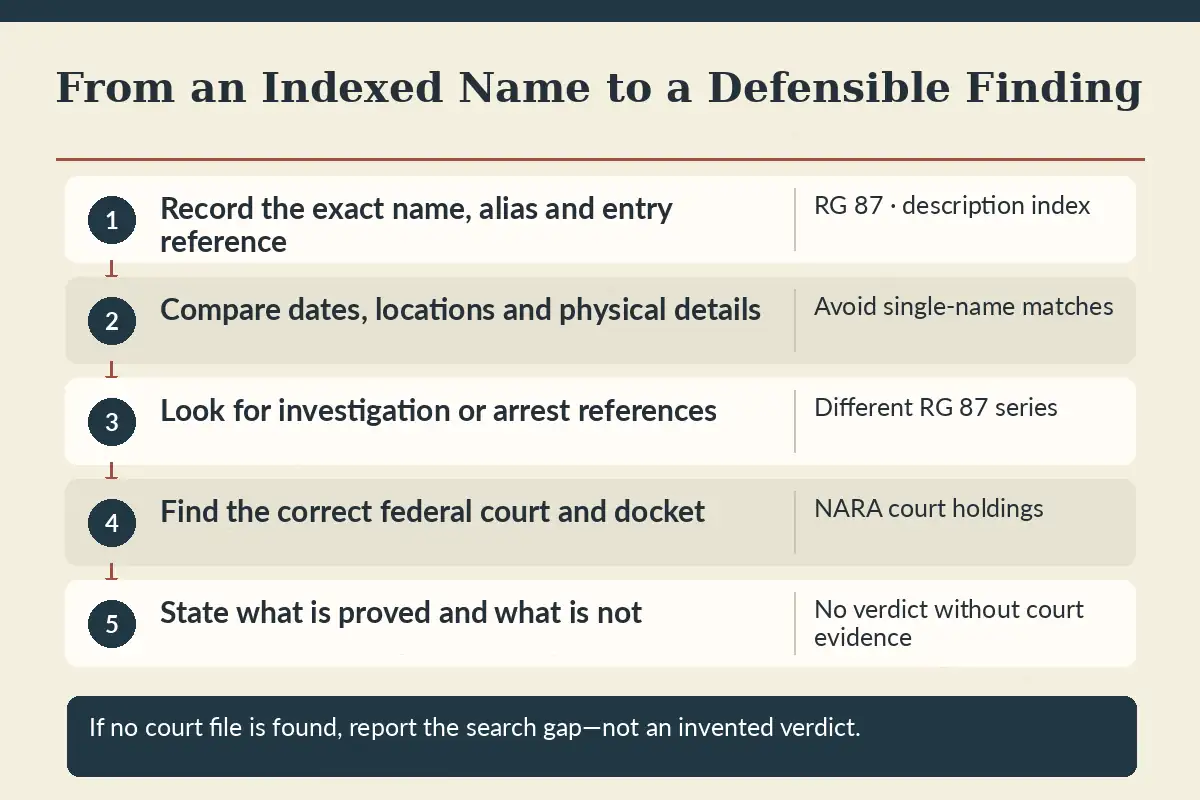
Write a Citation That Survives Later Checking
A useful citation includes the record group, precise series title, entry or volume identifier, page, date, repository and whether you viewed an original, digital copy or transcription. Preserve any index reference linking the description to the page. A statement like “Secret Service records say he was a counterfeiter” is too broad and hides which evidentiary stage you actually observed.
Conclude with calibrated language: “The indexed description places a person using this name in an investigative source in 1892; identity and any court outcome remain unproved.” That is not a weak finding. It tells a future researcher where the reliable boundary lies and which court or independent identity source would improve it. Missing pages and failed searches belong in notes, not in invented certainties.
More Research Method Guides
How We Research This Historical Record Group
We checked the NARA RG 87 entry for the exact title and date span, and separately confirmed the listed investigative, arrest and conviction record classes. NARA’s court research guide establishes why criminal case files and dockets must be treated as judicial evidence rather than as implied contents of a Secret Service description. The Catalog guidance supports series-first searching; none of these pages proves a particular individual’s identity or guilt.
Official starting points are NARA RG 87, federal court research guidance, and the Catalog search instructions. Our affiliate disclosure explains site policies; this research route does not require a paid partner.
No. The 1863–1906 description series is not itself a court judgment; look for a documented judicial disposition.
No. NARA lists suspect photographs from 1888–1931 separately, and not every description has a demonstrated portrait.
Keep the match provisional and compare original page details, other spellings, place and independent records.
No. An arrest and the court’s disposition answer different questions and should be cited separately.
Only a documented search gap until the jurisdiction, survival and other possible indexes have been checked.