
To use the Victoria Police Gazette for family history, identify the right publication year, consult the index available for that period, and open the original dated issue before recording what the notice actually says. State Library Victoria holds the Gazette for 1853–1971. Notices range from police appointments to stolen property and warrants; a surname appearing there is not inherently evidence of a crime, a conviction, or even the person you are researching. The reproducible unit is the dated issue and page, not a search-engine snippet.
Start with the year and reason a person might appear
Write down the ancestor’s name, alternative spellings, district and a plausible two- or three-year search period. A family story about an officer, missing person, stolen horse or prison release points to different kinds of Gazette notices. Do not search only for a name; start with the underlying question. A government notice may record a promotion or transfer, while another notice reports a claim still being investigated. Those events cannot be combined merely because the surname matches. Our guide “Queensland Government Gazettes, 1859–1900” goes into more detail.
A locality is especially important when several people share a common name. Record a residence, occupation, employer or family address from a separate source before opening the Gazette. Where a newspaper supplies a police event date, search neighboring Gazette issues as well: an event can precede its official publication. The year in a database collection name may describe a digitized subset, not every year the Library owns. If that is your next decision, our guide “Western Australia Police Gazettes, 1876–1900” explains how to find names and issues.
Route 1853 to 1971 through the correct library holdings
The Gazette began publication in December 1853. State Library Victoria identifies microfiche, stored holdings and selected digitized runs. Its research guide describes early 1853–1870 microfiche material and later microfiche through 1939, while its broader holdings extend to 1971. Treat these as access routes, not as a promise that every issue has been indexed online. Check the current catalogue entry for how the needed volume is held.
If a commercial collection does not return your family name, compare its explicitly listed years against the period you need. State Library Victoria names selected digital sets available through Ancestry and Findmypast, often through library access, but a free name query and a fully viewable page are different services. If the year is missing from a digitized set, use the Library’s issue or microform route instead of interpreting the absence as a historical fact.

Apply the changing index system rather than one universal search
The Library describes a consolidated index for 1853–1868, annual indexes in part of the nineteenth century, subsequent monthly indexes and quarterly indexes after 1935. Because index arrangements changed, do not search a modern database as though all names were consistently recognized by OCR. Determine whether the index covers that year and whether you need an issue, a month or a larger compiled index. Copy the spelling and any page reference exactly as printed.
A name can be entered under an occupation, a place or an administrative category rather than under its most familiar surname. Try spelling variants and inspect adjacent entries to understand the organizing rule. If the person does not appear in an available index, browse the relevant issue dates using the independent event lead. Log each unsuccessful route with its actual covered years; an index failure is not evidence the person never appeared.
Read the issue page and classify the notice
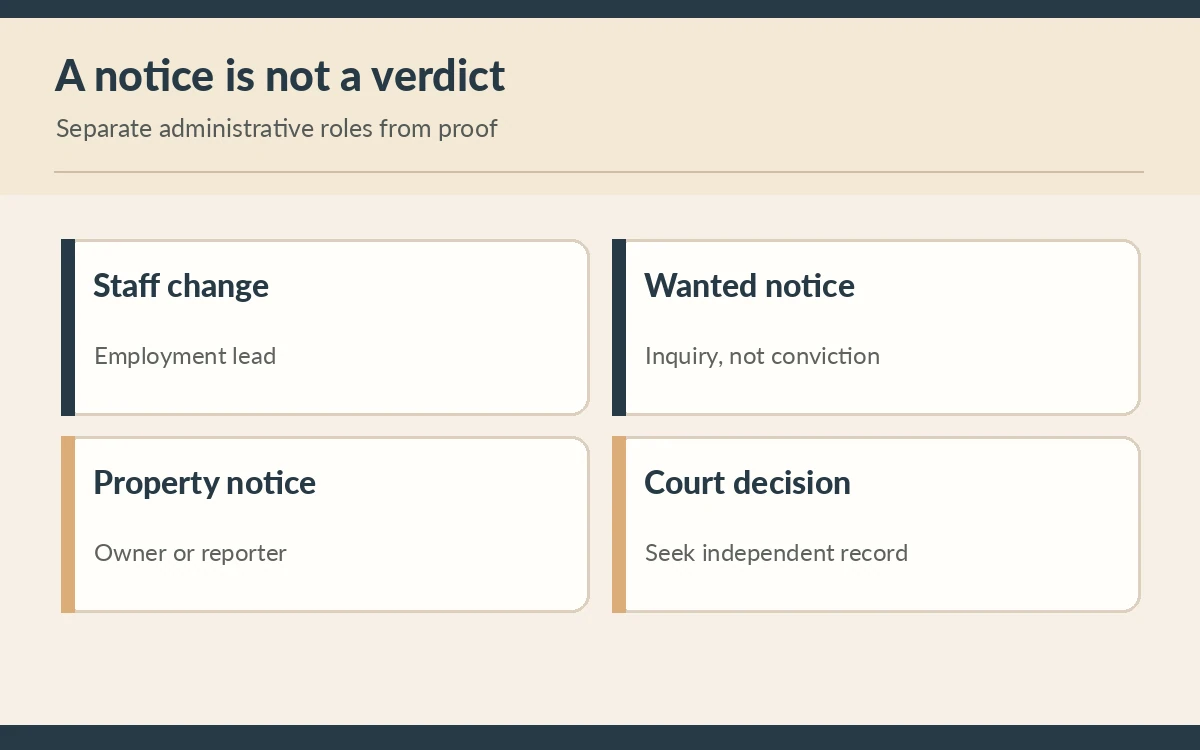
On the original page, transcribe the heading, publication date, notice date and the exact statement about the person. The Gazette covered wanted persons, missing property, police staff matters, released prisoners and other administrative notices. A wanted notice describes an inquiry or request for assistance; it is not a judgment. A listing under property lost or found may refer to an owner, a finder or a reporting officer. Distinguish those roles before assigning a family relationship. Our guide “Tasmania Police Gazettes, 1861–1933” goes into more detail.
Look for continuation columns, corrections and later notices concerning the same case. If a summary says a suspect was apprehended, use a contemporaneous court register to determine whether proceedings occurred and how they ended. Even when the Gazette printed a description or an alias, it may not uniquely identify one individual. Record its wording without repeating stigmatizing allegations as established facts about an ancestor.
Use a fictional two-candidate identity check
Suppose a fictional John Martin is named in an 1894 notice near Ballarat and a different John Martin appears in a household record near Geelong. A surname match is only the start. Compare the Gazette’s place and occupation if supplied with independent electoral rolls, directories or employment records. Do not invent an age or birthplace when the notice lacks one. Keep each person as a separate candidate until at least two discriminating identifiers agree.
Create three columns headed Gazette statement, independent record and unresolved issue. The first records only verbatim details from the issue; the second identifies another dated source; the third records a competing person or unexplained conflict. If later evidence favors neither John, preserve both candidates. This hypothetical illustrates a check, not an assertion about any historical individual.
| Record or clue | Best use | Limit to remember |
|---|---|---|
| Index entry | Find possible issue and page | May omit names or years |
| Original Gazette | Read exact published notice | Not an automatic verdict |
| Court or service file | Test outcome or employment | Different creator and custody |
| Independent household source | Distinguish namesakes | Matching surname is weak |
Search related archives without creating a false case history
For police employees, the Gazette may point to a service appointment, promotion or posting. Consider whether departmental personnel files or government notices cover the period, using PROV’s catalogue and creator filters when relevant. For a criminal allegation, seek the court and jurisdiction indicated by original evidence; a police notice alone cannot tell you what court heard the matter. State Library Victoria’s occupational research guides help clarify which record classes may exist. For the fuller picture, see our guide “Victoria Police Employment Records, 1853–1973”.
A notice about a deserter, discharged prisoner or missing person can be especially sensitive. Do not infer motive, culpability or family abandonment from one administrative label. Historical language may now be offensive or medically inaccurate. Describe the exact record and its limited function rather than transforming it into a sensational biographical claim.
Record a complete issue-level citation
A useful citation identifies Victoria Police Gazette, issue date, page, column or notice heading, physical or digital holding institution, collection or microform reference where available and access date. Add the index reference separately if one led to the issue. A database transcription is a discovery aid and should not silently become the cited original. For a scan, record the page number printed on the Gazette, which can differ from a viewer’s sequential image number. To go further, our guide “Queensland Police Gazettes, 1864–1945” shows how to find names and original issues.
If the record is only accessible at the Library, note the catalogue call number and what has not yet been examined. Avoid saying ‘confirmed by Victoria Police’ when you have only read a later website summary. Treat a pending original-page inspection as an open task. Repeatable citations make it possible for a second researcher to assess both the identification and the notice’s meaning.

Log negative results and review ethical use
Create a search log with issue years, index type, spelling variations, database limits and microform volumes checked. If a digitized subset omits the year you need, mark the search as untested for that year and move to another access route. Distinguish an unread issue, an unindexed name and a genuinely searched page with no relevant notice. This prevents a weak database search from becoming a false claim of absence. Our guide “New Zealand Police Gazettes” goes into more detail.
Before reproducing a notice, consider the privacy and potential harm to descendants and living people. A historical allegation should be placed in context, not attached to a living family’s name without careful evidence and reason. A well-supported result may simply be that a dated Gazette contains a particular notice; its significance remains unresolved until another record corroborates it.
How We Research Victorian Police Gazettes
We checked State Library Victoria’s police occupation guide and its Gazette research article for publication dates, holdings and index eras, then compared the PROV access guidance for follow-up records. Our example people are fictional. We do not treat an indexed or printed accusation as proof of guilt, and access to particular digital years should be rechecked at the Library.
More Records and Archives Guides
Original Records and Repository Guidance for Victorian Police Gazettes
State Library Victoria outlines Gazette publication, physical holdings and library access routes (guides.slv.vic.gov.au).
State Library Victoria describes changing Gazette indexes and different types of notices (blogs.slv.vic.gov.au).
Victorian government describes PROV catalogue filters, record locations and reading-room ordering (www.vic.gov.au).
Editorial disclosure: This article has no sponsored recommendation or paid affiliate placement. Our site-wide policy is explained in the GenHis affiliate disclosure. Historical records are imperfect and access restrictions can change. Consult the original record, avoid unsupported accusations and protect personal information about living people.
State Library Victoria dates publication to December 1853.
No. Digitized sets and indexes vary; Library holdings extend beyond the years searchable in particular databases.
No. Notices can include staff updates, requests, reports, allegations and administrative information.
Record the original issue date, page, heading, holding institution and access method.
Check the index year range, spelling variants and original issues before drawing any conclusion.