
Tasmania Police Gazettes are historical administrative publications that can place a named person in a report of an arrest, absconding, missing individual, release from prison, inquest or other police matter. Libraries Tasmania lists a nineteenth- and early twentieth-century POL709 sequence for 1861–1933 in its post-convict prison records guidance. Begin with a dated place or incident, locate the relevant issue, read the full notice, and then test each claim in its proper record system. A wanted notice is not a guilty verdict; a name under a report is not a confirmed relative. Because the kinds of notices changed over time, a failed modern keyword search says little until the relevant issues and their surviving content have been checked.
Choose a dated police-notice question
Start with a narrow question: was someone mentioned as missing, reported arrested, listed after discharge, or associated with an inquest at a particular time and place? These are distinct published notice types with different legal meanings. Write a likely date window and historic locality before searching for a surname. The archive’s guidance explains that police gazettes report many sorts of activity, including stolen property and deserters, not only convicted prisoners. In a family tree, reserve a separate fact field for the newspaper or Gazette report itself; do not silently convert it to proof the reported allegation occurred. Our guide “South Australian Police Gazettes, 1861–1973” adds more detail on this.
Use POL709 with its date and content limits
Libraries Tasmania identifies POL709 as the principal Tasmania Police Gazette series in its historical prison-record guide, including issues described for 1861–1933. Another linked holdings guide describes additional later Gazette material. Check the actual catalogue item and issue dates for the portion you need rather than assuming every year is searchable by person. The guide notes that release-of-prisoner notices stopped in 1910; you cannot interpret a later absence from that type of column as evidence a particular person remained imprisoned. Record the specific issue and page and whether you searched OCR, a contents list, or actual page images. Our guide “Victoria Police Gazettes, 1853–1971” shows how to find notices and check the evidence.
Search the incident, place and possible aliases
A person may be described by full name, initials, an alias, a physical description or a location rather than the spelling expected today. Try short surname fragments, occupations and locality terms if a digitized search exists, but browse consecutive issues around a documented event when the name index is inadequate. Look for cross-references to a previous Gazette notice or a numbered case and copy them exactly. Date the report separately from the underlying incident; an event may have happened days or weeks before its Gazette appearance. Maintain alternative identities until external sources confirm the match.
Read a wanted or missing notice as a dated claim
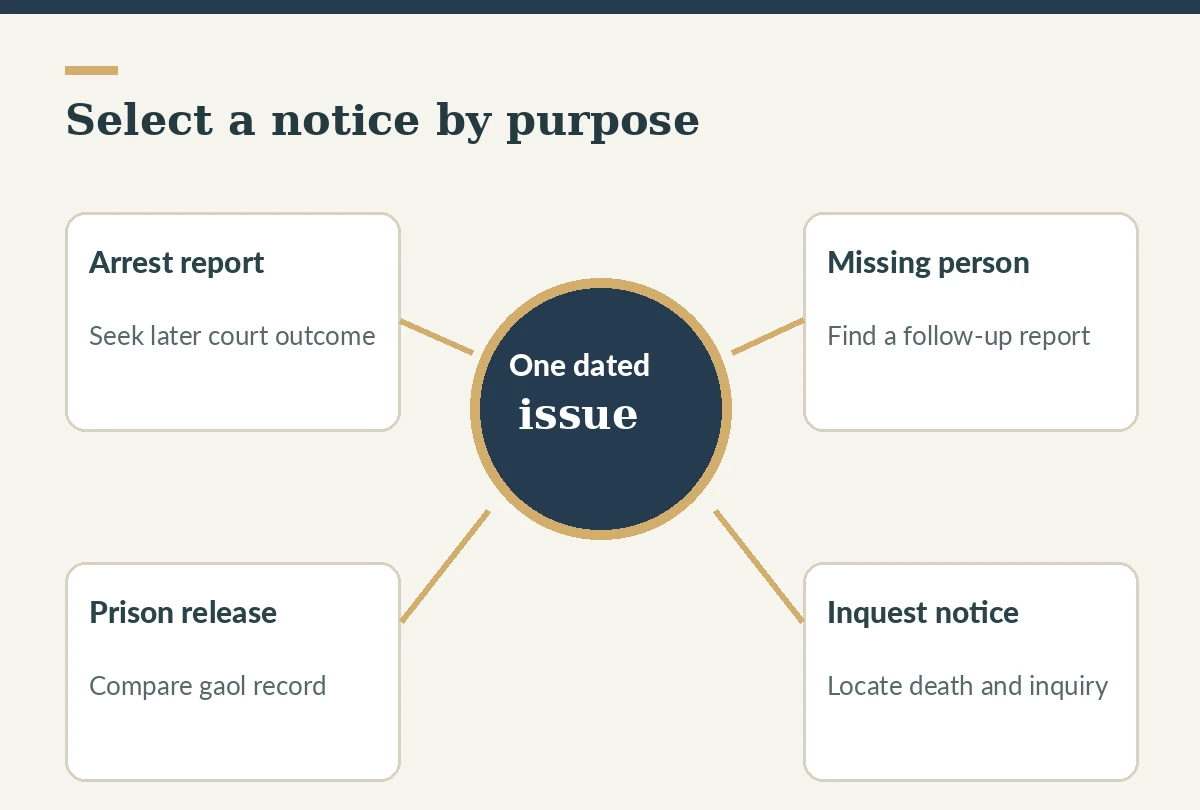
Wanted-person and missing-person notices can be useful for reported age, place, description or contacts, but their accuracy depends on the person who supplied the information. A physical description can distinguish candidates yet still be mistaken or incomplete. The fact that a name appears in a notice does not establish the person’s ultimate whereabouts, responsibility for an alleged offense or a later outcome. Search issue follow-ups and court records for resolution. If the Gazette contains historically offensive descriptors, quote only what is necessary for identification and explain the context rather than repeating terms as neutral modern categories.
Track release notices without treating them as lifelong histories
A prison-release notice can be a valuable lead to a prior imprisonment, but its statement of discharge should be compared with an institutional register. Libraries Tasmania lists separate post-convict prison and gaol series containing admissions, discharges and other details; their dates and arrangements differ. The Gazette’s publication and prison-entry dates need not coincide. When a relative appears in two notices, treat them as separate observations until age, court, location or another stable identifier links them. For a person released after the category ceased in 1910, lack of a Gazette notice offers no reliable negative evidence.

Keep inquest information separate from death registration
A Police Gazette may summarize an inquest finding, a report of a death or an investigation into circumstances. That report is not automatically a death certificate or a full coroner’s file. Search Tasmania’s civil death registration or relevant inquest records if the question is when and where a person died. Distinguish the event date, the legal inquiry date and the Gazette issue date in your evidence table. A person named as a witness, relative or officer in a report does not thereby become the deceased. Use each stated role exactly as printed.
Illustrative comparison: two similar names
Imagine two fictitious people named A. Walker appearing in issues one year apart, one in a reported theft notice and one in an announcement about missing property. A family directory places your ancestor A. Walker in a town shared by one notice, but no age or occupation matches. The responsible conclusion is that one person is a plausible candidate, not that both notices describe the same ancestor. Search independent locality and court sources, and seek follow-up reports to resolve the possibilities. This is a fictional teaching comparison, not a claim about an actual Gazette page.
| Notice type | What the Gazette reports | Follow-up source |
|---|---|---|
| Reported arrest | A police account or notification | Court or custody entry |
| Missing person | A dated notice and description | Later notice or civil record |
| Prison release | Reported discharge in that period | Gaol admissions/discharges |
| Inquest mention | Summary of a death inquiry | Coroner file or death record |
Use complementary court and gaol records
For allegations, seek the relevant court case or register; for detention and discharge, use the proper gaol record; for vital events, use civil or church sources. Libraries Tasmania’s prison-record pages describe holdings such as registers for Launceston and country prisons, but those series have their own date ranges and finding aids. A police notice is often an investigative prompt, not the best source for an eventual conviction or release. Do not substitute a Gazette reference for a court judgment. Record the creator and administrative purpose of each corroborating source to avoid circular reasoning from repeated press reports.
Handle changing issue coverage and difficult searches
When a search fails, ask first whether the category you expected appeared in that period, whether the surviving issue covers the relevant week, and whether the text is indexed at all. Poor scanning and spelling variation can defeat name queries; a month-by-month issue browse around a known arrest can be more useful. Search alternative terms—missing, stolen, absconded, discharged—only as historically appropriate, since notice terminology changed. Document the issue date range inspected. A no-result search is not evidence of a clean legal history, proof of residence, or the absence of a death.

Cite the Gazette notice at the issue and page level
Include Tasmania Police Gazette, issue date, printed page number, column or notice heading, record-series reference POL709 where applicable, and the repository or stable viewer location. If you accessed a catalog description but not the Gazette issue, do not claim to have verified a person’s entry. Attach a transcript that preserves spelling and uncertainty, and keep sensitive allegations out of profiles of living family members until they have a compelling research purpose and lawful basis for disclosure. A short dated, role-specific conclusion is more defensible than a dramatic but unsubstantiated narrative. To go further, our guide “Western Australia Police Gazettes, 1876–1900” shows how to find names and issues.
How We Research Tasmania Police Gazette evidence
We checked Libraries Tasmania’s official post-convict prison introduction and its complementary holdings guide, especially the stated POL709 range, changing notice types and alternative gaol sources. We distinguish that archival description from our suggested matching workflow. The illustrative people are fictional, and no specific individual police entry has been examined for this article. Availability and online browsing may depend on the relevant issue; the archive’s present catalog should be checked for each exact reference.
More Records and Archives Guides
Tasmanian Police Gazette series and archive search guides
Libraries Tasmania description of POL709 Police Gazettes 1861–1933 and the notice types listed across the series (www.libraries.tas.gov.au).
Libraries Tasmania guidance to complementary gaol admission, release and prisoner-card series, and later Gazette material (libraries.tas.gov.au).
Official Tasmanian Archives search guide for locating catalogue items, online images, and restrictions (libraries.tas.gov.au).
Editorial and affiliate disclosure: GenHis is an independent family-history publication. No archive or government agency has sponsored or endorsed this article. Historical records can contain sensitive or inaccurate personal allegations; apply repository access rules and verify claims before sharing them. Our affiliate disclosure explains our approach to commercial links; none of the archival citations here implies an affiliate relationship.
They may report arrests, missing people, absconders, prisoner releases, inquests and other administrative matters.
Libraries Tasmania describes POL709 in its historical post-convict prison-record guides.
No. Allegations, police reports and eventual court judgments are different forms of evidence.
The archive notes that this particular notice category ended in 1910, even though other Gazette material continued.
Compare date, locality, reported age, occupation and independent court, gaol or civil records before connecting it to a family.