
State Records of South Australia holds Adelaide Gaol prisoner registers under GRS 2414, covering 1848–1955. For historical names, the archive supplies surname-arranged indexes covering 1848–1912, divided into register-volume groups. Begin in the index that covers your ancestor’s possible admission date, copy the volume and page locator, and view the corresponding register through the archive’s advised access route. Entries can include admission, alleged offense, court, sentence and release details, but the fields and completeness vary. A gaol admission does not by itself prove conviction, a listed allegation is not a factual finding, and access to later records is limited by the 100-year restriction described by the archive.
Find the correct GRS 2414 volume group before searching
The official gaols guide divides its Adelaide Gaol surname indexes into 1848–1857 (volumes A–B), 1857–1889 (C–I), and 1889–1912 (J–N). Choose the group based on a known or estimated gaol date, not automatically the date of the court incident. The register series continues beyond the online historical index, so do not say the prison ceased recordkeeping in 1912. Copy the prisoner name exactly as indexed along with the original volume and page. Variant spellings and misread letters may require scanning neighboring alphabetical entries rather than relying on an exact name query.
Go from the name index to the original register image
State Records links digitized early volumes through FamilySearch, with separate routes for GRS 2414/2 (1848–1857) and GRS 2414/1 for later volumes in the published online selection. The archive also describes access through its Research Centre. Availability of a digital copy depends on the specific volume, service and access rules. Do not cite a search result as though it were an inspected register. Locate the physical or digital page, preserve the volume heading, and check that the index’s name and date refer to the same entry you have opened. Record any differing spellings rather than silently editing them.

Transcribe the recorded columns before writing a story
The catalogue for GRS 2414 lists fields such as date brought to gaol, name, offense, committing or convicting court, sentence, age, literacy, marital status, religion, occupation, arrival in South Australia, discharge and remarks. That description tells you what the series can record, not a promise that each entry has all those facts. Keep the exact column labels and distinguish blanks from illegible words. An occupation or year of arrival may be reported to the institution and should be tested in outside documents. Sensitive historic classifications reflect their creators’ practices, not present-day judgments about a person.
Separate arrival, legal process, and release events
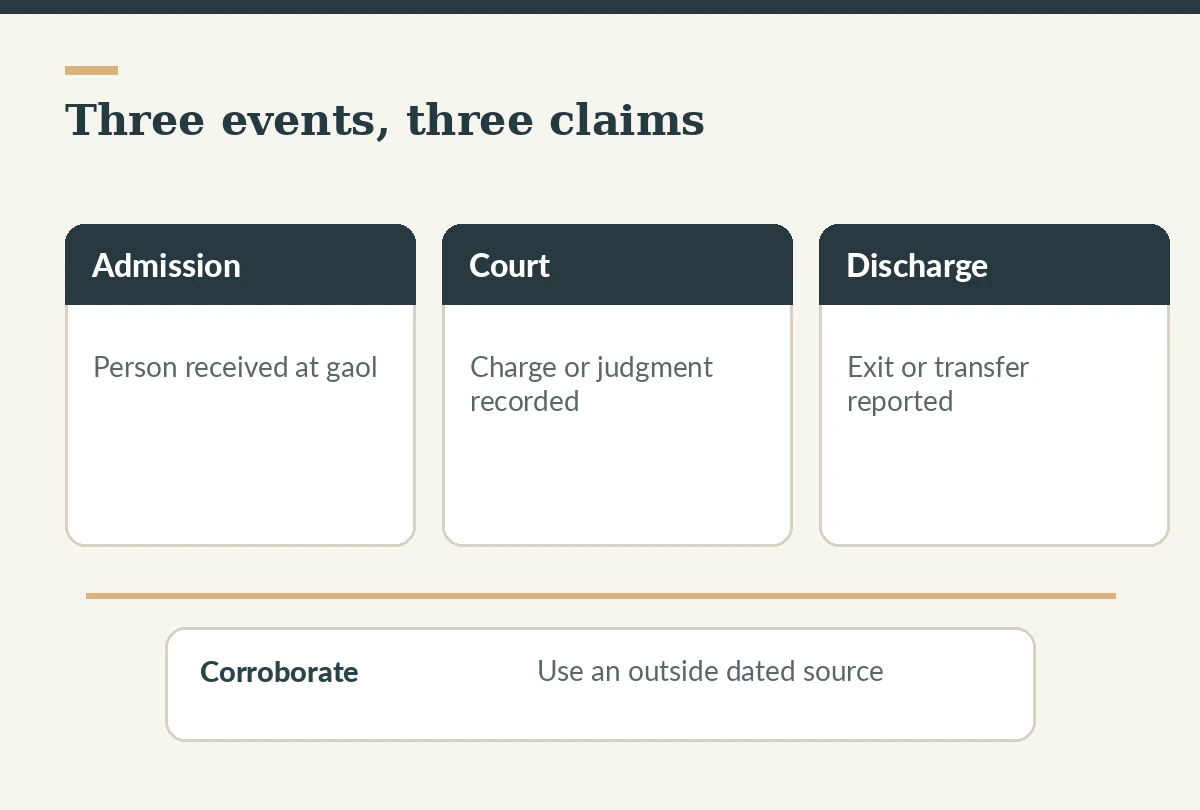
Build a chronology with at least three independent columns: admission to gaol, court outcome, and discharge or transfer. A person could be committed while awaiting trial, sentenced after a hearing, transferred, or released without the assumptions a modern reader may bring. If the register’s court name is abbreviated, find the relevant court records before interpreting the outcome. The archive also holds an older GRS-independent series for people committed and tried in Adelaide Gaol (GRG 54/24, 1839–1849). That is not interchangeable with GRS 2414; choose the correct series for the event and date.
Work with the 100-year rule and access uncertainty
The Adelaide Gaol series has an official access determination of open after 100 years, and is classed partially open. Follow the record’s final entry date and current policy rather than subtracting 100 years mechanically from the person’s birth. The restricted-records guidance describes special access requests when a person has a lawful right to information. Do not suggest a workaround to access private later records. If a volume contains mixed years, ask the archive which portion can be consulted. Preserve a record of a restricted search without inferring that a person is absent. Our guide “Sydney Gaol Entrance Books, 1819–1841” shows how to find a prisoner and verify the entry.
Compare identity clues, especially for repeated surnames
Prisoner registers can mention age, trade, marital status and year of arrival, useful for separating two same-name candidates. Test any age against independently dated birth or marriage records, allowing for approximate or inaccurate self-reporting. A trade can change over time and is not unique; the admitting locality or court can be more discriminating. If two entries share a surname and offense, treat them as separate until matching contextual information makes identity persuasive. Create a candidate table rather than attaching a criminal record directly to a family tree because the name seems familiar.
Fictional test: two admissions and one family candidate
Imagine an invented individual, J. Morton, appearing twice in an index three years apart. One register entry describes a laborer of a particular age, and the other gives a different trade and reported origin. A family letter also mentions a J. Morton living near Adelaide but contains no institutional date. The correct next step is to compare court, age, occupation, and another contemporary address source for each entry. The two register lines could represent one repeat admission or two men; the index alone cannot tell. These names and facts are hypothetical teaching examples, not transcriptions. Our guide “Adelaide Hospital Admission Registers” adds more detail on this.
| Evidence | Can establish | Cannot establish alone |
|---|---|---|
| Surname index | Where to seek a register page | Full facts of the prison stay |
| GRS 2414 entry | Recorded admission and listed details | Truth of every allegation |
| Court record | Reported legal decision | Identity with a namesake |
| Discharge note | Recorded institutional exit | Future location or family link |
Do not confuse Adelaide and other South Australian gaols
The State Records guide also covers Yatala Labour Prison and regional gaols, each with its own index, date span and archival identifier. Yatala’s early and later prisoner registers are separately described under GRG54/41 and are not Adelaide Gaol volumes. If the person appears in a court report outside Adelaide, first identify which facility was involved. Historical references to a gaol may describe imprisonment before trial or a transfer between locations. Search the particular institution named in the source and use a dated map if a locality has changed.
Search beyond the register when the name is missing
Before drawing a negative conclusion, confirm that you searched the right volume band, variant spellings and the admissions period rather than only a court date. Newspapers may supply additional dated coverage of hearings, while court archives can describe a finding or sentence. Those sources have different creators and reliability for specific questions. A newspaper mention of a person charged is not proof of a conviction. Record an index failure, missing item, restricted item and contrary original entry as different research outcomes. Do not reframe any as evidence that the family story must be false.

Write a citation and a limited evidence conclusion
A recoverable citation should include GRS 2414, the volume designation, page or entry, dates, creating agency, State Records catalogue link, and the digital or physical access route you used. Cite the surname index separately if that is all you have examined. In your conclusion identify the exact admission reported, the court named and the outcome as written, with uncertainty over blank or contradictory fields. Keep incarceration history private when it concerns potentially living descendants or unverified accusations. Historical records can help a family understand events without sensationalizing them.
How We Research Adelaide prisoner sources
We cross-checked the prison topic page, the GRS 2414 series description and the archive’s restricted-access instructions. Our workflow is an evidence interpretation method, not an assertion that all indexed names are verified individuals from a particular family. The example is invented. Details about digital viewing, access exemptions and current copying options can change; check them with State Records before requesting a record. We distinguish the archive’s stated fields from what any single uninspected register page might actually show.
More Records and Archives Guides
South Australian prisoner-register holdings and access
State Records of South Australia guide to Adelaide Gaol indexes, digitized register volumes, and record access limitations (www.archives.sa.gov.au).
Official GRS 2414 catalogue description giving the 1848–1955 range, reported fields, and 100-year restriction (catalogue.archives.sa.gov.au).
Official access policy for restricted South Australian prisoner records (www.archives.sa.gov.au).
Editorial and affiliate disclosure: GenHis is an independent family-history publication. No archive or government agency has sponsored or endorsed this article. Historical records can contain sensitive or inaccurate personal allegations; apply repository access rules and verify claims before sharing them. Our affiliate disclosure explains our approach to commercial links; none of the archival citations here implies an affiliate relationship.
State Records of South Australia catalogs them as GRS 2414 and links historical surname indexes and early digitized volumes.
The described online historical indexes cover 1848–1912, although the register series itself continues through 1955.
No. Admission, allegations, a court decision and eventual discharge are separate claims.
The official series has an open-after-100-years determination; access depends on the relevant record dates and rules.
Record the conflict and look for a dated independent identifier before associating the record with your ancestor.