
Sydney Gaol entrance books survive for 1819 through April 1841 in New South Wales archival series NRS 2514. They can help establish that a named person was entered in the gaol at a particular time and may record a ship, committal, alleged offense, sentence, or discharge. The details differ among books. The institution was not the same as Darlinghurst Gaol, which opened in 1841, and a historical mention of “Sydney Gaol” should be routed to the appropriate date and repository before starting a name search.
Which Sydney Gaol record answers your question?
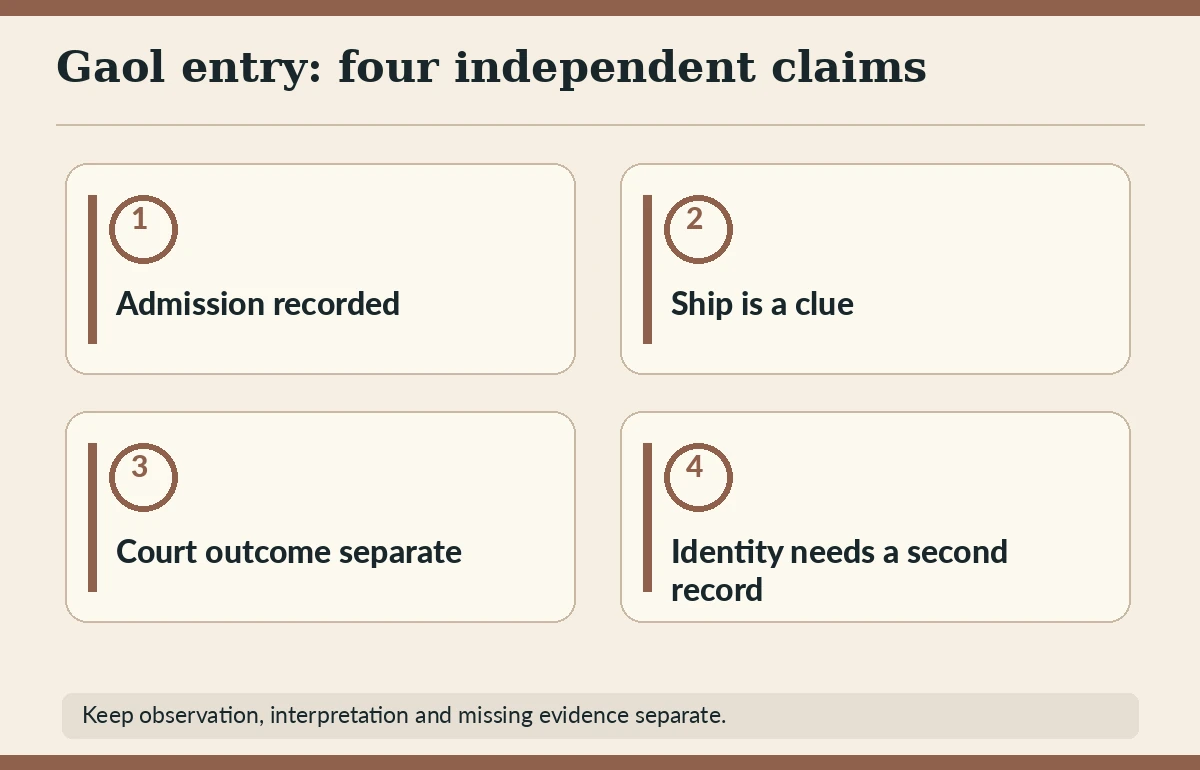
Treat the entry as a record of an institution’s actions, not a verdict on a person’s character. A gaol could receive people at different points in a legal process. Write the immediate question narrowly: Was a particular person admitted in 1832? Who committed that person? Was the prisoner discharged to another authority? Answer each from the actual page and seek court evidence before stating the outcome of an accusation.
Choose the correct NRS 2514 volume and film reel
The NSW State Archives’ Concise Guide lists volume 4/6360 and volumes 4/6428–29 for 1819–1828, with film Reel 850. Volumes 4/6430–39 extend the sequence from 1825 into April 1841 on Reels 851–853. The overlapping date ranges are intentional: the books do not form one tidy, continuously indexed database. Record the exact volume identifier as well as the date rather than substituting a generic “gaol register, 1830s” citation.
For 1839–1840, the guide separately describes an entrance book in NRS 2515, item X843, available on Reel 1864. That book may give a gaol number, free-or-bond condition, ship and particulars of the committal. Search it as a second series if the target date fits. First verify the volume’s described coverage and arrangement, then request or inspect its image. A catalogue hit alone does not demonstrate that the person occurs on a page.

Search the name without discarding a likely match
Start with the name and the best date interval from a dated event, family paper, or newspaper report. Search the State Archives’ gaol guide and the State Library of NSW’s indexes for Sydney and Darlinghurst inmates. Some index resources are supplied as microfiche or reading-room material rather than open image downloads. If a search interface returns nothing, distinguish “not indexed here” from “not present in the original books.” Search variants of first names, initials, married names, occupational aliases and plausible spelling changes.
Where you have the precise month, use the relevant register and read adjacent pages for a continuing entry or later correction. Transcribe the name exactly before normalizing it. Capture the institution, book number, page or folio, dates, ship, any identifying number, staff wording and archival reference. If a record has a number, seek that number in corresponding description or discharge books rather than assuming one apparent surname match is enough.
Read committal, sentence and discharge as different fields
The contents vary: volume 4/6360 describes when a person entered, a ship, who committed the person, remarks and when and to whom the individual was discharged. Volumes 4/6428 and 4/6429 may name a place of trial, offense and sentence. Do not merge these fields into an invented life story. A place of trial is not necessarily the person’s permanent residence, and “ship” may be a transport identifier requiring comparison with an indent.
An entry about committal says that an authority sent the named person to custody; it does not by itself establish every claim made at trial. “Discharged” does not necessarily mean found innocent or released to ordinary residence—it can describe removal or another disposition. Read its exact wording and seek an appropriate court file, transfer record or later gaol entry. Preserve any uncertainty about what a historical abbreviation actually meant.

Reconcile the prison record with independent sources
Build an identity matrix with four controls: name variants, ship or origin, age or occupation if supplied, and a dated locality. Compare these against a convict indent, a muster, court papers or a family record that was created for a different purpose. If two men named Thomas Brown were transported on ships with similar names, the shared surname cannot resolve them. A discrepancy between arrival year and gaol entry does not imply fraud; it may mean a mistake, another voyage, or the wrong man.
Check whether the record provides the identifying information at all before making a claim about a missing value. For example, an 1823 book may have fewer fields than an 1839 item. Report only what the actual folio gives, including question marks and uncertain letters. The goal is not to produce the longest narrative, but to build a chain that another researcher can reproduce from independent source references.
| Record | Potential evidence | Do not infer |
|---|---|---|
| Entrance book | Admission, ship, committal | A final verdict |
| Court record | Proceeding and legal outcome | Identity without cross-check |
| Convict indent | Ship and arrival candidate | Every later gaol admission |
| Discharge entry | Recorded disposition | Where the person settled |
Work a fictional gaol-entry identity test
Imagine a family story that a transported laborer named William Price was jailed in Sydney in 1835. This is a fictional research example, not an historical register extract. First locate a volume whose date range includes 1835 on Reels 851–853. Copy the exact entry and its context. Then find an independent convict indent that names a William Price and a transport ship. If the gaol entry names the same ship, that is a meaningful link, but the name and ship must be checked against other men on that voyage.
Next locate a court proceeding or dated newspaper notice if it survives, and separate what each source actually reports. A family timeline can say “a candidate William Price appears in a gaol entrance book” until ship, date and other details justify identifying him as the ancestor. If the record gives only the name, do not upgrade the entry to a firm identification because the year happens to fit.
Handle original terminology and practical access
Gaol descriptions may use labels such as “free,” “bond” or other penal categories from the period. These describe a past administrative system and should be quoted sparingly and accurately, without treating historical stigma as personal biography. Identify the creating gaol, the repository now preserving the item, and the version you used—microfilm, digitized page or a citation-only index. Respect any reproduction restrictions and avoid attributing conclusions to the archives that the record does not support. Our guide “NSW Gaol Photographs, 1870–1930” adds more detail on this.
If an index is incomplete or an image is not immediately online, consult the NSW State Archives catalogue and the State Library’s gaol-records guide for access routes. A negative result is persuasive only if it names the books and years actually examined. For each unsearched interval, leave a clearly labeled task in your log rather than declaring that the prisoner never entered Sydney Gaol. Our guide “Brisbane Gaol Prison Registers, 1850–1901” goes into more detail.
How We Research Sydney Gaol Entrance Books
For Sydney Gaol, we checked the NSW State Archives NRS 2514 and NRS 2515 series descriptions against the State Library guide to gaol inmates. We matched the date blocks to the specified volumes and reels, then separated admission from trial and discharge. The illustrative William Price investigation is fictional: no real individual record was represented as inspected. A future reader must obtain the original folio before making a personal identification. Catalogue descriptions alone do not establish the content of an individual entry. Access to a film or image should be confirmed with the collecting institution.
More Records and Archives Guides
Official Finding Aids and Original Collection Descriptions for Sydney Gaol Entrance Books
Official NSW guide defining entrance and description book evidence and search routes (mhnsw.au).
Concise Guide entry specifying NRS 2514 and NRS 2515 volumes and reels for Sydney Gaol (concise.mhnsw.au).
State Library of NSW guide to Sydney and Darlinghurst gaol indexes and transfer context (guides.sl.nsw.gov.au).
Repository series description confirming dates, item references and search limitations (researchdata.edu.au).
Editorial disclosure: No publisher or archival institution sponsored this Sydney Gaol guide, and there are no affiliate shopping links. The GenHis affiliate disclosure explains our general link policy. Historical custody language can stigmatize people; quote only relevant source wording and respect privacy.
No. It documents a gaol admission and may include court-related details. Verify the decision in the appropriate court records.
NSW State Archives describes NRS 2514. The books are spread across several volumes and film reels.
The archives also describes NRS 2515, a distinct 1839–1840 entrance book on Reel 1864.
Do not assume so. Some indexes are microfiche or have limited coverage; check the original dated volume.
Record NRS or volume, entry date, page or folio, reel or digital identifier, repository and access date.