
In Van Diemen’s Land, the Colonial Secretary’s Office served as a central registry for a wide range of official papers during much of the first half of the nineteenth century. Surviving correspondence can illuminate a person’s interaction with government through a petition, request, complaint, recommendation or response. The archive’s online guidance identifies the Colonial Secretary’s Office for 1813–1855 and an indexed correspondence dataset specifically covering 1824–1854. The narrower period in this guide refers to that searchable dataset, not the entire life of the office.
What the Colonial Secretary correspondence can reveal
Begin with a documented person, a likely date and a government-related question. Did an ancestor apply for a position, dispute a land claim or request assistance? A name appearing in an index proves only that the index associates that name with a document or summary. To establish what happened, locate the corresponding manuscript, identify its author and addressee, and distinguish what was requested from the government’s eventual action.
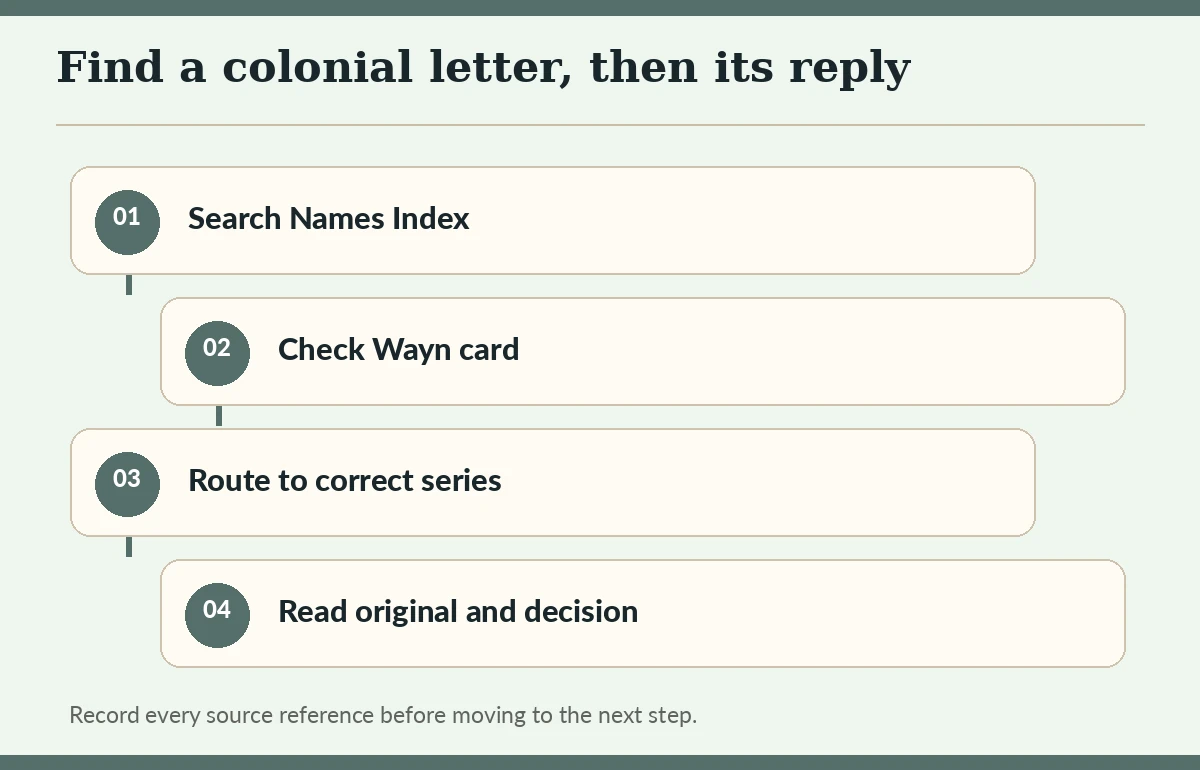
Search the Tasmanian Names Index for 1824–1854
Libraries Tasmania’s Colonial Secretary Correspondence dataset is described as an index of more than 14,700 records, available via the Tasmanian Names Index. Start with a surname and common variations, then narrow by period or the “Colonial Secretary correspondence” record type where that option is provided. A spelling variation, initials or a title rather than a personal name may explain why a family name returns no match. Explore entries for officials and correspondents as well as the apparent subject of a letter. Our guide “Victoria Council Minutes and Correspondence” covers a related question.
Save every locator shown with a promising result—year, correspondence reference, record identifier, description, series or any indicated page. Index metadata may mix a correspondent, a person discussed and an administrative subject. Do not identify the person merely because a surname is familiar. Record the exact language of the index in a source log, with the search term and date, before moving to the image or catalogue entry.
Use Wayn cards when the name search runs dry
The Wayn Index is a scanned card index of Tasmanian government material and colonial newspaper references. Libraries Tasmania explains that it includes names and topics for the Governor’s and Colonial Secretary’s offices before 1856. A card may be filed under a person, place, subject or another keyword rather than the modern spelling of a family name. Search it when the name database is silent, and examine cards near relevant alphabetical headings rather than relying exclusively on machine-readable text. Our guide “Tasmania Colonial Census, 1837–1857” covers how to find the householder and read the return.
A card is a finding aid, not the original correspondence and not a full transcript. Capture the card citation, any abbreviated series code, date and document reference. Follow the citation to a record description and determine whether an original, copy or summary can be viewed. If a card points to a newspaper, cite the newspaper issue separately rather than claiming that the information came from an administrative letter.
Distinguish local correspondence from imperial despatches
The archive’s early colonial administration guide identifies several distinct streams. For example, GO2 contains inward despatches from the Under-Secretary of State for the Colonies for 1823–1835, much of them about land grants. GO1 contains inward despatches from Britain to Van Diemen’s Land for 1823–1932, while GO33 covers outgoing despatches from Van Diemen’s Land to Britain for 1825–1855. These are not interchangeable with a personal petition found through the general Colonial Secretary correspondence dataset.
The Wayn Index marks some imperial despatch references with “ID” or “OD,” and the official guide notes printed summaries AE713 and AE714. A search result mentioning “land” could relate to a government-to-government communication rather than an application made by your ancestor. Confirm direction of correspondence, sender, recipient, series and administrative context before treating the document as evidence of a grant or an entitlement.

Prove who was involved and what the paper decided
Read a letter as a sequence of claims rather than one truth statement. The sender may assert a relationship or identity, while a clerk’s annotation shows receipt, referral, a recommendation or a later reply. Dates on a letter, a received stamp and a decision can differ. Create separate columns for “writer states,” “office records,” “government decides,” and “supported by another source.” This guards against turning a request for land into evidence that a grant was issued.
Compare any named residence, occupation, ship, property boundary or family connection with a second source such as a passenger record, land grant, parish entry or official register. Letters can contain self-interested representations, memory errors and contemporaneous misinformation. Retain original spellings and indicate if a word is illegible. If the correspondence discusses another person with the same name, document why one candidate fits more securely than the other. For the next step, our guide “Western Australia Colonial Secretary Letters, 1828–1878” explains how to find original files.
| Source | Useful finding | Proof limit |
|---|---|---|
| Names Index | Person or subject locator | Not a letter transcript |
| Wayn card | Name, topic, reference | Not the decision itself |
| GO1 / GO2 / GO33 | Imperial despatch stream | Not necessarily personal petition |
| Original letter | Words and office annotations | Outcome may be in another file |
Walk through a fictional petition-search example
Imagine an 1842 family letter claiming that a woman named Mary Evans sought permission to occupy land near a Tasmanian settlement. This is a hypothetical case, not a found petition. Search the correspondence dataset using Evans and likely name variants, then follow a promising result to the Wayn card if one exists. Record whether Mary appears as petitioner, person discussed or witness. Locate the original paper and copy its reference, receipt date and any marginal decision. Our guide “Tasmanian Land Grants, 1804–1935” covers how to find deeds, indexes, and historic maps.
If the document states only that the request was forwarded, stop there. Search the relevant land-grant or property sequence for a documented outcome. If a grant belongs to another Mary Evans, note the conflicting candidate rather than filling a gap in the family narrative. A defensible conclusion might be that Mary made a request in 1842 while the government’s response remains unlocated. That is useful evidence without invented success.

Explain missing records and sensitive context
An unsuccessful name search is not proof that a person never wrote to the colonial government. Index selection, spelling, correspondence direction, loss, catalogue access and document arrangement can each influence discoverability. State what was searched: Names Index dataset, Wayn card headings, dates and the government series consulted. A reproducible negative search names its scope, not merely the phrase “nothing online.”
Colonial correspondence may concern convicts, dispossession, coercive administration and disputes involving Aboriginal people. Write about a specific source and its power context rather than treating every government assertion as a neutral fact. Respect the authority of Aboriginal communities over their own histories, avoid converting a bureaucratic label into a personal identity claim, and use the archive’s access instructions for any original image or reading-room request. To go further, our guide “NSW Colonial Secretary Papers, 1788–1825” shows how to find original correspondence.
How We Research Tasmanian Colonial Correspondence
For Tasmania, the evidence map comes from Libraries Tasmania’s early-colonial-administration guide, its description of Wayn cards and the 1824–1854 Colonial Secretary dataset. We traced the different GO-series functions before describing how a researcher could route a surname hit to a letter or imperial despatch. Mary Evans is a fictional case; no historical petition has been claimed or transcribed. A name index cannot stand in for official annotations, so each claim of action requires the manuscript and any subsequent file. Confirm reading-room or digital access with the repository.
More Records and Archives Guides
Official Finding Aids and Original Collection Descriptions for Tasmanian Colonial Correspondence
Official description of Wayn cards, Colonial Secretary correspondence, GO1, GO2 and GO33 (libraries.tas.gov.au).
Libraries Tasmania dataset listing 1824–1854 and index size and access route (researchdata.edu.au).
Official overview of Tasmanian Names Index source collections (libraries.tas.gov.au).
Official explanation of the Wayn Index as a place, person and subject finding aid (libraries.tas.gov.au).
Editorial disclosure: This Tasmania correspondence guide is independent and contains no paid archival recommendations. See the GenHis affiliate disclosure for website-wide policies. Colonial letters may preserve discriminatory administrative perspectives; do not present them as uncontested personal histories.
The Libraries Tasmania dataset is labeled 1824–1854. The Colonial Secretary’s Office and related records cover other years.
No. Wayn is a scanned historical card index; the Names Index offers searchable record descriptions, including correspondence entries.
The archive describes GO33 as outward despatches from Van Diemen’s Land to Britain, 1825–1855.
No. A petition documents a request. Search the recorded decision and independent land-grant evidence.
Include the index record, original series or file reference, letter date, creator, repository and the version inspected.