
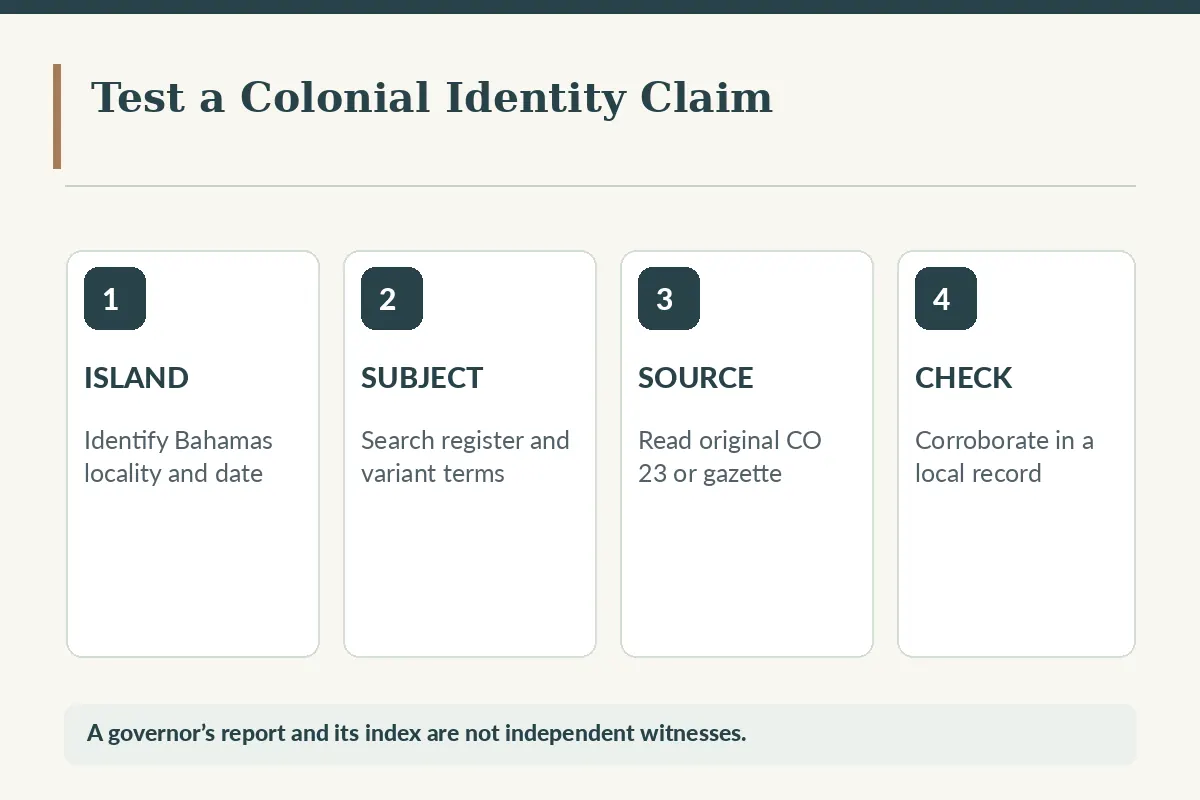
The National Archives lists CO 23 as correspondence concerning the Bahamas from 1696 to 1951 and CO 564 as Bahamas government gazettes for 1894–1965. These are administrative record series, not substitute islands-wide birth, marriage or death registers. The useful starting question might be whether a named individual petitioned the governor, held an appointment, appeared in an official notice or was involved in a documented dispute. Identify the island, date and institution before searching a surname.
Start With a Bahamas Event and a Colonial Record Type
Original correspondence can contain official letters, reports, enclosures and petitions. A government gazette, by contrast, is a published notice source. One may point to another but they are not the same piece of evidence. CO 23 reports are filtered through colonial administration and may reflect unequal power, biased language or omissions. Quote historical descriptions accurately while using respectful modern terminology for people, particularly when a file discusses slavery or racial classification.
Route the Search Through CO 23 and CO 564
The official Caribbean guide identifies the two collections and cautions that much correspondence and most gazettes are not name-searchable online. A catalogue title may describe an entire year or bundle rather than every person named inside. Record the specific volume, year and relevant governor or department. For an official appointment or public notice in the late nineteenth or twentieth century, a gazette may be the more focused first step.
For a petition or disputed local policy, begin with the correspondence year and look at the register or index appropriate to the period. Do not assume the earliest CO 23 volumes have the same finding aids as later ones. When a subject or individual appears in more than one source, verify whether one is a published summary of another rather than independent testimony.

Use Registers and Subject Indexes Before 1926
The National Archives explains that pre-1926 colonial correspondence is not generally described item by item in the online catalogue. For the 1815–1870 period, CO 714 includes subject indexes arranged by colony; the original correspondence registers provide another route, with later nineteenth-century registers recording links to related papers. Index subject terms are period terms, often unlike a modern researcher’s phrasing. Search several concepts and place variants, not just a contemporary category.
A subject index does not include everything sent to the Colonial Office; the official guide warns that private correspondents and organizations may be overlooked in some indexing. If a name is absent, browse a relevant governor’s register or a date-bounded volume. From 1926, descriptive file titles make keyword searching more useful, but the absence of a file in one search remains a catalogue observation, not a conclusion that the event was never recorded.
Identify the Writer, the Person Described, and the Claim
For each letter record the sender, addressee, date, written place, administrative subject and any enclosed documents. Separate first-person petitions from a governor’s description of a third party. A name in a recommendation, complaint or official report is evidence of a recorded statement; it is not automatically a finding that the statement was true. Distinguish a decision approved in London from local implementation, which may be documented at a different date.
A gazette notice can establish that a notice was printed on a particular day. It does not necessarily prove that a named appointee actually served, that a land transaction legally completed or that a person named as related truly was kin. Test the claimed event against local church or civil registers, deeds, court records and subsequent notices, depending on the question. A modern online transcription alone is weaker than an inspected printed or manuscript page.

Trace Bahamas Places Without Flattening Their History
The Bahamas is a group of islands; Nassau or New Providence cannot stand for every locality. A document may refer to an out-island district, a parish, a plantation, a port or a colonial jurisdiction. Transcribe the period locality and use maps or official gazettes to understand administrative boundaries. When searching records about Turks and Caicos, check the official table of shifting series and administrations rather than importing a Bahamas reference without a verified date.
Some documents were produced within systems of slavery, colonial control and restricted political representation. A label such as servant, apprentice, enslaved person or freed person requires attention to the historical legal context, not a generalized modern equivalent. A family relationship may be hidden, asserted by an interested party or absent altogether. Preserve those limits when correlating a reported surname with local records.
Build a Three-Source Test for a Named Bahamas Resident
Make three evidence rows: the original CO 23 correspondence, the CO 564 notice if applicable, and an independent local record. Record the event date, writing or publication date, name variants, town or island, role and precise reference for each. When two entries disagree, ask if they report separate stages—application, approval, appointment or public notice—before treating one as an error. Do not silently merge similar names from different islands.
A no-result search should identify which registers, gazette years and CO 23 piece descriptions were examined. A search result for 1901 is not exhaustive for 1890, and a volume title may conceal names of individuals. Research across an interval only where the survival and descriptive coverage justify it. Then phrase the conclusion narrowly: “this document describes” rather than “the family was definitely.”
More Records and Archives Guides
How We Research Bahamas Colonial Correspondence
We define the Bahamas locality, date and administrative question, choose CO 23 or CO 564 by creator and function, and use CO 714 or Colonial Office registers where the date requires them. We transcribe named roles and distinguish a statement from a government decision. Any family connection must be corroborated with a relevant local source, not merely another administrative index of the same letter.
Our citation identifies the archive, exact CO piece, date and document or page when visible, with a separate citation for gazette issues. Commercial databases are not treated as a different historical custodian from the papers they reproduce. See our affiliate disclosure for our general policy. Sensitive historical categories are described with context and without unsupported personal inference.
No. It contains Colonial Office correspondence and can mention people without systematically registering vital events.
It is the Bahamas government gazette series, listed by The National Archives for 1894–1965.
No. Many items require registers, subject indexes or volume browsing, and some index coverage is selective.
It proves a printed notice; employment or service may require independent evidence.
Compare island, parish, occupation, date and independent local records as well as name variants.