
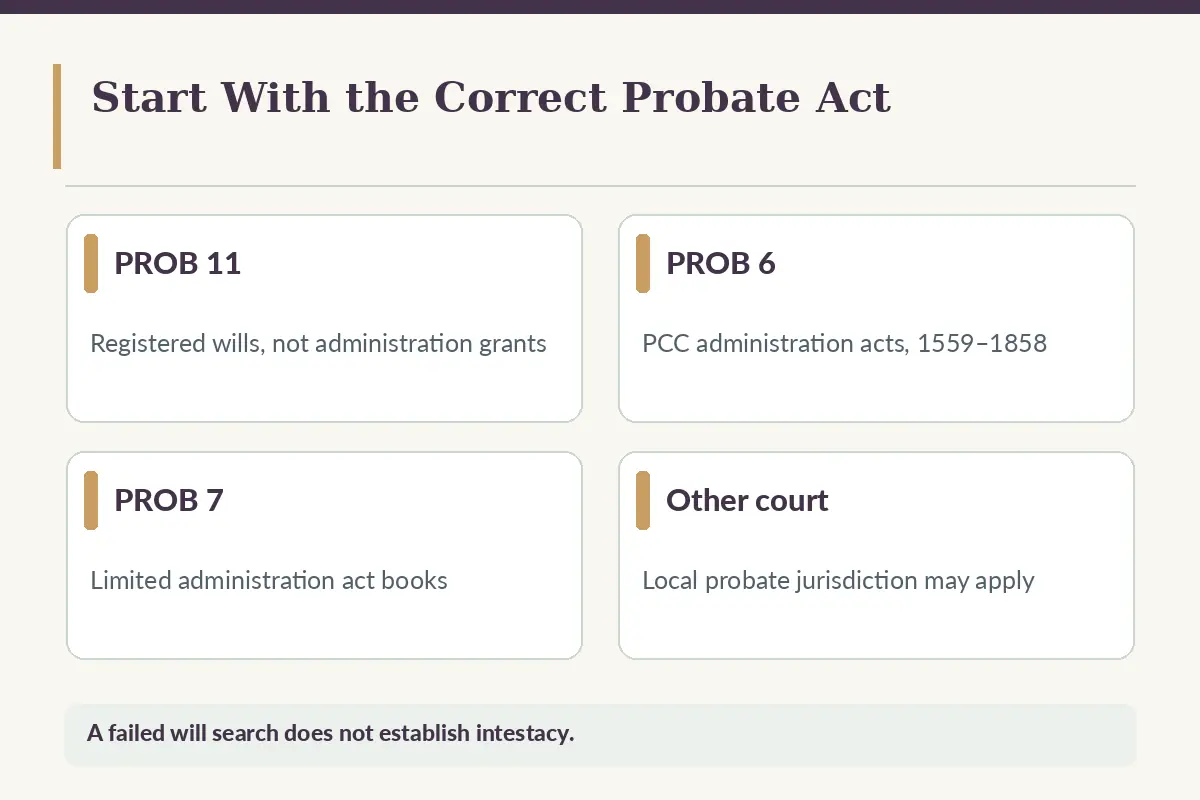
When someone died without a usable executor or without making a will, an ecclesiastical court might grant authority to administer the estate. The Prerogative Court of Canterbury (PCC) recorded many such grants in its administration act books, especially PROB 6 (1559–1858), with related limited administration acts in PROB 7. The grant identifies an administrative act; it does not contain a detailed inventory of everything owned or necessarily a declaration of every heir. An administrator is not the same legal role as a will’s executor.
Why an Administration Grant Is Not a Will
An administration with the will annexed can also occur if a will exists but its named executor cannot or will not act. Therefore “administration” does not always mean “no will survived.” Begin with the actual grant wording and its legal context rather than turning an index label into a family-history conclusion. The archival guide stresses that grants are often not very informative, so any apparent relationship should be traced into independent evidence.
Locate an Index Year and Folio First
The official TNA guide to wills and administrations instructs researchers to obtain an index year and folio number for a PCC administration, and for some later entries a county. Work from the probable date of death toward the court’s grant, not the reverse. The date on the grant is an administrative decision date; it should not be quietly substituted for the death date.
Extract the person’s written name, any place or occupation, court and folio citation. Then verify that the calendar entry points to PROB 6 or the appropriate administration material rather than PROB 11 registered wills. A surname in a PCC index can represent another namesake. A no-result search does not demonstrate there was no estate; a different ecclesiastical court may have had jurisdiction or the name may be indexed under an unexpected spelling.
Understand the PROB 6 and PROB 7 Structure
PROB 6 books are arranged by administrative sections and dates, and PROB 7 concerns limited administration acts. Historical organizational systems such as the court’s “seats” and monthly subdivisions affect how one locates an entry, particularly for grants after 1719. Do not mistake these filing units for geographical proof of residence. A folio and register reference locate the act; they are not property descriptions or family pedigree numbers.
When reading an act book, capture the full dated heading, name, any capacity stated for the grantee and the exact grant type. An administration limited to a defined purpose or asset should be distinguished from an unrestricted grant. If a transcription abbreviates the wording, examine the original before deciding what authority was granted. Some early records use Latin, so a partial translation may hide the crucial relationship or legal capacity.
Separate Administrator, Beneficiary, and Kin
A person named as administrator had authority to deal with an estate under the court’s grant. That name does not alone prove being the deceased’s child, spouse or principal beneficiary. Depending on wording and period, the grant can specify a relationship, but the correct method is to quote the claim and then seek corroboration. Distinguish “named in the book,” “appointed administrator” and “proven relative” as three different findings.
Try probate inventories, bonds, related court papers, parish entries and property records where survival and jurisdiction allow. A deceased person’s occupation or county in an index may be enough to distinguish a namesake, but the absence of a town may leave several candidates. Preserve those alternatives. A grant of administration is not a patent of title to a property, and an estate’s existence does not establish ownership of a particular farm or house.

Compare a Possible Will With the Grant
Use PROB 11 registered will copies only when the research question calls for a will and the PCC court is appropriate. A PROB 11 search that does not find a will is not sufficient proof of intestacy; there might have been another court, a lost document, or an administration with the will annexed. The recorded grant type and later estate papers are more directly relevant to the legal question. Keep probate grants distinct from the date the testator originally signed any will.
The TNA guide to PCC registered wills describes how PROB 11 differs from originals and grants. Use that distinction to create a source map: index, grant act, any will, and independent evidence for relatives. Avoid treating multiple digital copies of the same indexed grant as additional proof. Link every image to the manuscript piece and the administrative action it documents.
PCC administration should be understood as a jurisdictional decision as well as a document type. Where several counties or courts may be relevant, the strongest search begins with the likely place of the deceased’s moveable property and contemporaneous jurisdiction, not simply the county named in a later census. Do not assume a central court’s absence means that no one settled the estate in another venue.
Interpret No-Result Searches With Care
Before declaring an estate not found, check spelling variants, alternative counties, a grant several years after the probable death and courts other than PCC. The absence of a PCC record is particularly uninformative when the person’s assets fell under a local court’s jurisdiction. An index search can fail because it uses an earlier name form or a clerk’s filing convention. Record which years, folios and courts were actually inspected, and separate a missing index entry from an unavailable original.
A late reference to someone as “widow” or “administrator” should not be retrofitted into earlier years without proof. Construct a dated mini-timeline with source quotations: last known alive, death evidence, administrative grant, and later property dealings. Mark an event unknown if no independent dated source resolves it. This prevents probate technicalities from becoming fictional dates and lineages.

More Records and Archives Guides
How We Research PCC Administration Grants
We begin with the identity and probable death window, check whether the research question concerns a will or an administrator, then search the correct PCC index. After locating year, folio and the appropriate act book, we transcribe the grant’s precise role and any expressed relationship. We search outside PCC when geographic jurisdiction or negative results point elsewhere. The process does not assume that “intestate” follows from a failed will search.
Our evidence ledger separates source text, interpretation, a possible namesake and the independent record needed to test each assertion. We keep Latin or abbreviated terms visible until they are translated reliably, and we cite each manuscript by series and piece. For information about any research links, see our affiliate disclosure. A court grant is evidence of an administrative act, not a family tree by itself.
No. It authorizes an administrator; a will, when present, has a different legal and documentary function.
Not always. An administration with will annexed is possible, and an index absence does not prove intestacy.
Start with the appropriate PCC index, noting grant year, folio and, when relevant, county and register arrangement.
No. Record the stated role and any stated relationship and verify kin independently.
No. You need property-specific deeds, surveys or other title documentation for that claim.