
PROB 11 contains registered copies of wills proved by the Prerogative Court of Canterbury (PCC) between 1384 and 12 January 1858. Search The National Archives’ catalogue by a deceased person’s name, probate year and place; then verify the original registered entry. A PROB 11 image is not the testator’s original signed paper. For certain dates, compare surviving original wills in PROB 10 and historic calendars in PROB 12. The official PCC will guide states both the series and copy status. Read our affiliate disclosure for transparency.
Check Whether the PCC Had Jurisdiction
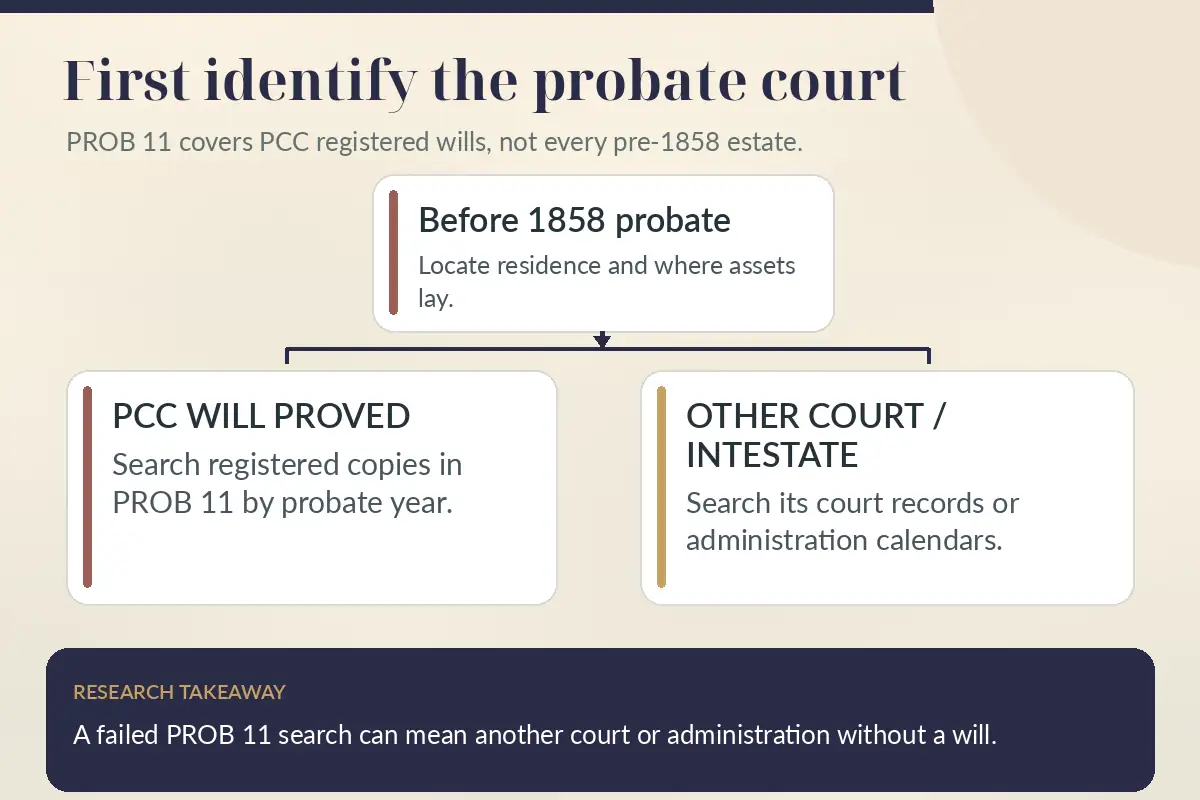
Before entering a surname, establish why a will might have been proved by the PCC. The PCC mainly served the south of England and much of Wales, but its business was not confined to residents there; the location and extent of a testator’s goods affected which ecclesiastical court held jurisdiction. The Prerogative Court of York and lesser church courts also proved wills. An English death before 1858 does not therefore guarantee a PROB 11 entry. If the estate belonged to another jurisdiction, search appropriate local and diocesan probate material rather than drawing negative conclusions about the person’s wealth or having no will.
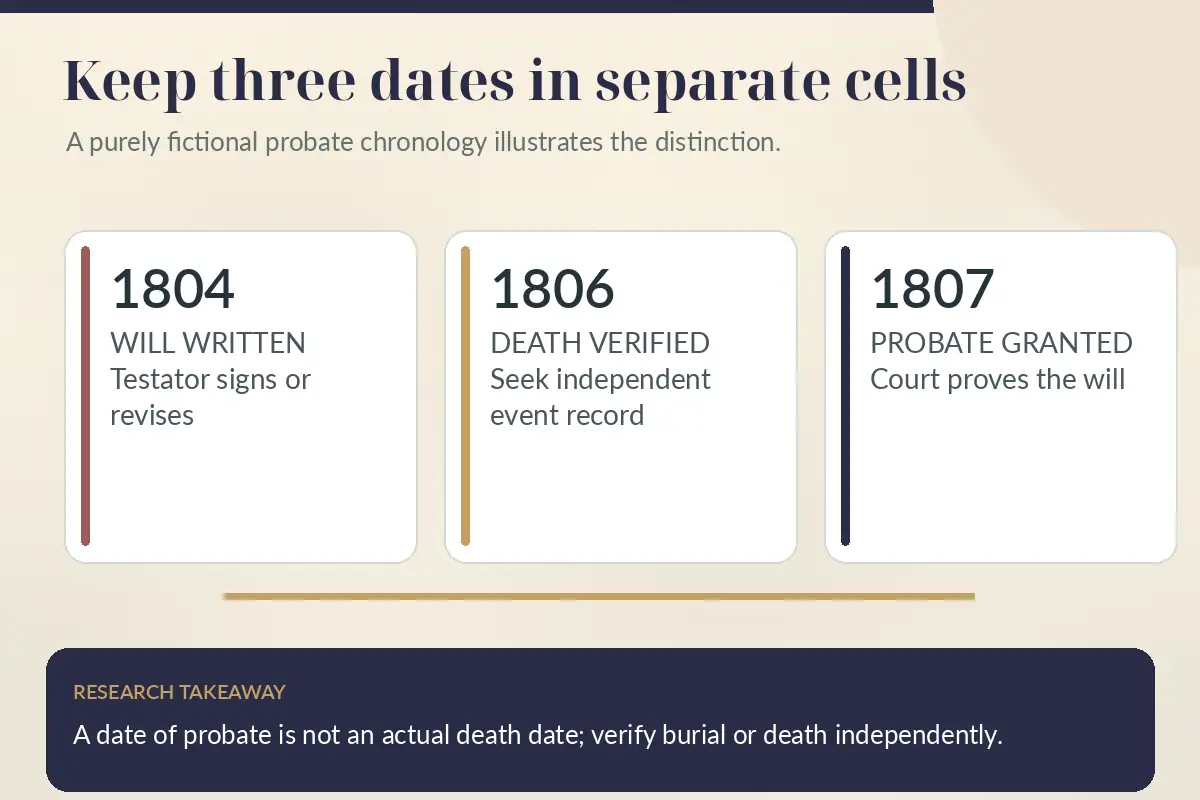
The key date for searching PROB 11 is the probate grant, not necessarily the date of death or the date the will was drafted. The National Archives’ broader pre-1858 wills and administrations guide emphasizes this distinction. A will signed in 1797 might be proved years later; do not assume that the catalog’s probate year is the death year. Create separate timeline columns for will date, codicil dates if shown, death evidence and proof or administration date. Do not fill an unknown death date from an adjacent procedural event.
Search PROB 11 by Probate Date and Spelling
Search spelling variations, forename forms, county and occupation where available. Historical names and places vary considerably in clerical spelling, and modern indexes may not preserve every variant. The National Archives supports wildcard catalog searches, but too-broad queries bring many unrelated entries. Verify the occupation and residence stated on the actual copy against independently dated records. When two men share a name, distinguish them by executor, witnesses, bequests and beneficiaries rather than by a single county label. A catalog description is a locator, not a complete abstract of the testamentary evidence.
Distinguish Copy, Original, and Probate Calendar
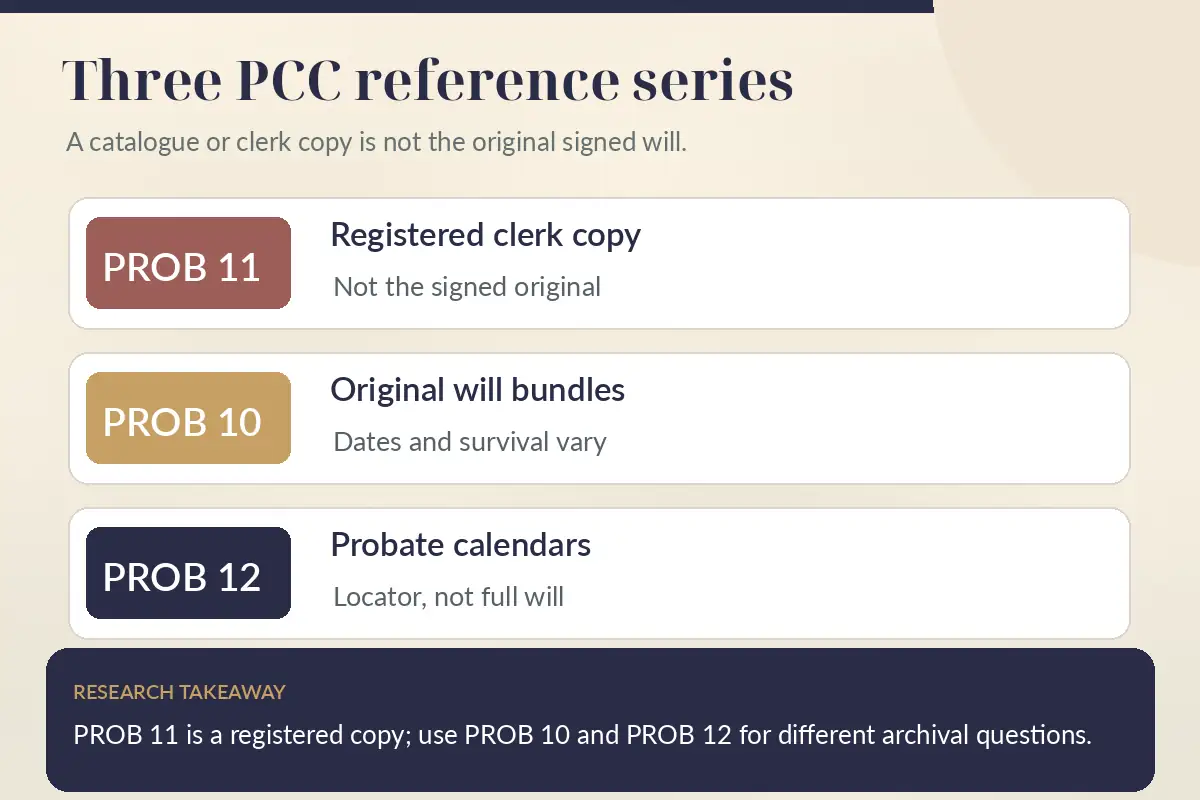
The label ‘registered copy’ matters. PROB 11 includes clerk-transcribed versions entered in court registers, and ordinary entries are not the original document brought to court. A transcript can introduce spellings, abbreviations and copying errors. If a particular word changes the identity of a beneficiary, note the reading uncertainty and investigate whether a corresponding PROB 10 original survives. Do not describe a distinctive flourish in a PROB 11 register as the testator’s own signature. Recording the source type is part of a sound citation, as important as recording the person’s name.
PROB 10 holds bundles of original PCC wills from 1484 onward, with arrangements often based on probate date and surname group. PROB 12 holds historic indexes or calendars to grants of probate and administration. The National Archives explains that these calendars can sometimes contain spelling or domicile details differing from modern catalog indexes. Their role is to find or reconcile records, not to supply all testamentary clauses. Not every pre-1858 probate involved a will: an administration for an intestate estate follows a different documentary path. Do not treat a grant of administration as a missing will whose text must have existed.
Read Executors and Beneficiaries as Legal Roles
Transcribe legal roles with precision. A testator names executors to carry out the will, and may leave property or personal goods to legatees and beneficiaries. A named beneficiary is not automatically an heir by blood, and a witness is not necessarily a relative. A legacy to ‘my nephew’ is an explicit relationship claim by the testator, but full identity still depends on matching the right person and context. A person omitted from a will was not necessarily disinherited; they may have received property previously or the tested will may concern only some possessions.
Original wills and registered copies may preserve different practical clues, particularly for handwriting and alterations, but neither proves every assertion within the estate narrative. Separate the words of the testator from later clerk-made additions or court certification. Note whether a bequest appears conditional or names another person of the same name. If a property is mentioned, determine whether the wording actually conveys a particular holding or merely refers to a rent or debt. Test title against land or manorial documents rather than treating any property description as a modern deed.
| SERIES | SOURCE TYPE | CAUTION |
|---|---|---|
| PROB 11 | Registered clerk copy of will | Not the signed original |
| PROB 10 | Original will bundles and exceptions | Survival and arrangement vary |
| PROB 12 | Calendar or probate index | Locator, not full will text |
Investigate Missing Wills and Special Cases
If a candidate is missing from PROB 11, first check the court boundary: where were the individual’s goods situated, what probate court had jurisdiction and could the person have died intestate? Then search the local court calendars or administration material. The National Archives notes an unusual Civil War exception in 1643–1646, when certain PCC wills were proved at Oxford and are available in PROB 10/639–642 rather than ordinary PROB 11 copies. A failed modern name query should also trigger variant spelling and a check of PROB 12 calendars. Log which repository, series and date ranges have genuinely been searched.
For each inspected entry preserve an exact record citation, including PROB 11 piece and item where shown, date of probate and digital image or folio location. Copy the whole clause around a relationship phrase so that a conditional gift is not read as an unequivocal statement of kinship. Record whether a suspected codicil appears. Where handwriting is difficult, seek a second reading and preserve alternate possibilities. Avoid building a new tree branch from a single ambiguous abbreviation in a clerk’s copy. If an original is available, compare readings explicitly rather than silently replacing one text with the other.
Compare a Fictional Will to Its Original
Imagine a fictional will written by Elizabeth Martin in 1804, later proved in 1807. A PROB 11 index search for 1804 would overlook the relevant probate year if used alone. The registered copy names ‘my niece Ann,’ while a separately found baptism record names several potential Anns in the extended family. The will supplies a relationship assertion, not a unique baptismal identity. Comparing an original PROB 10 will may clarify a doubtful surname, but it would not alone prove which Ann was intended. The result should be an evidence table that keeps document roles and dates apart.
A good research worksheet has distinct cells for named testator, will date, probate date, issuing court, PROB reference, original-versus-copy status, relationships claimed, persons in legal roles and unresolved ambiguities. Supplement it with death or burial records and contemporary deeds or tax papers where appropriate. The table helps expose an error common in online trees: turning the probate date into a death date and using a beneficiary’s surname as proof of a parent-child link. Every additional source should have its own date and custodian recorded for later checking.
More Records and Archives Guides
How We Research PCC Registered Wills
We use The National Archives’ dedicated PCC guide together with its broader explanation of ecclesiastical probate before 1858. Our search begins with court competence and probate-year evidence, then moves from the catalogue to the original image. We label PROB 11 as a clerk’s registered copy, check PROB 10 or PROB 12 where their distinct functions can resolve a discrepancy, and corroborate relationship and property claims independently. We report uncertainties in reading early handwriting and never equate a probate grant with the day someone died.
No. It contains registered copies written into probate court volumes by clerks.
Use the probate grant date, which may differ from both the will date and death date.
The National Archives describes originals from 1484 onward in PROB 10, with their own arrangement.
No. An executor is a legal role; any family relationship requires explicit and corroborated evidence.
The estate may belong to another probate court or have been administered without a will; spellings and special cases also matter.