
PROB 32 at The National Archives includes original Prerogative Court of Canterbury (PCC) inventories from 1658 to 1723. An inventory may list a deceased person’s movable goods, valuations, stock, livestock and debts, sometimes by room. It is not a survey of every person who lived in a house, and it is not a deed proving title to land. The strongest research result is a carefully cited account of what the appraisers actually recorded at a particular moment.
Search with a name, place and the word “inventory,” then verify whether the result belongs to PROB 32 or another PCC inventory series. The National Archives identifies overlapping coverage in PROB 3, PROB 4 and PROB 5 for 1661–1732, as well as material in PROB 2 before 1660 and PROB 31 after 1722. A failure to find one PROB 32 item is therefore not proof that no inventory exists.
Identify the estate and probate jurisdiction
Before reading valuations, establish which deceased person the file concerns. Write down the stated name, parish or residence, occupation where given, burial or death evidence from another source, and the date of the inventory if legible. PCC jurisdiction can extend far beyond the place where goods were appraised, so a document held under a central London probate court does not make the subject a London resident. The place named in an index may also reflect probate administration rather than the place of death.
Be careful when connecting two names. A will, an administration and an inventory for a common surname may concern different people. Compare executors, administrators, identifying phrases, dates, and the precise archival references. Do not assign an inventory to an ancestor because a modern catalog entry uses a matching name. An early-modern spelling variant may be plausible, but plausibility does not substitute for an explicit identifying link.
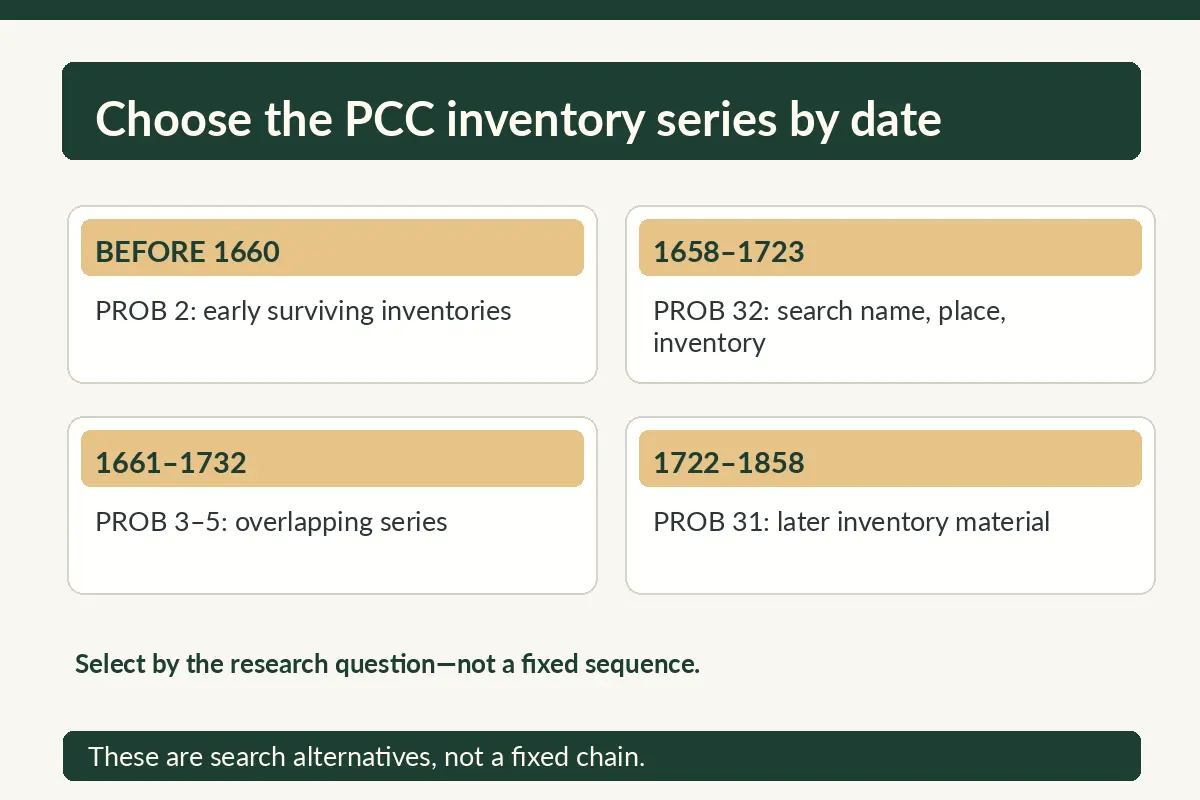
Choose PROB 32 and its overlapping inventory series
The National Archives guide lists PROB 32 for 1658–1723. If you have only a rough death date in that window, search the series by surname and place, then repeat relevant queries in PROB 3, PROB 4 and PROB 5. These are parallel survival possibilities, not guaranteed duplicates. The repository explicitly notes that not all inventories survive, despite the substantial surviving body of more than 60,000 PCC inventories distributed across its collections.
When browsing Discovery, save the collection description and reference for each candidate. Try parish names, county abbreviations and occupational terms such as merchant, baker or “at sea” if a name search returns too many entries. Do not use a published probate-will index as proof that an original goods inventory exists. A will or administration can be present when its inventory is missing, and an inventory may need a different search route.
Read valuations, rooms and debts as an appraiser’s categories
Transcribe the inventory heading, appraiser names, date, goods and values before interpreting the household. Note the currency and whether the totals are in pounds, shillings and pence. A room label such as chamber, buttery or kitchen might locate an item within the described building, but historical household vocabulary and the practical movement of goods can complicate modern reconstruction. The listed objects are a valuation record, not a guaranteed complete photograph of domestic life.
Separately code household furnishings, trade stock, tools, agricultural produce, animals, outstanding debts and cash if stated. Appraisers may group objects, omit items or apply conventions that prevent exact modern comparisons. A valuation is not a sale price, and a listed debt is not proof that it was collected. Preserve “one feather bed” rather than rewriting it into a complete bedroom or an inferred number of people sleeping there.

Do not treat possessions as proof of land ownership
An inventory describing cattle, timber or furniture at a property does not by itself establish freehold title to the farm or house. Real property often followed different legal rules and may not be represented among goods assessed for probate. Even a phrase such as “at the hall” could identify where objects were kept, not who owned the hall. Look for deeds, manorial court rolls, estate accounts, conveyances or local taxation to test ownership independently.
Similarly, a named executor, creditor or appraiser is not necessarily a relative. Record the explicit document role first. A debt owing to a brother may be kinship evidence if the original says “brother,” but two people sharing a surname in the same inventory cannot automatically be described as siblings. Use a separate parish, marriage, will or court record when an asserted relationship must be resolved.
Build a room-by-room ledger without false precision
Make columns for entry number, original phrase, normalized object category, appraised value, room or place, confidence in transcription and source reference. Keep any uncertain total in a separate calculation row and compare your sum with the scribe’s recorded total without silently repairing differences. Historical weights, denominations and valuation practices can vary; do not convert an early-modern amount into a modern price using a guessed multiplier.
The final narrative should state exactly what is known: “An inventory in PROB 32, dated within the specified period, appraises household and business goods associated with the named deceased person.” Add property ownership or kinship only when a different source establishes it. Where a will exists, check PROB 11 or the appropriate other probate records, but note that a proved will, a post-death inventory and an administration can record different events and dates.

More House and Local History Guides
How We Research and Verify These Records
This guide uses the record-series descriptions and the boundaries explained in The National Archives guide Secondary archival guidance. The sources identify the kinds of documents, their arrangements and possible access routes; they do not certify any particular ancestor, institution or map as independently inspected. Check each original item and the current catalogue access status before quoting a detail as a documentary finding.
We separate a catalogued lead from an original document, an administrative statement from an event, and a possible identity from a proven link. Historical names, jurisdictions and date ranges can be uncertain; missing entries are not negative proof. Reader information is editorial, not a claim of professional archival representation. Review our affiliate disclosure before following any commercial material on the site.
No. It is one inventory series for 1658–1723 and inventories do not survive for every estate.
The Archives identifies PROB 3, PROB 4 and PROB 5 for 1661–1732, plus other periods in PROB 2 and PROB 31.
Not by itself. Check deeds, manorial records or other evidence of legal title.
No. Their estate role must be kept separate from any separately documented kinship.
No. It lists appraised goods, not a complete count of residents or sleeping arrangements.