
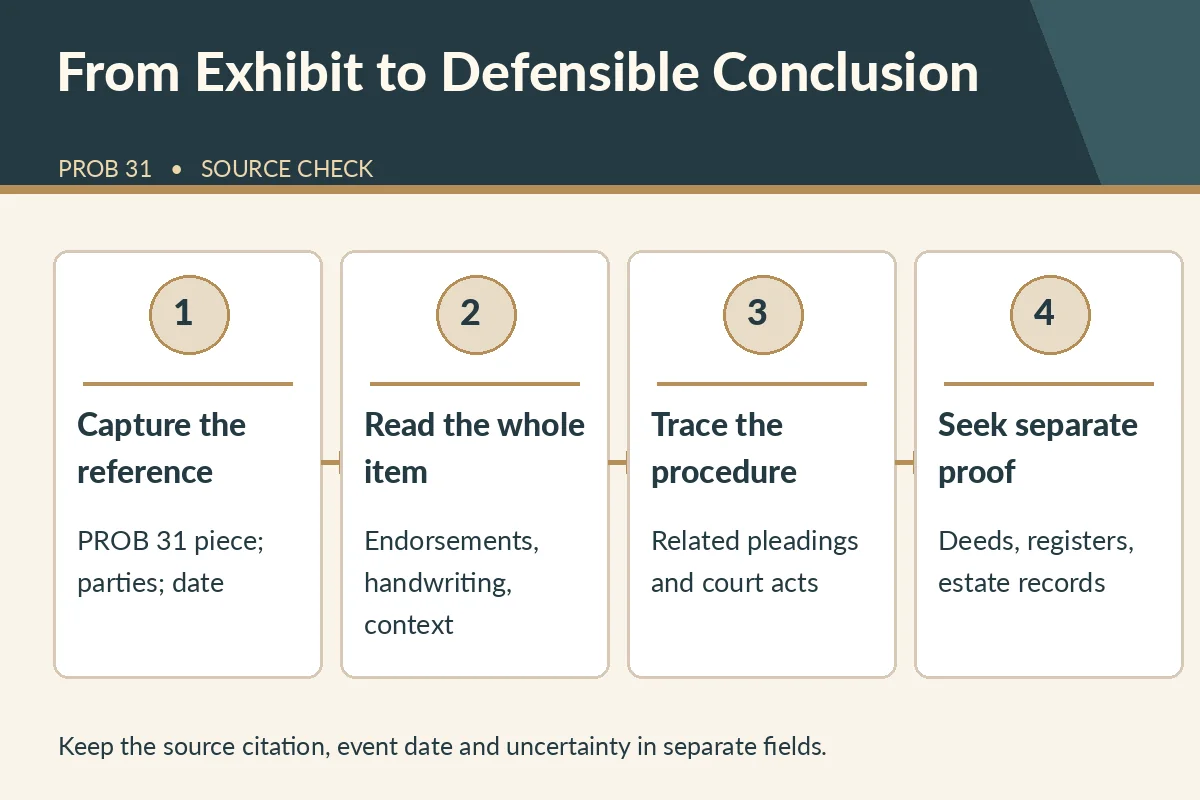
A paper introduced in a probate dispute is valuable evidence, but it is not an automatic statement of truth. In the Prerogative Court of Canterbury (PCC), the series PROB 31 holds exhibits for 1722–1858, while PROB 33 provides indexes to these materials. Exhibits can help reveal the documents and objects that parties considered important. Their presence does not establish who legally owned the property described or whether a judge accepted the argument. Begin with the disputed estate, not an isolated surname, and preserve a separate record of what the exhibit says and what a final decision actually settled. For the archival search route, consult The National Archives guide on the series. The National Archives guide on related records.
Identify the lawsuit before ordering an exhibit
Begin by confirming the deceased person, the competing parties and the approximate court period. A person mentioned in an exhibit may be a servant, creditor, witness or earlier property holder rather than the testator. The National Archives’ disputed-wills guide explains that PCC litigation produced several different record streams. PROB 18 contains allegations from plaintiffs; PROB 25 contains defendants’ answers. Those statements frame competing claims, so reading only one side can create a falsely certain family narrative.

Enter the case style as recorded, including the litigants’ surnames, rather than silently rewriting it into a modern family-tree title. Compare dates of the will, probate, lawsuit and any attached instrument; they need not coincide. Spellings and occupations are useful locating clues but should not be treated as unique identity markers. If the catalogue supplies only a broad bundle description, retain that uncertainty until the actual item can be inspected.
Use PROB 33 to reach PROB 31 exhibits
The official guide directs researchers to PROB 33 indexes for the exhibits preserved in PROB 31, a series covering 1722–1858. A keyword search for the deceased alone may miss an exhibit indexed under a litigant or case label. Record the index entry precisely, including any older cross-reference, before ordering the item. If an index names a paper without providing its text, do not summarize the document as though you have read it. A finding aid is a route to evidence, not a substitute for the evidence.
Once an exhibit has been found, inspect its physical or digital context. Does the document identify a maker, date, addressee or endorsing clerk? Is it an original, contemporary copy, later transcription or only a description of an object that no longer survives? A signed inventory, for example, might reflect the assets someone claimed to know about at a particular moment. It does not by itself prove that every listed item belonged beneficially to the deceased.
Separate testimony, exhibits and final procedure
A witness deposition is not the same thing as a document tendered in evidence. For PCC probate litigation, related witness material may appear in PROB 24 or PROB 26; procedural progress is recorded in PROB 29 and PROB 30. An exhibit may be mentioned in testimony, challenged by another party or never adopted in the reasoning of the court. Keep these stages apart. Do not draw a single arrow from a submitted note to a favorable verdict unless the record explicitly links them.
Court procedure can be frustratingly incomplete. A missing decree in the material you have viewed does not demonstrate that proceedings ended without judgment. Build a chronology naming each event: allegation, response, witness evidence, exhibited paper, procedural act and an independently located final instrument. When only some stages survive, state that you have evidence of a dispute but not yet of its resolution. That is a substantive, useful conclusion.

Test property and kinship claims independently
Estate inventories and other submitted lists can identify rooms, tools, debts, livestock or securities, but categories and valuations need contextual reading. A rented house mentioned in an inventory is not necessarily a freehold owned by the estate. A ring said to belong to a daughter may be merely the subject of a contested assertion. For real property, look for deeds, land tax, manorial records and other title evidence appropriate to the place and date. For kinship, compare baptism, marriage and burial records with wills and administration papers.
A claimant’s relationship to the testator can be described differently in the same litigation. Record the exact phrasing, such as ‘nephew’ or ‘widow,’ and distinguish statements by a party from findings in a probate act. For disputed goods, ask whether possession, beneficial ownership, pledge or debt is the actual issue. Never use an attractive list of family possessions as a substitute for the legal chain of entitlement.
Write a transparent probate source citation
Your working citation should include PROB 31 and the piece reference, the exhibit identifier if present, case title, approximate date and repository. Note separately how you located it through PROB 33. If your evidence derives from a published index, say ‘index entry’ rather than ‘exhibit examined.’ An image of one side is not automatically the full document: reverse endorsements, seals and marks can change an interpretation. Maintain a transcription layer and a separate interpretation layer.
When publishing a family history, explain why an inference is reasonable and what could disprove it. Two spellings of the same name may belong to different people. The strongest result connects the disputed paper to the appropriate will, the court’s procedural record and an outside record relevant to the claim. The weakest result quotes a single exhibit as unchallenged fact. Readers should be able to retrace the path without relying on your confidence alone.
More Records and Archives Guides
How We Research PROB 31 Records
We follow the National Archives guidance on disputed wills to distinguish case stages before consulting the associated probate records. We use PROB 33 as an access route, inspect PROB 31 as the underlying exhibit where available, and record any missing part of the chain. We cross-check court statements against independent land or family evidence. This method does not assume that the exhibit was accepted, that the surviving papers are complete or that a probate claimant acquired the property described.
Our explanations are independent research guidance, not access guarantees or legal advice. For transparency, see the affiliate disclosure. A link to an archive or a category is not a claim of a paid relationship.
PCC court exhibits from 1722–1858, which may be papers or other materials submitted in contested probate matters.
Use the PROB 33 indexes and the names of parties or the disputed estate, then inspect the specific PROB 31 item.
No. It shows what was submitted in litigation; ownership needs contextual court and independent title evidence.
Related depositions may be in PROB 24 or PROB 26; acts of court are in PROB 29 and PROB 30.
Record the dispute and the exhibits found, but do not describe a judgment or inheritance outcome as established.