
Identify an Exhibit Before Calling It a Will in Force
DEL 10 holds testamentary exhibits connected with the Court of Delegates, the English appellate court that handled certain ecclesiastical and civilian appeals before jurisdiction shifted in the nineteenth century. Exhibits are documents presented to the court as evidence. A will, testamentary paper or copy in such a collection does not automatically prove the testament was admitted to probate, that its provisions governed the estate or that an appellant succeeded.
The National Archives describes DEL 10 as only partially searchable in the catalogue. This matters because an exhibit may be attached to a disputed proceeding whose best access point is the case or parties rather than the name of every individual mentioned on a document. Begin with the testator, litigants, original ecclesiastical court if known, and a plausible period. Do not rely only on a phrase search for a surname.
Ask precisely whether the question concerns what a document said, who produced it in litigation, or the outcome of an appeal. Those are separate claims. A disputed signature can be an important genealogy clue without establishing legal validity; a witness named in a testamentary exhibit may appear as a witness rather than a beneficiary or relative.
Follow the Case Through DEL 1 and Other Court Records
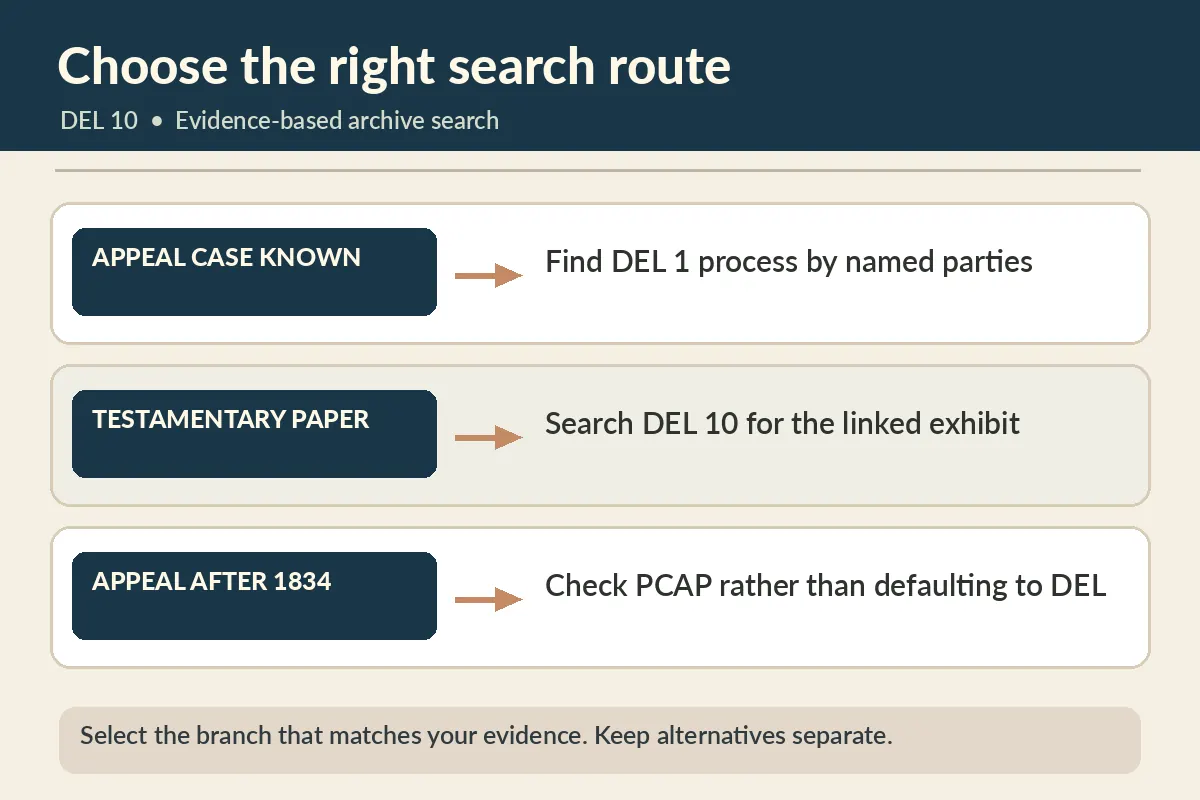
The National Archives points researchers toward DEL 1 processes for appeals, some of which are searchable by litigant or testator. Search the case title and variant names, record the full reference and use that identification to pursue any related DEL 10 exhibit. Case identifiers are safer than assuming all wills for one surname belong to one appeal.
The DEL departmental scheme separates processes in DEL 1, cause papers in DEL 2, personal answers and depositions in DEL 3, procedural acts in DEL 4, and sentences in DEL 5. DEL 10 documents can be correlated with these other series when a relevant surviving case is demonstrably connected. These are parallel types of records, not guaranteed steps present in every lawsuit.
DEL 11 contains miscellaneous lists and indexes which may assist with navigation. Index coverage is not the same as the survival or completeness of an appeal. Record whether the catalogue description states a testator, party, document date or only a subject heading. When an item is hard to locate, examine the archive’s case hierarchy and any descriptive list rather than treating a failed keyword search as a final result.

Check the Appeals Jurisdiction and Date Boundary
The Court of Delegates route applied to appeals from ecclesiastical courts and other civilian jurisdictions until the 1830s. The National Archives disputed-wills guide puts certain testamentary appeals before the Court of Delegates from 1534 to 1832 and points to Privy Council processes for the succeeding period. Dates should be read as jurisdictional guidance, not a claim that each individual DEL 10 exhibit has been dated to the same endpoints.
From 1834, the National Archives describes the Judicial Committee of the Privy Council as taking appeals recorded in PCAP series; PCAP 1 succeeds DEL 1. Do not place a later appeal in DEL 10 without checking the actual creation and custody. Transitional cases may be complicated: identify when the original case was heard, when an appeal was filed and which tribunal rendered the decision.
An underlying contested will may also leave evidence in probate court cause papers, depositions and act books. The Archives guide identifies PROB 24 and PROB 26 witness depositions for different periods and PROB 29 and PROB 30 procedural acts, among other series. Those records are evidence of probate litigation but cannot be assumed to survive for every Delegates appeal.
Distinguish a Litigant, Witness and Beneficiary
Testamentary exhibits can contain family names, places, property descriptions and statements of testamentary intention. Classify each person from the record itself: testator, executor, objector, witness, beneficiary or unrelated person mentioned in a recital. The roles are not interchangeable. A witness to a disputed paper does not automatically become an heir, and a claimant’s kinship statement is not independent genealogical proof.
When a testamentary document conflicts with a later probate entry, preserve both sources and explain their different legal functions. Some exhibits were offered precisely because their genuineness, execution or interpretation was contested. A catalogue label reading “will” is not a certification that this was the final operative document. Compare the exhibit with relevant probate registers, the appeal decision and any later estate administration records.
Where handwriting or the language of an old paper is uncertain, distinguish what is visible in an image from an editor’s expanded spelling. Record each page and the original sequence of the manuscript, including attachments and endorsements. Small annotations may have been created after the will itself; their dates and authors should not be silently merged with the testamentary text.

State Exactly What the Appeal Evidence Proves
An audit-ready statement says that a document was presented as an exhibit in a specified Court of Delegates proceeding, gives its DEL 10 reference and identifies how the proceeding was matched to a named case. It should not say that the exhibit proves a death date, final estate distribution or legal parentage unless another relevant record supports the claim.
If a sentence in DEL 5 is located, read its terms rather than guessing from the result of a party-name search. Check whether the sentence disposes of the same issue described in the exhibit. An interim procedural act, a document filed during the case and the final sentence have different meanings even when the same two litigants appear throughout.
Finish with a source map: original probate dispute, appeal process, testamentary exhibit, sentence where available, and independent vital or property evidence for biographical claims. Record gaps as unresolved. This provides a defensible family-history route while avoiding the misleading idea that the survival of one dramatic will determines the whole inheritance.
More Records and Archives Guides
How We Research and Verify the Archival Record
For this guide we checked the official series and research descriptions for DEL 10 against the document categories, chronological boundaries and access limitations specified by the custodians. We separate series-wide statements from claims about a particular piece: the former establish a search route, while the latter require the piece itself. Our principal source descriptions are High Court Admiralty Records Disputed Wills Citing Records National Archives. These sources support reference names and evidence limits; they do not certify an uninspected record as proof of an individual event.
Our verification worksheet records the claim, exact DEL 10 reference, creation date, nature of the entry, names and roles actually written, independent source used for comparison, and any unresolved alternative. The illustrated search routes are teaching reconstructions, not facsimiles of original records. Consult the affiliate disclosure for the site editorial and commercial policy. This article does not depend on an unverified paid provider or a claim of access to closed material.
The Archives describes DEL 10 as testamentary exhibits associated with Court of Delegates business.
No. It establishes that the paper was offered as evidence; determine validity and outcome separately.
Use testator and litigant names to find a relevant DEL 1 process and compare case details.
DEL 5 contains sentences; inspect its actual record and verify the case match.
The Judicial Committee of the Privy Council took later appeals, with related records in PCAP series.