
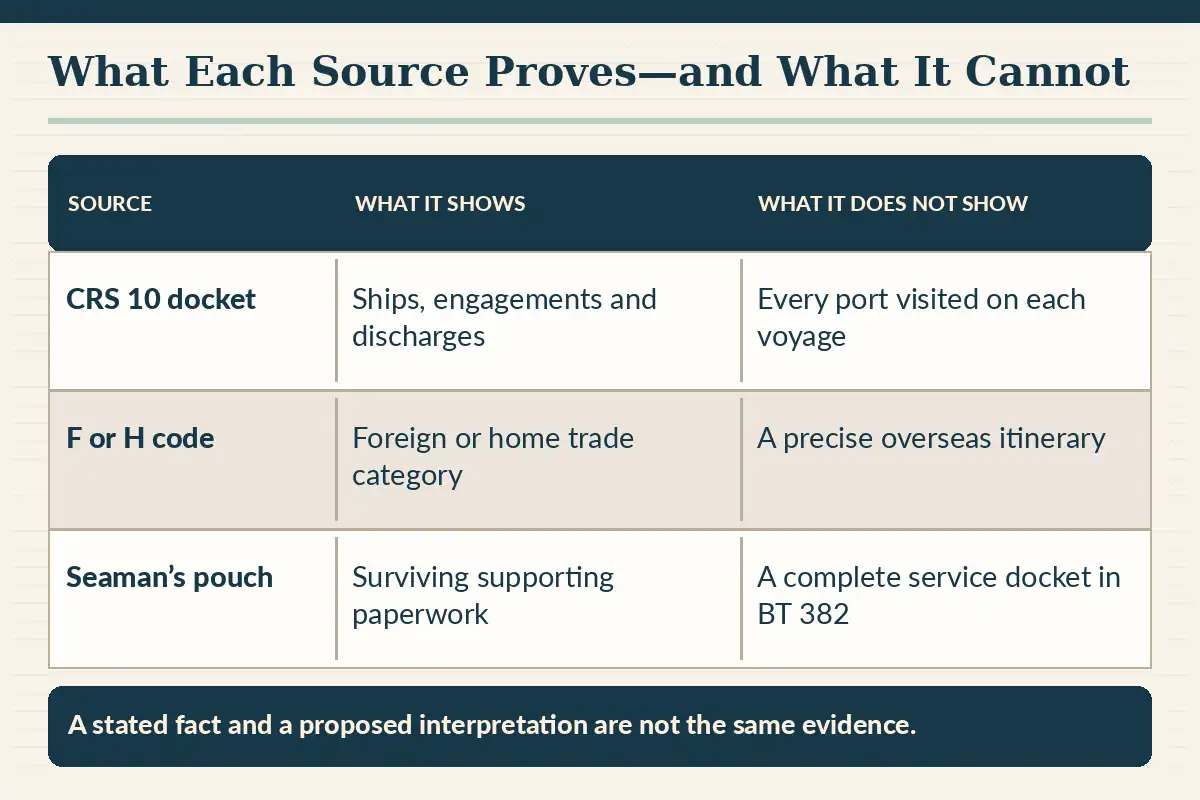
The Central Register of Seamen, also called the Fifth Register, is held in BT 382 for 1941–1972. Its CRS 10 docket books can supply a merchant seaman’s birth information, discharge-book number and a sequence of ships with engagement and discharge dates. That makes BT 382 a different kind of source from the seamen’s pouches in BT 372, BT 390 and BT 391. Build a ship-by-ship ledger instead of assuming the existence of one pouch or that each recorded engagement proves every voyage a vessel made.
The National Archives describes BT 382 as arranged in eight parts by nationality or origin and other categories, with catalogue descriptions in surname ranges. It advises checking Parts 1 and 2 for European-origin seamen. A CRS 10 record may use F/H codes for foreign or home trade. Such designations describe the register’s classification and should not become a detailed personal itinerary without another document.
Choose the correct part of the Fifth Register
BT 382 is not simply one alphabet of every seaman. The National Archives explains that the records are divided into eight sections according to nationality or origin and other criteria. For people of European origin, Parts 1 and 2 may both need checking. Record which part and surname range you searched, and do not claim a negative finding across the register after examining only one section.
Start with all known forms of the surname, given names, birth details and a possible discharge “A” number. A surname range in Discovery identifies an archive unit, not an individual page automatically visible online. If you find several candidates, use independent birth and service information to distinguish namesakes before joining any recorded ship to a particular ancestor.

Read CRS 10 docket fields literally
CRS 10 forms may contain a birth date and place, rank or rating, discharge-book number and service entries naming ships and official numbers. Read each column’s heading before transcribing. Ship names are frequently reused, and an official number is a better discriminator than the name alone. Write down exactly which date is engagement and which is discharge from the ship.
Create a row for each listed vessel with the official number, rank, date and place of joining, and date and place of leaving where supplied. Leave blanks blank; do not fill them from a general vessel history. A docket assembled administratively may contain omissions, delayed updates or corrections. Preserve crossed-out entries and uncertainty rather than silently “cleaning” the historical register.
Do not turn foreign-trade codes into a route map
The National Archives notes F and H abbreviations for foreign- or home-trade service. These classify the type of voyage rather than supplying a sequence of ports. An F-coded line does not by itself show the seaman visited a particular foreign city. Similarly, a long date range tied to one ship does not prove presence on every sailing during that interval.
To research a claimed journey, trace the official ship number to appropriate crew agreements, voyages or port records. Separate the vessel’s movements from the person’s proven engagement and allow for time ashore, changes in crew and incomplete entries. Where sources conflict, the researched outcome should be a dated, qualified service interval rather than a fictional continuous cruise.
Keep CRS 10 separate from seamen’s pouches
The Fifth Register includes the main CRS 10 docket books and related supporting documentation, but “seamen’s pouches” have separate series including BT 372, BT 390 and BT 391. Those pouches may contain photographs or paperwork and are not guaranteed to survive for every individual. Do not treat a pouch index entry as the same document as the BT 382 docket.
If a pouch survives, compare identity details and certificates with the CRS 10 service entries. A photograph can assist identification but does not prove a specific voyage. Conversely a surviving docket may document service even if a pouch is missing. Record the distinct source reference for each item and identify which claim it actually supports.
Account for temporary service and privacy restrictions
The official guide warns that some temporary workers and apprentices may not have received a discharge-book number or identity card, making standard register searches less effective. A missing BT 382 result therefore does not prove the person never worked at sea. Try ship-based documents and other appropriate records rather than treating the absence as a historical negative.
The same guidance warns that access to full information about seamen born less than 100 years ago may be restricted. Use the archive’s published access process. Do not copy potentially sensitive personal fields into a public family-tree profile without considering the person’s circumstances and relevant privacy rules.

Build a ship-by-ship proof summary
A defensible summary gives the exact BT 382 part, surname range, docket reference, name and service number, plus a dated table of ship official numbers. Preserve both the original F/H coding and any explanation of its meaning. Keep separate columns for reported, independently confirmed and unresolved voyage details.
Finish with an explicit boundary between record and inference: “the central register reports service on the named vessel between these dates,” not “the seaman completed all the vessel’s voyages.” A future researcher should be able to inspect the same docket and test every line using crew agreements or surviving ship records.
Build a traceable evidence worksheet
Start a claim-specific ledger with the full archive reference, repository, record level, historical creator, date, geographic scope, exact name and role, and whether you saw the original or a description. For each relevant field copy the literal evidence and add a separate inference column. Begin with BT 382 surname range and correct origin part; the eight sections are parallel search routes, not sequential voyages. If an index is incomplete, the right conclusion is that the search is incomplete, not that an event could not have occurred. Save every no-result search with its terms and coverage.
Compare with a record created independently of the first whenever possible. An engagement date establishes a recorded period with a vessel, not every journey made by that vessel. If two websites repeat one archival description, they are not two independent witnesses. Work with genuine conflicts rather than silently changing dates, spelling or personal identity until an ancestor fits. A good final sentence states what was directly documented, what remains an interpretation, and one specific record that could change the result.
More Records and Archives Guides
How We Research and Check These Records
We checked official archival guidance on 2026-11-03. The National Archives identifies BT 382 as the 1941–1972 Fifth Register, with eight origin groups and CRS 10 entries for ships and engagement dates. This verifies the described source route; it does not assert that a particular family member appears in the series.
We checked official archival guidance on 2026-11-03. The government guidance separately describes the 1941–1972 Fifth Register, official ship numbers, and sign-on/sign-off details. This verifies the described source route; it does not assert that a particular family member appears in the series.
We checked official archival guidance on 2026-11-03. The Discovery guide explains catalogue-level references and the need to check availability and institutional custody. This verifies the described source route; it does not assert that a particular family member appears in the series.
The images are original explanatory illustrations, not archival facsimiles. No paid endorsement or affiliate arrangement is implied. See our affiliate disclosure.
The National Archives describes the Fifth Register of Seamen as 1941–1972.
BT 382 has eight origin-based parts; the Archives advises checking Parts 1 and 2 for European-origin seamen.
A central service docket that can list ships, engagement and discharge information.
No. F is a foreign-trade category and does not establish a detailed itinerary.
No. Pouches may contain additional paperwork in separate BT series.