
BT 351 medal cards help identify merchant seamen eligible for First World War awards. Read the reverse and confirm the sailor elsewhere. Begin with the official archive guidance, distinguish a catalogue entry from an original image, and review our affiliate disclosure before choosing paid collections.
What a Merchant Navy Medal Card Actually Documents
The National Archives identifies BT 351/1 as an index of First World War merchant seamen’s campaign awards, not as a ship’s crew list. The papers include cards for the British War Medal and Mercantile Marine Medal; an associated list for the Silver War Badge is MT 9/1404. Start with the question of award eligibility or issue, rather than promising that a card will trace an ancestor’s route across the Atlantic. The collection contains more than 155,000 cards, but the published figure is a collection description, not proof that every wartime merchant sailor received a card.
The qualifying rules and issued material differ. The Mercantile Marine Medal was awarded for at least six months’ service at sea including a voyage in a danger zone, and the British War Medal followed for recipients of that medal. The Silver War Badge concerned those no longer fit for sea service. An entitlement or issue notation does not describe the whole voyage, any combat, or the reason a sailor subsequently left employment. Keep medal type, claimed entitlement, issue date and the source’s wording in separate fields.
Search the Name and Read Both Sides of the Card
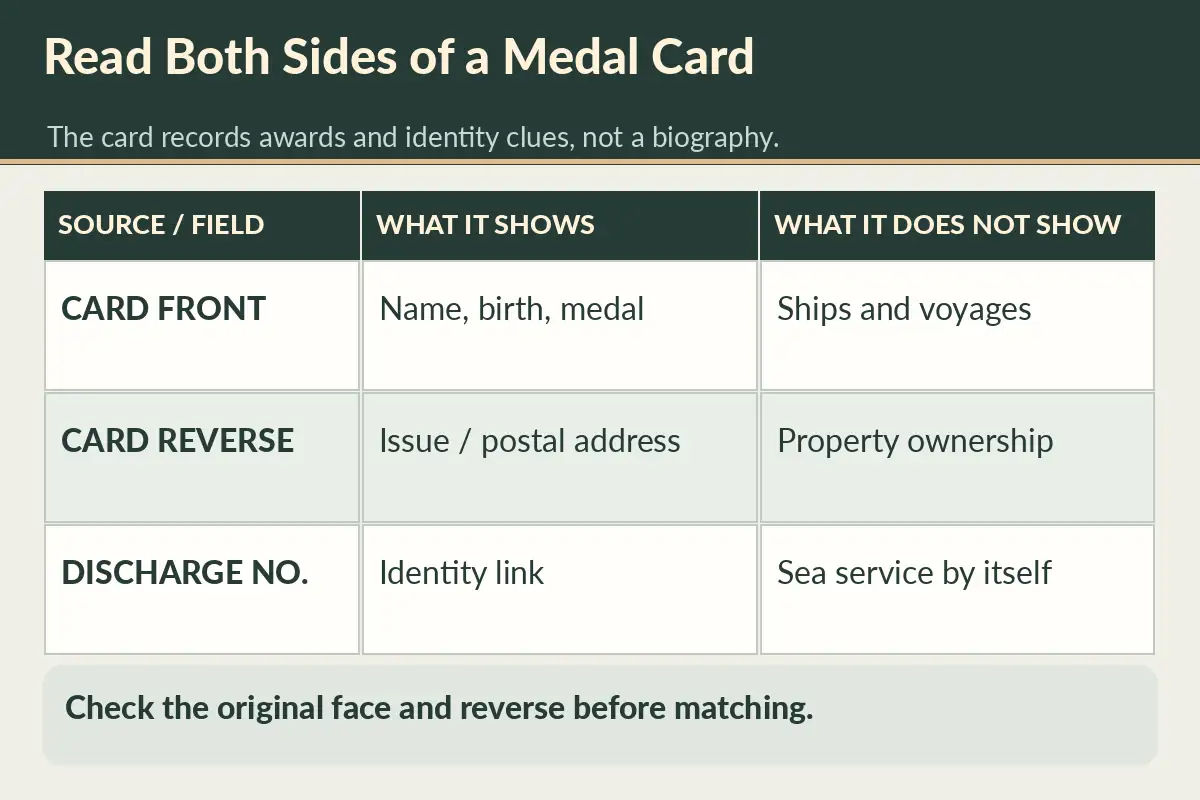
The Archives offers name searching for BT 351 through its Discovery catalogue, with paid downloads where available. Search a full name, then repeat with initials, spelling variants and birth information. A surname shared by several sailors is not a confirmed match. The guide specifies that the index card front can include name, birthplace, birth year, award and issue details, the mercantile marine office to which material was sent, and discharge or RS2 numbers. The reverse can include confirmation dates and the address used for dispatch. Read both sides before making a decision.
Copy the original card’s reference down to its BT 351/1 subpiece rather than citing only the database brand. A destination address for a medal or ribbon is a correspondence address at a particular date, not permanent residence or property ownership. In some cases a card notes that no medal was received; the Archives explains this may reflect failure to satisfy eligibility, not lack of all wartime service. Write down exactly what the card says. A birth year may be approximate, and names can be normalized in an index, so use an independent identity check.

Distinguish Award Type From Silver War Badge Evidence
An ordinary BT 351 campaign medal card and the Silver War Badge list do not answer the same question. The National Archives identifies MT 9/1404 as a list of badge recipients with names, badge numbers, ships served on and the incapacity or reason for the award. This information is more directly relevant to the end of someone’s sea-going career but still does not automatically supply a detailed medical file. Do not write that a badge proves a specific injury occurred on a particular named voyage unless the source says so.
The online routes also differ: the medal cards are searched by name through Discovery and partner services, while the Archive describes a downloadable list for the badge. Record the badge number and the ship exactly as listed. Check whether a recipient’s name and service identity are truly the same as the man on a campaign medal card. If they share a name but have no matching port, date, number or birth details, leave the connection as unverified. A family story about an injury may be a useful lead, not the needed cross-reference.
Use Discharge Numbers to Find a Real Seaman
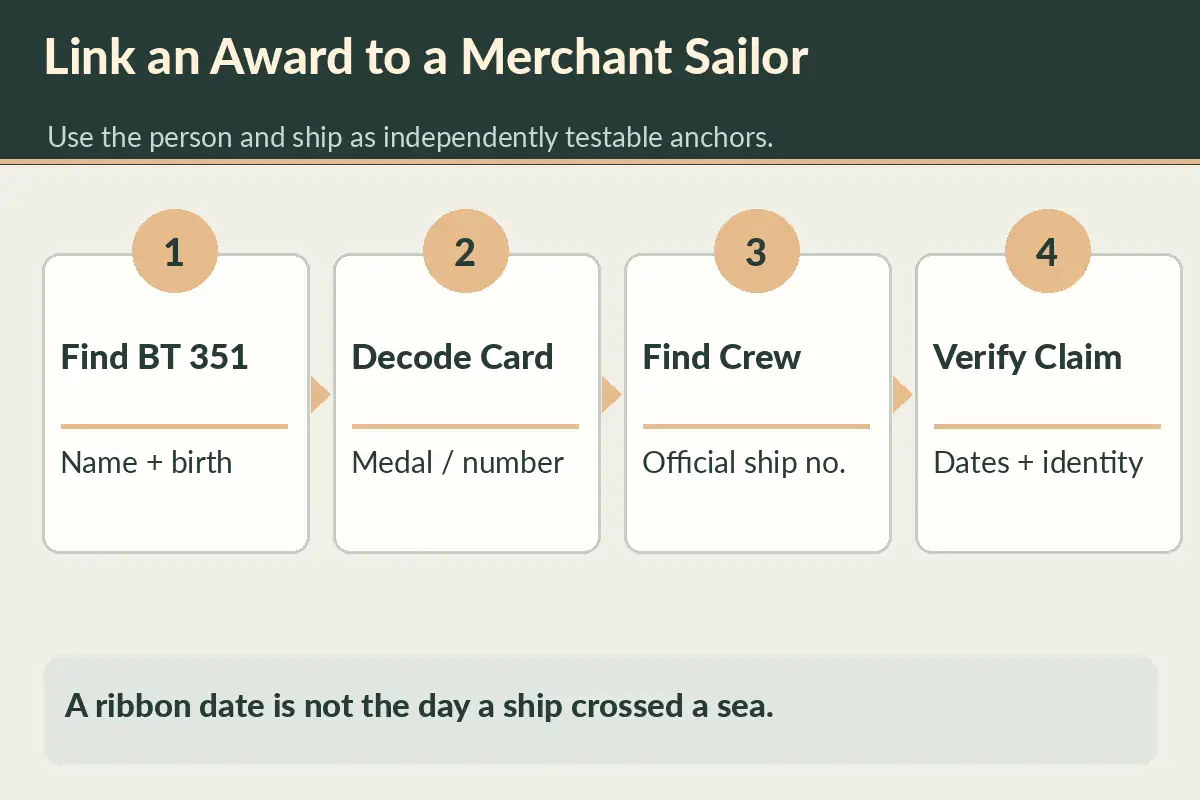
The discharge or RS2 number appearing on some BT 351 cards can help distinguish men with identical names. However, it is not a voyage description. Consult Merchant Navy service and crew-list guides to see which registration series cover the period and whether the relevant service details survive. The Archives also recommends a vessel-first route through the Crew List Index Project, using a ship’s name, port of registry and official number. This can identify a possible crew list, but finding a vessel with the right name is not proof your ancestor sailed in it.
Build a person-to-vessel worksheet: name and birth year from the medal card, discharge number if present, ship official number from an independent source, crew list date and source image. A ship can change names or owners, and a commonly named vessel may not be unique. A crew agreement signed in a particular port documents a specific hiring or engagement, while the medal award describes service qualifying for a campaign award across a separate administrative process. Preserve each document’s date and coverage. Never infer an unnamed wartime crossing simply from medal entitlement.
Differentiate a Wartime Death Record From the Medal Index
The National Archives directs researchers to the separate Merchant Navy First World War Roll of Honour in BT 339 for seamen who died in service or were declared missing presumed dead. The usual information includes a rank or rating, ship and date of death or presumed death. Do not read this casualty coverage into BT 351, and do not assume that every absence from BT 339 means the sailor survived the war. Conversely, an award card does not by itself prove when a man returned home. Search death and casualty material only when the family question requires it.
If an indexed death date and an award confirmation date conflict, the two may refer to different administrative actions. A medal could be confirmed or sent after the service ended, and a casualty entry may report a presumption rather than an observed death. Compare the named ship, birth details, home address and independent death documentation. Keep a memorial inscription distinct from a primary service file. A reliable narrative can state both that the man appears on a medal card and that another source separately reports his death, without forcing either document to contain every fact.
Make a Medal-Card Proof Ledger Before Writing the Story
A finished entry should include card identifier, name as written, birth details, medal or badge type, issue or confirmation marks, correspondence address and any discharge number. Add separate citations for crew agreements, registration forms and death or disability evidence. When a card is image-accessible, review both sides in full size because a small notation can qualify a claim. An index-only search result must be labeled accordingly. Check the source date rather than treating a late issue mark as the date of service.
The useful final conclusion is often modest: a specific sailor was recorded for a specified award, and an independent crew or identity record makes the match strong or provisional. A blank medal field does not prove an absence of voyages; the qualifying rules and surviving index must be understood first. If a card’s home address includes descendants still alive, consider privacy before sharing it. Keep all record references and negative search decisions in one research log so the next researcher can reproduce the match rather than simply trust a family anecdote.
How We Research This Specific Archival Claim
Our review first distinguishes the office that created the records from the later catalogue, digital provider and modern interpretation. We check the repository’s period, surviving extent, original arrangement, access rules and description of each series. Every source is read for exactly what it reports: an original statement may be accurate about one event yet inadequate for a family relationship, legal outcome or residence claim. We test competing namesakes with independent dates, places and record identifiers, keep conflicting claims in separate rows and document precisely which portions of a collection were searched. A negative online search is not a negative archival finding without a documented coverage assessment.
More Records and Archives Guides
Archive Sources and Their Evidentiary Limits
The primary archival guide explains Details BT 351/1 index cards, fields including place and year of birth, issue dates and discharge numbers, and a separate Silver War Badge list MT 9/1404.. An additional official research source confirms Explains Merchant Navy WWI identity research using BT 351 medal cards, BT 339 roll of honour and vessel-first crew-list searches.. These institutional descriptions establish the existence and general scope of records; only the original document can establish what it says about a particular person. Date your retrieval, cite the full piece and page, and keep unresolved namesakes open rather than borrowing unverified details from a published tree.
No. It records campaign medal administration, not every voyage or ship served.
It may show confirmation dates and the address used for sending medals or ribbons.
The National Archives identifies MT 9/1404 as the separate list.
No. It is an address used for correspondence at a particular time.
Use relevant casualty records including the BT 339 Roll of Honour and verify the named ship.