
What a BT 395 Medal Card Can Actually Establish
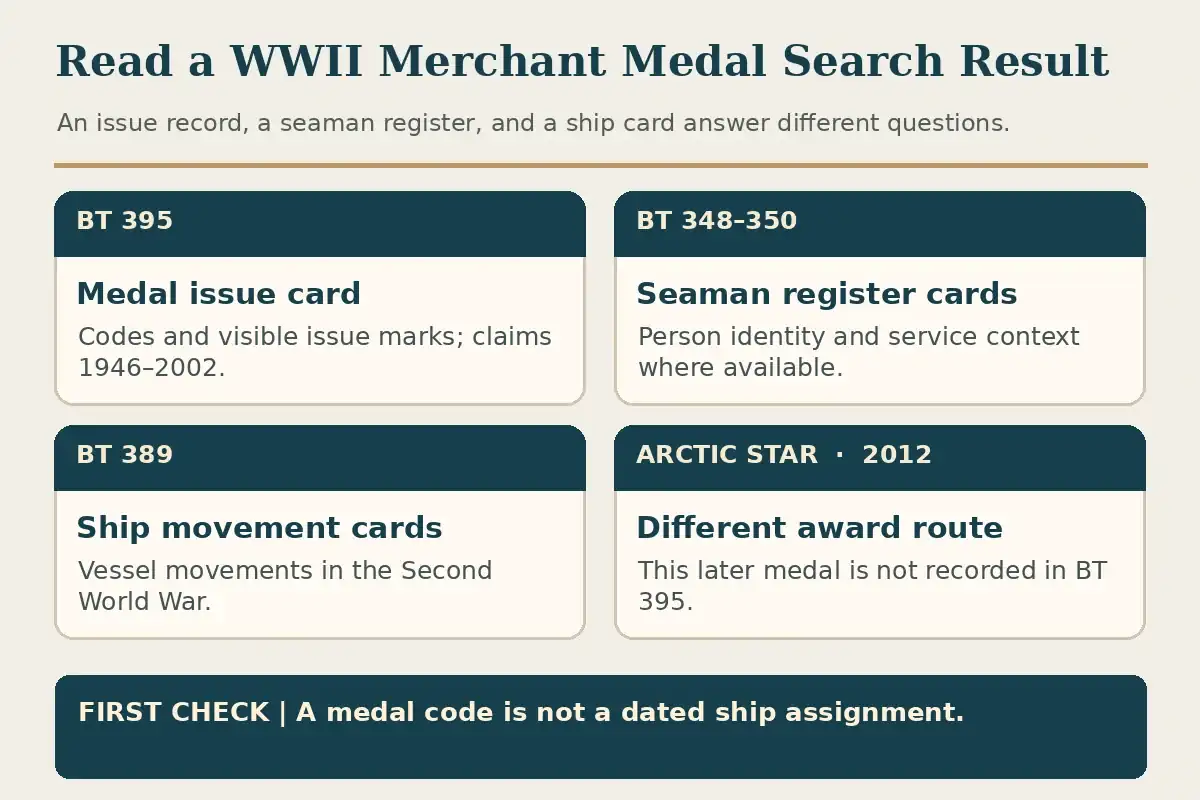
BT 395 is The National Archives series for records of Second World War campaign medals issued to British merchant seamen. The underlying wartime service was in 1939–1945, but many medal claims and issues occurred much later, between 1946 and 2002. Those are separate dates. An entry records administrative consideration or issue of medals and ribbons; it is not a ship-by-ship service diary, a verified sailing list, or a complete roll of everyone who went to sea.
Begin with the person’s name and any known discharge book number. A BT 395 entry can carry the name, medal abbreviations, issue annotations, an entitlement-file reference and sometimes birthplace or birth date. Keep the index description separate from the card image: a catalogue search result may supply only a name and a retrieval path, while the actual marked record contains the distinctions your conclusion requires.
Use The National Archives specific BT 395 guide before interpreting a symbol. Namesakes make this especially important. Two people called William Brown might share a medal type, yet a discharge-book number and an independent crew agreement are a better identity link than medal abbreviations alone.
Decode the Marks Before Recording an Award
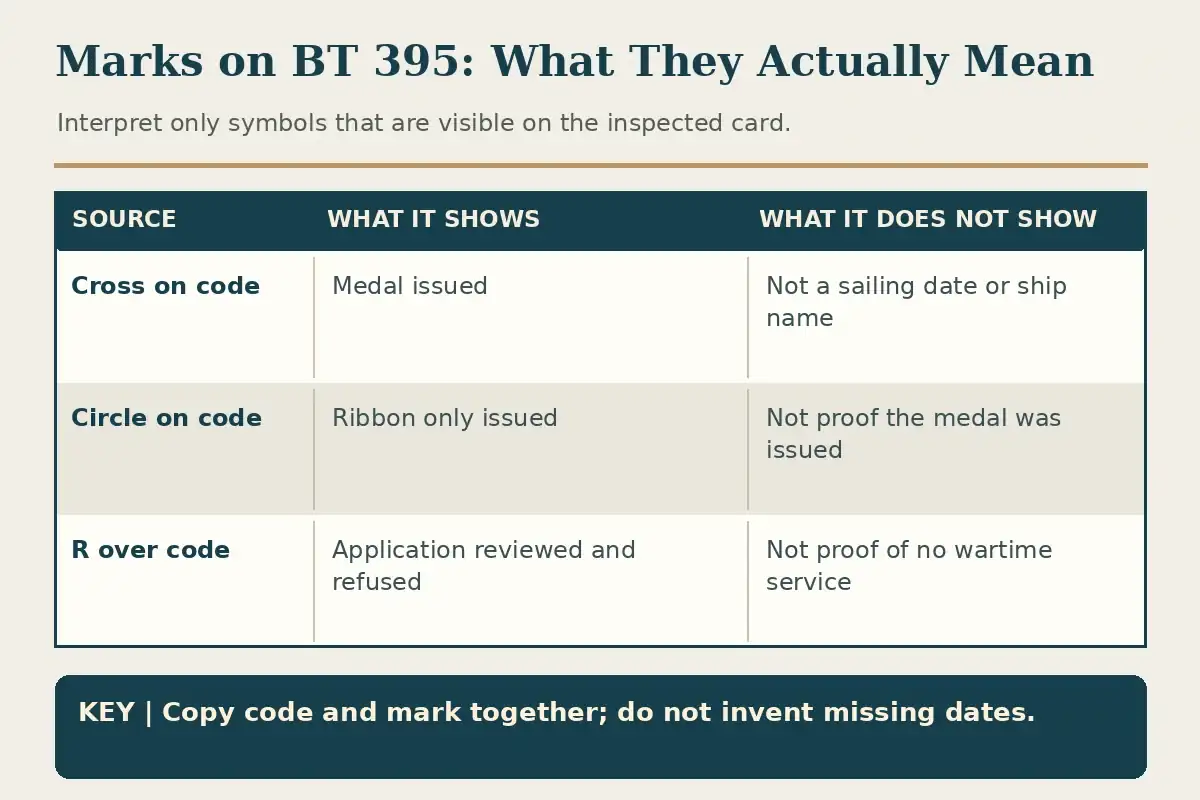
The official guide identifies common codes including WM for War Medal, AT for Atlantic Star, 1939 for 1939–1945 Star, AF for Africa Star, PA for Pacific Star, BU for Burma Star, FR for France and Germany Star, and IT for Italy Star. CL indicates a clasp; OLE indicates an oak leaf emblem. Copy the exact printed code and any mark over it. Do not treat an abbreviation alone as an issue date or claim that every coded medal was physically received.
On the official example, a cross through a medal code indicates the medal was issued; a circle indicates only its ribbon was issued; a cross and circle indicate both. An R above a code can indicate a reviewed and refused application. These marks are meaningful only when you can see the image clearly. Keep an uncertain or damaged mark as uncertain rather than deciding it fits an attractive family story.
Create a small transcription table with columns CARD CODE, VISIBLE MARK, OFFICIAL MEANING, and UNRESOLVED QUESTION. A series description is not a substitute for the actual card. Record the referenced Registry of Shipping and Seamen file separately because it may not be held with the downloaded image. If the card shows several names, avoid copying the neighbouring seaman’s annotations.
Why an Absent Medal Entry Is Not Negative Service Evidence
Medals were not automatically issued to all surviving eligible merchant seamen. The National Archives explains that they had to be claimed. Therefore a person absent from BT 395 may simply never have applied. A no-result search should name the database, date, spelling variants and search fields used; it should not become a statement that the ancestor never sailed or failed to qualify.
The Arctic Star is a special case: it was introduced in 2012 and is outside BT 395. It requires different evidence, often linking a named seaman to a specific ship and the ship’s Arctic operations. Searching BT 395 for an Arctic Star award is therefore the wrong question. The official medals and honours guide explains the distinct evidence route.
Even where a qualifying medal appears, the card does not identify every voyage, every date afloat, or every wartime danger experienced. Medal qualifications and issue administration answer a bounded eligibility question. If a family account mentions a particular convoy, that claim needs contemporaneous vessel and person evidence beyond a medal code.
Connect One Named Seaman to One Documented Ship
First identify the seaman using a discharge book, registry card or crew agreement, with enough personal details to exclude namesakes. Next extract vessel name, official number, and the precise service period supported by that named-person source. Only after this step should a ship movement record be used to reconstruct the ship’s route. The National Archives identifies BT 389 as movement cards for British and Allied merchant vessels during the Second World War.
A BT 389 movement card concerns a vessel, not all its crew. If the ship visited a port while the person’s crew entry covers a different interval, do not join them. Maintain two dated rows: PERSON ON SHIP and SHIP AT PLACE. An overlap may support a carefully qualified hypothesis, but neither row automatically supplies the other. Departure, arrival, convoy and shore leave can require further evidence.
Use the correct historical vessel identity when ship names repeat. An official number, registry port, and dated crew list are safer than matching a name alone. Record uncertainty about a damaged number, a changed vessel name or a non-consecutive voyage. You can tell a strong family story while explicitly stating that the evidence proves an award issue rather than a complete service narrative.
For an ambiguous card, maintain a photograph-based audit trail: record whether you inspected a digital image, a transcription or only a search hit, and name the field or symbol that remains unclear. If you compare two nearly identical cards, use the discharge number, personal details and file context to avoid combining medals belonging to separate men. The resulting evidence statement should tell a later reader exactly which physical marks support the interpretation and which alternative readings remain possible.

More Records and Archives Guides
How We Research Medal Evidence Without Overclaiming
Our method is to start with the archive’s published key to BT 395 symbols, transcribe the visible card, then seek independent named-person and ship-level records. The sample values in the diagrams are teaching labels rather than a copy of a particular historical card. Researchers should cite the specific BT 395 item and image page they consulted, including any restrictions, image-provider details or missing reverse.
Keep separate dates for wartime activity (1939–1945), the card’s administrative claim or issue (potentially 1946–2002), and any later records used for corroboration. If your source lacks a date, say so; do not turn a generic medal qualification into a month on a ship. A precise, narrow conclusion is far more useful than an invented certainty about an ancestor’s war service.
Check the linked official guides for changes in access routes and fees before ordering records. This is a research method, not an offer to obtain restricted personal files. For transparency about the site’s business relationships, see the affiliate disclosure before using any suggested service.
No. The official guide states that medals were claimed rather than automatically issued, so missing entries cannot exclude wartime service.
The National Archives explains that a cross indicates issue of the medal; a circle indicates ribbon issue, and the two marks together indicate both.
No. The Arctic Star was introduced in 2012 and its award records are not included in BT 395.
Not by itself. Link a named seaman and service dates to a ship, then investigate the vessel movement record and any convoy evidence.
Transcribe the visible parts, mark the symbol as uncertain, and avoid interpreting issue status without a legible image.