
World War II Merchant Ship Movement Cards BT 389 can provide useful evidence only when the document type and its limits are understood. Begin with the official research guidance and distinguish what the repository holds from what a family story suggests. This guide gives a source-specific search sequence, the meaning of each relevant field, and a tested way to separate an original record from a mistaken name match.
Identify the Vessel Before Reading the Card
BT 389 records the movements of British and Allied merchant ships in the Second World War. A wartime movement card can follow a vessel from port to port, but it is not a passenger manifest or individual seaman’s record. Start with a confirmed ship name, estimated year and vessel identity. The National Archives explains that these cards were created because wartime security restrictions discouraged recording destinations in ordinary crew documents.
Where a family letter names a vessel, verify it against contemporary registration, ownership and other identifiers rather than selecting the first matching ship in an online catalogue. Names were reused, vessels changed names and a ship mentioned in a memoir may have operated as part of a convoy. Establish which physical hull the clue concerns before correlating a route with a person’s service.
Use BT 389 as a Ship-Name Search, Not a People Search
The archive’s BT 389 guide offers ship-name searching of digitized movement cards. The cards can contain names used previously, vessel size, day-by-day movements, expected destinations, cargo expectations and clerical dates. They do not list passengers or crew. Build a transcript including exact entry dates, place names as recorded and whether the item is an event or a forward-looking plan.
Use separate symbols for a recorded movement and an expected movement. An intended destination can change, and a card can contain shorthand understood within the wartime shipping office. Do not insert an imagined arrival to make a tidy map. When two cards have a similar ship name, compare tonnage and documented name changes before joining their journeys. Preserve the precise BT 389 item reference and image.

Understand the Security Reason Behind the Different Records
In 1939 the Admiralty instructed the Board of Trade to restrict masters from showing destinations and ports of call in logs and crew agreements. The shipping administration therefore used movement cards to record vessel itineraries separately. This split custody explains why finding a voyage in BT 389 does not locate a named sailor, and why a crew agreement can exist without the destinations you expected.
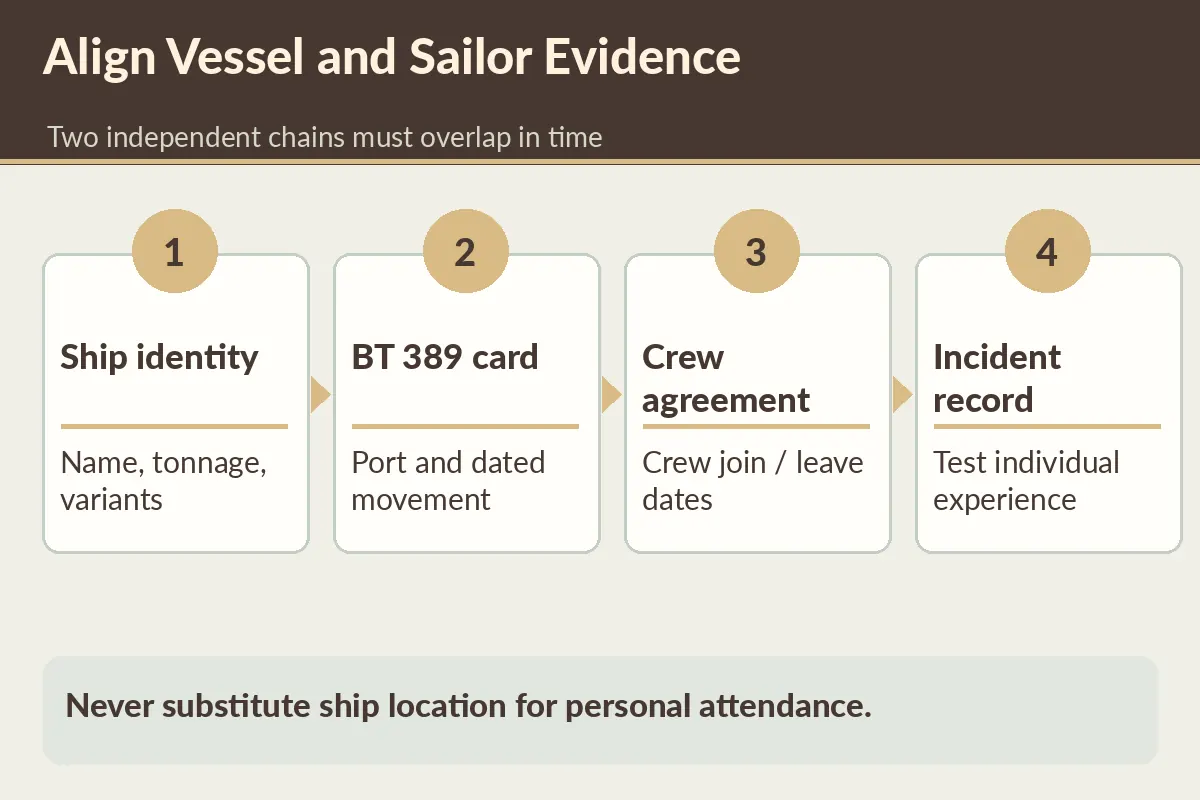
The two sources were created to answer different administrative needs. The movement card tracks ships; the crew agreement tracks employment on a particular vessel. Do not create a synthetic “crew aboard at port X” claim by placing a name from an undated crew list next to a movement-card date. First demonstrate that the person was signed on during that exact interval.
Read Voyages as Dated Observations With Gaps
The card may show a route spanning several ports and dates, but individual files do not all begin or finish at the same time. Record missing intervals in the original sequence. A notation may reflect a proposed onward journey or a clerk’s later amendment, not a documented landing or departure. Examine the card headers, annotations and any continuation pages as a unit.
The National Archives warns that BT 389 omits vessels generally engaged in home trade, requisitioned military ships and small craft. A missing card therefore can be due to record scope, not proof that a vessel never sailed. Check whether the search used a former name or whether its trade category fell outside the collection. Distinguish not indexed, not preserved and actually absent from a complete surviving series.

Connect a Sailor to the Ship With a Separate Agreement
For personnel evidence, consult wartime agreements and crew lists. The National Archives directs wartime searches to BT 380, BT 381, BT 99 and associated indexes such as BT 385, choosing by period and ship number. These may record when a person joined and left, their occupational capacity and sometimes the reason for leaving. Exact access routes vary by item.
Link a named mariner to a movement-card port only when documented signing-on and signing-off dates bracket the relevant movement and the vessel identity is secure. Even then, consider absences, transfers or notes that qualify the employment. A departure date can mark administrative discharge rather than physical embarkation, depending on record wording. Do not infer that a named sailor survived every voyage solely because a ship completed it.
Avoid Treating Cargo and Convoy Notes as Family Evidence
Cargo details can explain the ship’s wartime administrative function, but they say nothing on their own about a relative’s job or exact experience. Convoy histories and incident records can provide independent context when the dates and ship match. Treat these materials as contextual unless they identify a person explicitly. A family story of a submarine attack should be tested in a dated incident report instead of being extrapolated from an unexpected port call.
Draw a three-lane timeline for vessel location, crew employment and independent incident evidence. Keep gaps visible. If the ship’s movements suggest a possible encounter, describe it as a research lead until original reports and personnel records support it. Dated cards can support a ship’s presence near an event but not an individual’s injury, leave, nationality or status.
Make an Auditable Claim About a Merchant Voyage
In the final finding separate two statements: “BT 389 records the vessel at this port on this date” and “a named person’s crew agreement places them aboard.” Cite both sources independently, explaining the dates that support their overlap. If you only possess the movement card, write a ship history rather than a sailor biography.
For a missing card, document the vessel variants searched and whether the TNA exclusion list might apply. Follow up with contemporary ship registers, crew agreements, shipping notices or convoy reports according to the unresolved claim. Avoid routes drawn from guessed points; the incomplete source deserves an incomplete but honest visual timeline.
How We Research This Archive and Its Limits
Our research method starts with the National Archives record guide and a second official archival description. We establish why the document was created, what dates and places it covers, how its finding aids differ from original pages, and whether the item has restrictions or known survival gaps. An index hit only identifies a candidate. A signed statement reports a claim or legal act but may not independently establish the truth of its subject. The next source must be genuinely independent where possible. We record the catalogue piece, leaf or image, original column heading, transcription uncertainty, dates of observation and interpretation, and each same-name alternative. Before sharing a conclusion, we check whether changing jurisdictions, archival custody or missing years invalidate the assumption. The diagrams are original explanatory artwork, not facsimiles.
More Records and Archives Guides
Official Sources, Availability, and Disclosure
The first official guide supports the record series and its search route: BT 389 voyage movements, expected destinations, 1939 secrecy measures, and excluded ship types. The second archival guide adds this limitation: BT 380/381 and BT 99/385 wartime crew agreement and finding-aid routes. Check the current catalogue entry for the specific piece, including view, copy and digitization availability; these vary even within a series. Images shown here are conceptual illustrations rather than source-document scans. Read our affiliate disclosure before using any commercial source links.
No. The official guide states that it contains vessel movements but no crew or passenger details.
A port the shipping office anticipated the vessel would reach; it should not be treated as a confirmed arrival.
Home-trade vessels, small craft and requisitioned military vessels fall outside the usual scope, and dates differ by ship.
Compare a matching crew agreement with the movement period, using the same securely identified ship.
Not on its own. Obtain an incident report and personnel evidence that names or dates the person’s participation.