
World War II Merchant Crew Lists BT 381 is useful when it answers a specific historical research question, not when an index mention is treated as a complete biography. The direct route is to identify the record creator and series, find the original document by its correct reference, then distinguish what is stated from what is merely suggested. This guide explains the series, search strategy, evidence limits and practical independent tests.
Begin With the Ship’s Official Number
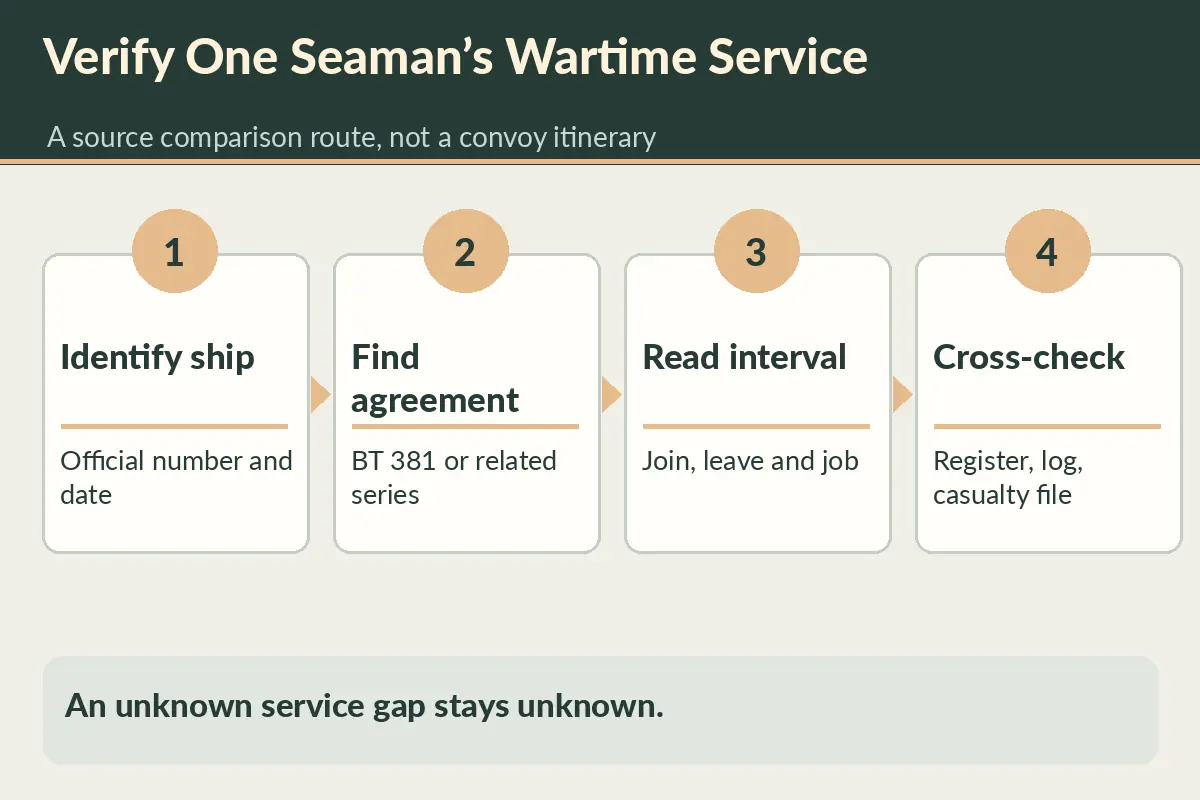
World War II crew agreements can identify seamen who worked aboard British merchant vessels, but a personal name alone is usually not the best route. The National Archives directs researchers to an official vessel number for the surviving wartime material in BT 381 and BT 99, dated 1939–1946. The ship’s name is useful as a lead, but names were reused and can change; number, dates and registry port give a stronger target.
Start with a service card, family letter, casualty report or vessel photograph. Record the source of the ship name, spellings, approximate voyage dates and every conflicting clue. Never claim that every crew member was present during every movement of a ship merely because they appear on one agreement.
Choose BT 381, BT 99, BT 380, or BT 385 Correctly
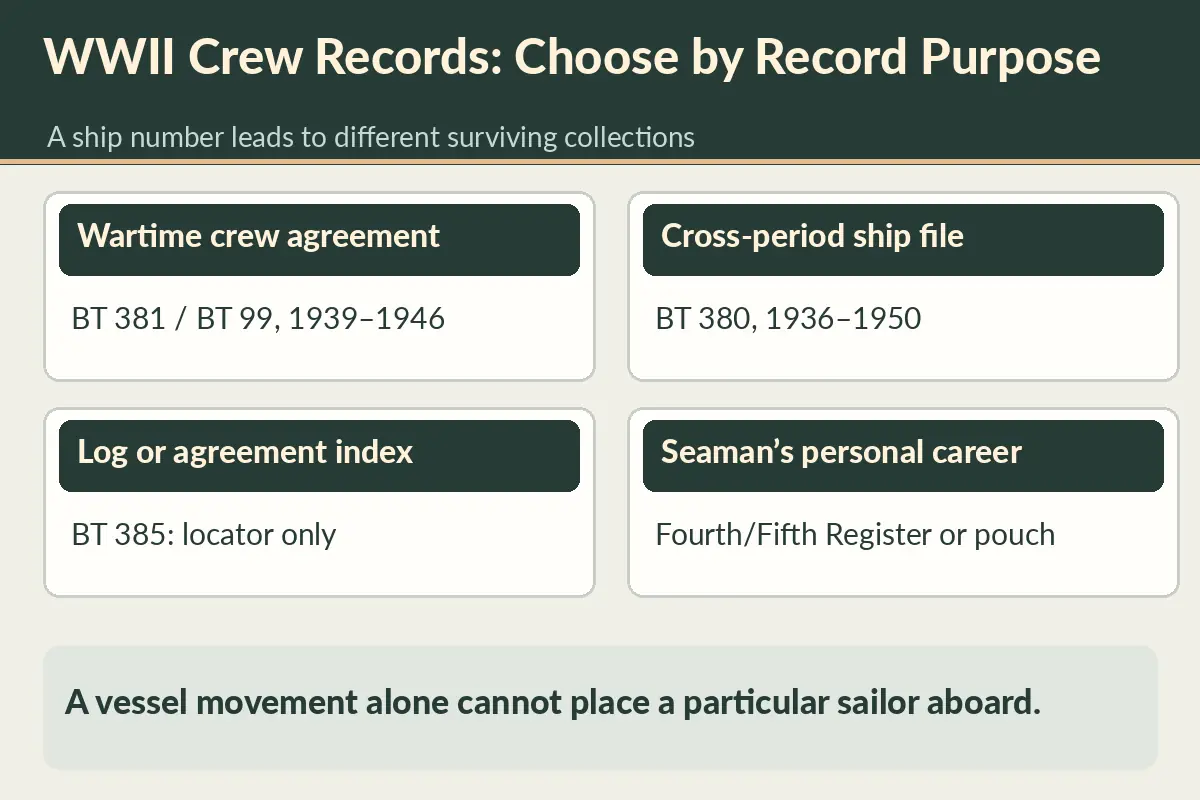
The Archives lists BT 381 and BT 99 for crew records from 1939 to 1946; BT 380 includes material from 1936 to 1950. BT 385 is an index to wartime log books, agreements and crew lists rather than a replacement for the underlying records. A hit in that index is a route toward a piece, not a complete transcription of service or a promise that a log survives.
Write the series and its purpose in separate research rows. Do not present these series as consecutive years or mandatory stages in one person’s career. Which material survives for a given ship and voyage is a source-coverage question. Confirm the particular ship number and archive description before attempting to identify the ancestor.
Read the Agreement as a Dated Employment Record
A crew agreement may report a seaman’s age, birthplace, role aboard, dates and locations of engagement and discharge, and a reason for leaving. Read column headings from the actual form, not a modern database’s simplified label. A discharge entry may refer to a transfer, illness or loss; the context must be verified. Some log books record incidents and conduct, but they are not diaries of every day at sea.
Create a row for each ship and each dated engagement rather than constructing one uninterrupted career. A gap between discharges and fresh engagements remains unknown. When a name resembles another crewman’s, compare discharge number, occupation, birthplace, age and dated port information with an independent seamen register.
Distinguish a Seaman Register From a Vessel File
Individual records for merchant seamen serving since 1918 include the Fourth Register, the Fifth Register beginning in 1941, and seamen’s pouches. Those files answer different questions from a ship’s crew agreement. Some temporary or apprentice workers may lack the usual discharge number and may be hard to trace in person-based registers. A missing individual register entry is not proof that they never sailed.
If you know only a surname, establish a candidate ship or discharge number through a verified family source. If you know only a vessel, work from its official number and the date. Compare both tracks where possible, and record whether each item is an original crew list, card, pouch or catalogue index.

Check Dates Against Actual Crew Membership
A vessel could sail through several ports while its complement changed. A crew agreement signed in one place proves a documented contractual or administrative event, not presence at every later port. If a ship was sunk, an ancestor’s earlier entry does not prove the person remained aboard at the time of loss. Verify the last known engagement, later discharge or transfer, and independent casualty documentation.
For a hypothetical seaman named Daniel Price listed on a ship in 1941, do not put him on a 1943 Atlantic crossing without a continuing service record. Compare the official ship number carefully: ships of the same name are not interchangeable. Mark each asserted voyage as documented, plausible or unknown.
Do Not Confuse Crew Lists With Passenger Manifests
Crew agreements were created to administer seamen, whereas passenger lists were created for other purposes. A name in a crew list may identify an engineer, steward, cook, deckhand or other occupational role. It does not automatically identify a paying passenger, immigrant or family member accompanying a seaman. Similarly, a birthplace field is not an official birth registration.
Use the correct original for the question: passenger travel, employment, a casualty, nationality or residence. For a birthplace claim, look for a contemporary registration or baptismal source. For migration, corroborate destination and later residence rather than treating a ship’s route as the seaman’s permanent relocation.
Handle Missing Documents and Restricted Names Carefully
Survival is uneven despite broad wartime holdings. A catalogue date span is not a guarantee for every voyage. The Archives notes that more recent merchant seamen records may have access restrictions, including some people born fewer than 100 years ago. Respect current access decisions; do not attempt to reconstruct details of living people from fragmentary public records.
Keep a search log listing official number, volume, year, source searched, spellings and result. If no record is found, consider another ship number, a transfer to an allied requisitioned vessel, or errors in a family transcription. Do not add an imagined record to bridge the gap.
Build a Defensible Career Timeline
An evidence table should have ship official number, vessel name, agreement period, recorded crew role, entry/exit dates, source and uncertainty. If the ship changed name, preserve the name used at the time and link the rename only with a vessel registry. Cite BT 381 or the appropriate alternate series at piece and document level.
The final finding might say that the agreement records a named seaman serving as a cook on a particular vessel for a documented interval. It should not say he completed a named convoy, was a casualty or owned the vessel without the separate evidence. An honest gap and a specific follow-up item are useful results, not editorial failures.
How We Research This Archive and Test Namesakes
We checked the custodian’s research guidance alongside the related series description on 28 October 2026. We compare institutional purpose, years, jurisdiction, indexing, record roles and the restrictions described by the archive; a name hit is a locator rather than a verified historical person. The three illustrations are educational reconstructions, not authentic document facsimiles. We keep parallel identities distinct until a dated independent reference connects them. We also distinguish a negative search from proof that no record or event existed.
More Records and Archives Guides
Cite the Original Item and Respect Access Limits
Primary sources clarify this scope: WWII merchant crew lists and agreements in BT 381/BT 99, BT 380 and BT 385 index by official number; Individual seamen register periods, identity-card context and privacy restrictions; ship number fallback. Record the repository, original series, full piece and item number, page, folio or membrane, document date, role and transcription uncertainty. The availability of a digital index does not mean every original can be viewed freely or searched by name. Use the GenHis affiliate disclosure for transparency about commercial links; no unverified partner relationship is assumed.
Start with the ship’s official number, then choose the record and date.
No. BT 381 contains wartime crew materials; BT 385 is an index to ships’ records.
No. Check actual joining, leaving, transfer and relevant sailing dates.
Temporary service and gaps in records can explain absence; investigate the vessel file.
No. Employment aboard a vessel does not establish permanent migration.