
British Officer Commissions WO 4 offers an evidence-based path to a specific historical question. First identify the right administrative series and original record, then separate a reported assertion, a dated decision and an unverified family inference. This article shows where to search, how to interpret the source, and what independent record should test the conclusion.
Begin With the Difference Between Request and Appointment
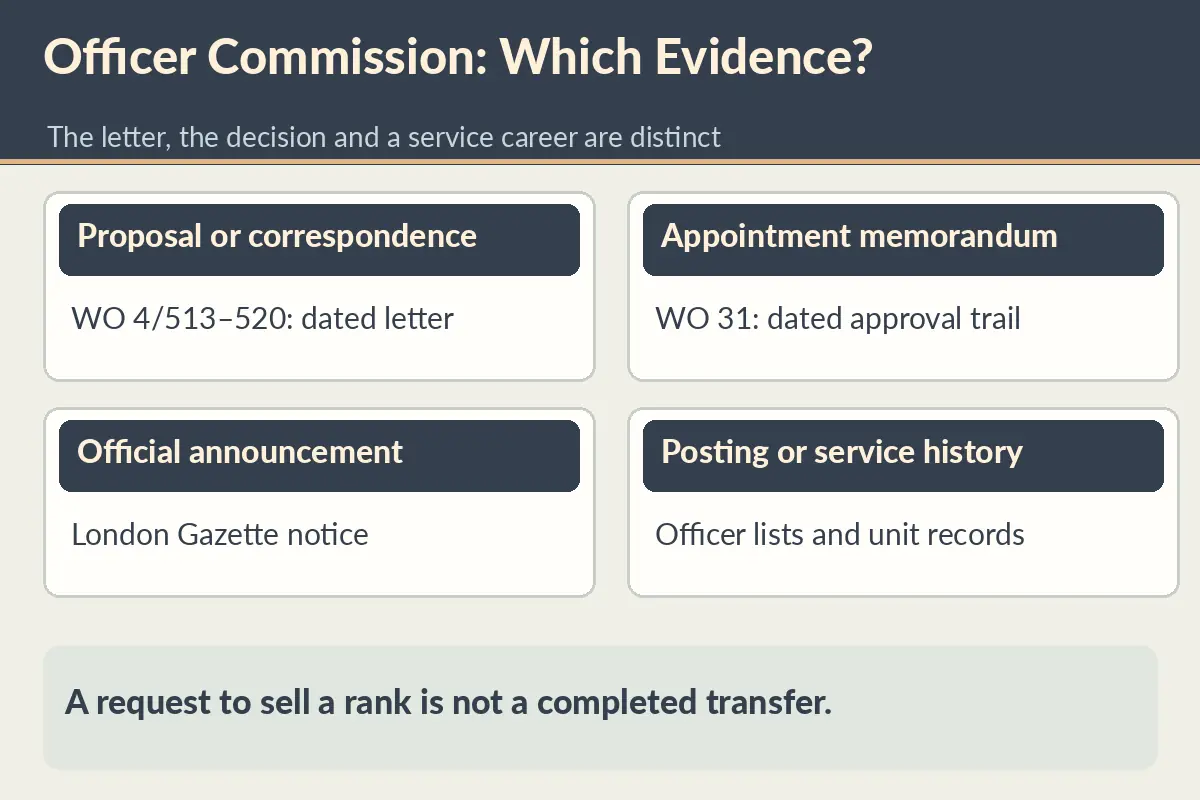
The National Archives identifies WO 4/513–520 as Secretary-at-War correspondence concerning the purchase and sale of British Army officer commissions from 1704 to 1858. Correspondence is evidence of administrative business, not automatically proof that an officer obtained the rank requested. An application, a price discussion and a completed appointment are three distinct claims.
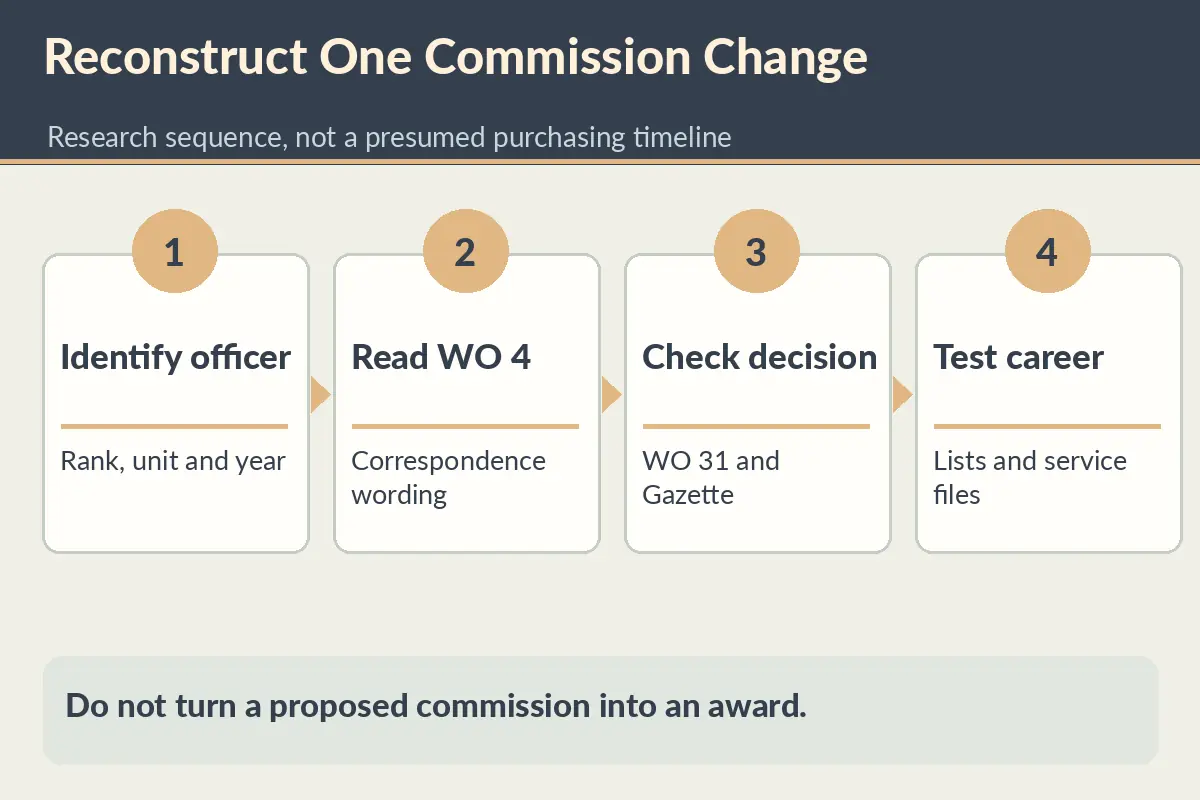
Write down the officer’s full historical name, alleged regiment, rank and approximate date. Avoid using modern regimental names where the unit was later renamed or amalgamated. The target question might be whether an application was made, whether money or commission transfer was considered, or whether promotion was finally gazetted; each answer has a different supporting source.
Use the Year to Locate the Correct WO 4 Volume
WO 4/513–520 should be browsed by year span rather than treated as an all-name digital index. Later volumes may include a regiment’s station or an officer’s private address, but such details are not assured in every entry. Find the correct volume through its catalogue dates before reading the letter or memorandum in full.
Capture the piece number, document date, writer, recipient, enclosure notes and the officer’s exact role. Do not assume a name in the margin identifies the letter’s author. Military correspondence can mention more than one candidate, including family members, patrons, rival applicants or an officer selling the commission.
Follow WO 31 Memoranda for the Decision
For personal applications to buy or sell commissions, The National Archives also directs researchers to Commander-in-Chief’s memoranda in WO 31, organized around the date the appointment or promotion was announced in the London Gazette. This offers a decision-oriented comparator to WO 4 correspondence. A failed proposal may leave one type of paper without the other.
If WO 4 names a proposed promotion, search for its eventual disposition in WO 31 and contemporary Gazette notices. Match the same regiment, rank and officer rather than relying on the surname alone. A formal notice helps date the administrative change but does not establish every subsequent posting or the officer’s personal circumstances.
Interpret Purchased Commissions in Their Period
The Army’s historical purchase system involved officers’ commissions but should not be simplified into ordinary commercial ownership of a military rank. Procedures and opportunities varied across regiment and period. A record of a contemplated sale may name an outgoing holder, prospective successor or intermediary; their presence is not proof of kinship.
Transcribe the transfer language and any date of approval before making a statement. Do not assign a modern cash value or invent the size of a transaction from a similar case. Where only the request survives, state that the administration considered a purchase or sale. The actual promotion must be verified in a distinct appointment source.

Track Regiments Through Name Changes
British Army regiments changed names, merged and sometimes reorganized. The Archives warns that unit organization affects how regimental records are found and interpreted. A regiment mentioned under a former number or title should be matched to its historical organization at that date; a later successor unit may hold related local documents but is not a direct substitute for the original commission papers.
Create a dated unit concordance using an authoritative regimental history and separate source citations. A family story identifying someone as an officer in a later-named regiment may refer to an earlier formation. Verify the commission’s original wording and date before searching locally held service material or unit histories.
Keep Officer Status Separate From Pension or Half Pay
An officer might retire, sell a commission or be placed on half pay. The National Archives notes that pension entitlement developed over time and that half-pay or widow-related series can answer separate questions. WO 4 correspondence about purchase is not itself an officer pension record. A request for relief is not an award.
Where the individual’s later career matters, consult appropriate officers’ service documents, lists, half-pay ledgers or pension records; record each as an independent administrative event. Avoid adding a presumed retirement date just because a proposed commission sale appears in correspondence. Distinguish a final rank from a rank held at the date of the letter.
Resolve Same-Name Officers With Date and Rank
Two officers with the same surname may serve in different units or even the same branch. Rank and regiment on a single date, together with a Gazette date, are stronger identification clues than the surname itself. Similarly, someone appearing as a purchaser need not have an identical name to the eventual appointee.
Create a candidate ledger with date, original regiment, rank, role, and official appointment notice. Record conflicting dates and explain whether they are dates of letter, announcement, effective commission or later publication. If uncertainty remains, keep both officers separate and seek a qualifying detail such as a previous rank or patron named in the correspondence.
Cite the Transaction Without Inventing an Officer’s Life
Cite the exact WO 4 piece and page or folio, correspondence date, author, recipient, regiment and requested action, then give the independent WO 31 or Gazette reference for the reported outcome. An accurate conclusion may confirm that an officer applied to sell a commission in a specified year and that an appointment was later announced.
Do not extend that statement into unverified wealth, kinship, battle service or residence. A private address in a letter is a contact point at a moment, not a lifelong domicile or property title. Record a next search in the officer’s lists or regimental papers for each biographical claim that the correspondence cannot establish.
How We Research Historical Archive References
We checked the principal archival research guide and a second repository or related-source guide on 28 October 2026. We compared the dates and type of record, the intended purpose of each series, available finding aids, and the limits of individual identification. No fictional example is represented as a genuine historical person. The illustrations explain source relationships and are not original archive scans. A negative catalogue search is not proof that an event never occurred.
More Records and Archives Guides
Source Citations and Ethical Research Boundaries
The sources establish: Secretary-at-War correspondence WO 4/513–520 covers purchase and sale of officer commissions 1704–1858; WO 31 memoranda and Gazette provide complementary appointment routes. Related documentation adds: Regimental records are organized by historical unit and date, may be incomplete, and cannot be substituted for an individual officer commission. A complete citation needs the repository, series, piece, original date, page or folio, role of the named individual, and access format. Note when only a secondary description or an index was read. Keep sensitive living-person information private where necessary. Read the GenHis affiliate disclosure; none of the links here implies a paid endorsement.
Secretary-at-War correspondence on the purchase and sale of commissions, 1704–1858.
No. Compare WO 31 memoranda and official Gazette notices for the appointment.
Some later volumes may include a private address or regiment station, but coverage varies.
Use the contemporary Gazette announcement and the relevant officer or regimental sources.
No. Any such assertion needs independent family or land documents.