
WO 42 is an unusually helpful route to an officer’s family because it preserves certificates, wills and personal papers associated with some applications by widows or children. The National Archives dates the series to 1755–1908. It is not a nationwide register of every army marriage or every officer’s family. The central question is who supplied a document and why it entered a pension-related file. Begin with the officer’s name and regiment, identify the claimant, and then distinguish original vital evidence from a statement made to support an allowance.
Recognize Why Family Papers Entered a War Office File
Military families sometimes left paper trails because an officer died in service or on half pay and a widow sought pension support or a child required compassionate assistance. The War Office needed to assess eligibility and collect evidence. A packet can therefore include a marriage certificate, a death certificate, a child’s birth or baptism, a will, a letter, or an administrative summary. The presence of a document tells you about a claim and its supporting material; it does not demonstrate that every family of every serving officer created a similar surviving packet.
Start with a narrow identity profile: officer’s full name and spelling variants, commission dates if known, regiment, approximate death date, marriage place, and the proposed widow’s own name. Do not substitute the husband’s surname for a woman’s maiden surname without evidence. Some families may contain two officers of the same name across generations. The witness named on a copy is not necessarily a relative. Keep a chart separating officer, applicant, child, certifying clerk, executor, and other persons in the packet; those roles can be very different.
Search the WO 42 Papers and Indexes
The official officers guide says WO 42 is searchable on Ancestry and can also be browsed in the catalogue; printed index books are held at Kew. It names separate indexes for French, Swiss, Italian and Greek corps, Loyal American and Canadian corps, and the King’s German Legion. These specialist indexes matter when the officer’s unit cannot be found in an ordinary British regiment list. Note the catalogue piece reference before moving to a commercial index or image view.
A name-search hit may represent a claimant, officer or associated child. Inspect the underlying record pages rather than reading the database title as the document’s entire content. Determine whether an item is an original certificate, an official copy, an extract, an applicant’s narrative, or a pension office note. When a date is difficult to read, transcribe its exact appearance and note the uncertainty. Do not silently modernize place names. If the index points to several officers with the same name, resolve the regiment and death dates before downloading multiple unrelated files.

Separate Certificate Evidence From Pension Assertions
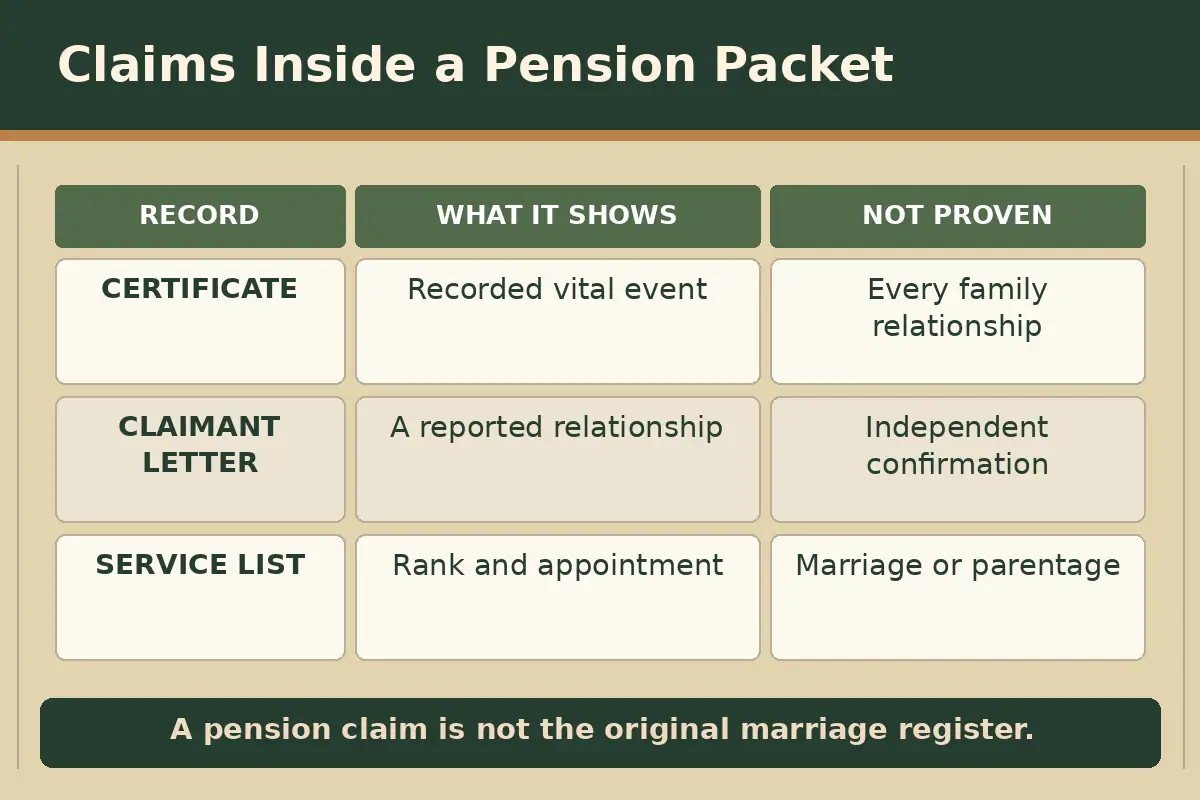
A certified marriage extract, if present, can supply a marriage date and place that a widow’s bare assertion cannot independently establish. Conversely, the packet might contain only a claimant’s statement that a wedding occurred. A child might be named with a baptism record; baptism and birth need not have identical dates. A will may identify beneficiaries but does not automatically prove that all named people were biological relatives. The relevant question is not whether the packet looks official, but which document, created by which person, supports each individual claim.
Create a three-column worksheet headed ‘record in packet,’ ‘literal fact recorded,’ and ‘independent confirmation.’ For a birth, seek a parish register or appropriate civil entry. For a marriage, trace the denomination, locality and original register when possible. For a death, distinguish death date, certificate registration and date the War Office processed the claim. For an officer’s military service, consult a service series rather than treating a pension officer’s summary as complete. Record contradictions, especially age and marital status, without forcing an easy reconciliation.
Connect the Family Packet to Actual Army Service
WO 42 complements, rather than replaces, officers’ service documentation. The National Army Museum directs researchers to WO 25 and WO 76 for officers’ records, which may help test rank, regiment and career chronology. The commissioned officer named in a family packet can be the same man as a similarly named officer in an Army List, but that is an identity hypothesis until dates and unit details align. A widow’s entitlement is an administrative question, while the history of the officer’s regimental service is a separate documentary question.
Use the year of marriage, birth of the children and reported death as boundaries for the comparison. An officer may transfer, retire on half pay or die overseas; the claimant’s address may not be the officer’s final station. Make two timelines—one for family events and one for service or pay—and only connect them at events supported in both. Keep units and ranks as stated in each source. If a spouse’s name appears in a will but not in a pension grant, investigate timing and marital status instead of deciding that one document is necessarily wrong.
Handle Missing Claims and Duplicate Family Names
The absence of a WO 42 hit is not evidence that an officer was unmarried or left no children. The series reflects certain claims and preserved papers, not compulsory family registration. Try variants of the officer’s surname, claimant’s surname and regiment; inspect the index for a foreign corps if applicable. Where a child was recorded after a father’s death, check the actual chronology before drawing conclusions about parentage. Multiple claimants may refer to the same officer, or two similarly named officers may have served in different periods.
Photocopies and indexed descriptions can omit reverse-side annotations, attachments or seals. Preserve a full-page reference for each significant fact, noting whether you used an original image, a copy, or only an index. When the file supplies a person’s age rather than a birth date, preserve that distinction. In contentious family histories, a pension application may be strong evidence of an assertion being made but may still require independent evidence before a relationship is accepted as established.

More Records and Archives Guides
How We Research Officers’ Families in WO 42
We begin with a definite family-history question—such as identifying an officer’s widow—then identify the likely officer and a period in which a pension claim could have arisen. We compare WO 42 with Army Lists, WO 25 or WO 76, the original civil or parish registers, and, where relevant, an estate record. Our citation ledger describes the file’s creator and the particular source status of each extracted claim, because a certified extract and a pension clerk’s paraphrase are not interchangeable evidence.
The armed forces vital records guide also cautions against assuming a single military birth, marriage and death collection exists. We document absent records without converting them into negative proof. Access terms and image availability should be checked with the custodian when searching. If a paid provider is used for convenience, the archival reference should still be retained; see our affiliate disclosure. We claim no financial relationship based simply on a database suggestion.
No. The papers are linked to surviving family and pension-related claims, not a complete register of army weddings.
It proves what the claimant reported. Seek a certified extract or original parish or civil marriage entry to establish the event.
WO 42 has specialist printed indexes for several foreign and loyalist corps and the King’s German Legion.
No. They are officers’ service evidence, while WO 42 focuses on family certificates and other papers associated with claims.
Only that the searched index or holdings did not reveal a matching packet; it says nothing definitive about marriage or children.