
British Overseas Marriages FO 83 is useful only when its record type answers the question you actually have. Start with the historical place and date, determine what the creator was trying to document, then retrieve the original piece or image. An archive index is a locator rather than a substitute for the underlying record. This guide separates documented facts, official or personal reports and claims that still require independent verification.
Begin With the Foreign Ceremony and Jurisdiction
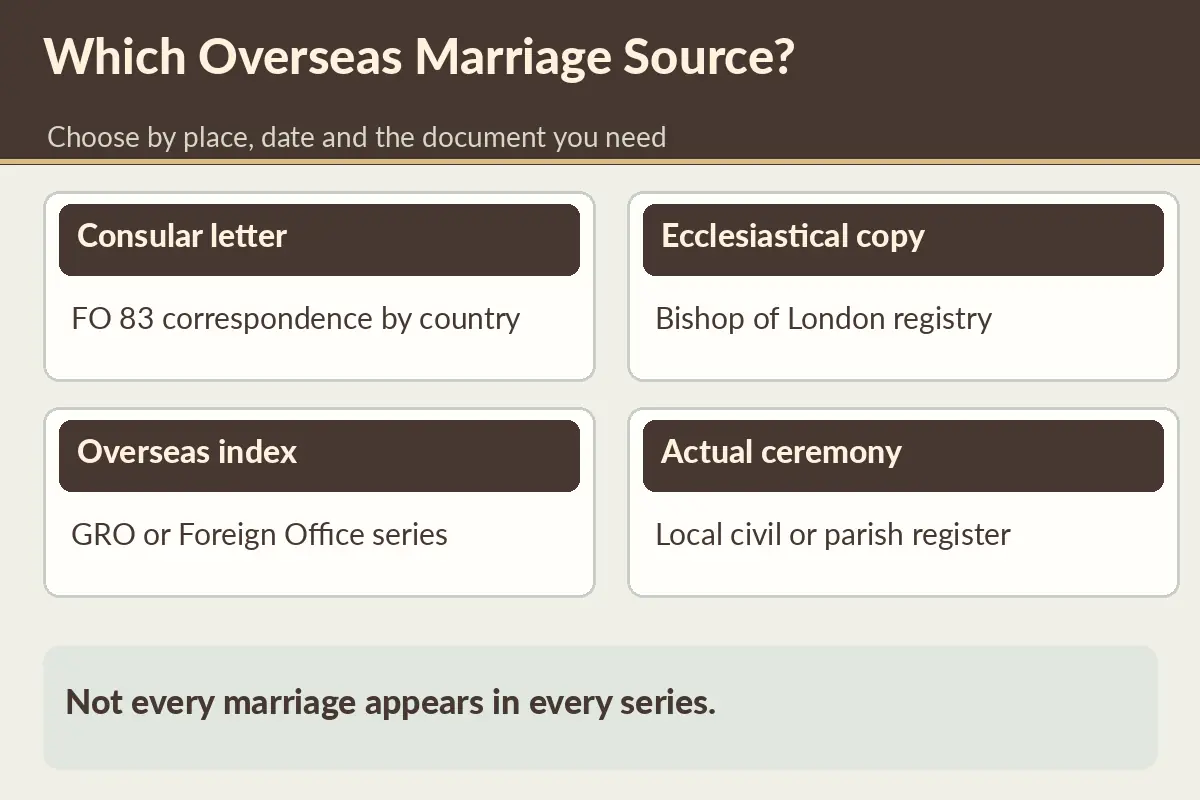
A British subject who married abroad may appear in a consular report, a local civil or religious register, a Foreign Office record and a General Register Office overseas index. These are possible routes, not four automatic copies of every marriage. The National Archives states that FO 83 contains various topics, among them correspondence forwarding details of particular overseas marriages to the Bishop of London’s registry. Start with country, town, the approximate date, the names as recorded locally and which authority could perform or register the ceremony.
An English-language family story may use a modern country name for a port that once belonged to a different state. Record the historic locality and sovereignty before searching the catalogue. A traveler’s temporary address does not imply permanent residence, and a reference to an embassy does not establish that the marriage occurred inside it.
Identify Whether FO 83 Is Relevant to That Country
The Archives guide to births, marriages and deaths overseas gives a table of country-specific record groups and some FO 83 references. That makes a country-and-date search a better starting point than an unrestricted surname search in FO 83. The series includes general Foreign Office matters, so a search hit on a consular district is not automatically a matrimonial file. First inspect the guide table, then follow the relevant document reference in Discovery.
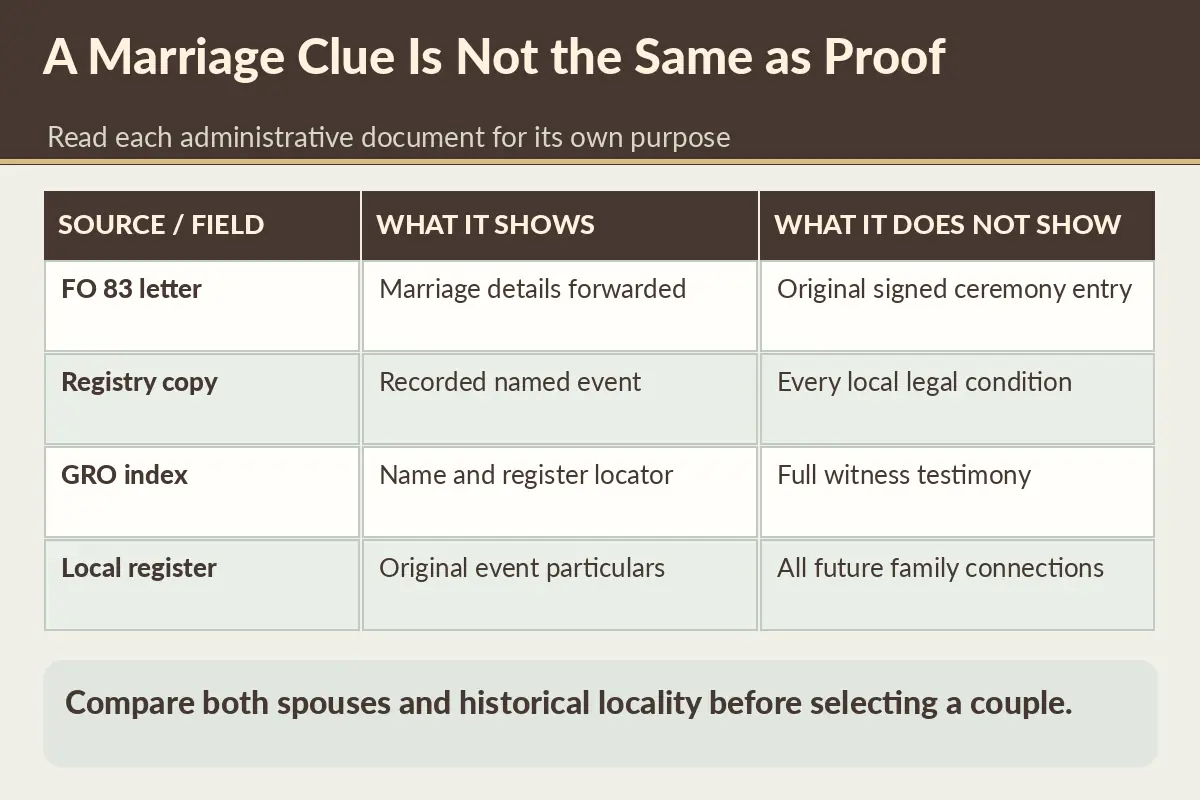
For an FO 83 correspondence item, transcribe the named partners, stated ceremony date, writer, destination and purpose of the letter. A letter forwarding details records an administrative act and may give direct evidence that a named marriage was reported. It does not always reproduce the signatures, witnesses, legal authority or full text of the original marriage entry.
Compare the Bishop of London Registry and Indexes
The Archives explains that corresponding marriage details should also appear in the Bishop of London registers held by the Guildhall Library or The London Archives, and may appear in Foreign Office registers and GRO overseas indexes. Treat these as separate possible holdings. Search a given couple by surname variants and year, then request or view the actual register page if available. An index entry supplies a locator; it is not a reproduction of all underlying evidence.
Track each result with columns CUSTODIAN, COUNTRY, DATE, NAME SPELLING, RECORD TYPE and ACCESS. A letter may cite a date when it was sent, while a register may cite the actual ceremony date and an index may be arranged by registration year. Do not silently make those different dates equal.
Find the Local Marriage Record When Possible
The strongest route to the actual ceremony is often the civil or religious register created under the law of the place where the event occurred. The person may be listed with a translated given name, patronymic, military occupation or local form of the surname. Check the local authority’s historical dates, denomination, record survival and any restrictions for recent marriages. An embassy register is not necessarily the same record as the host country’s civil entry.
When the two sources disagree over spelling or date, retain both transcriptions. Determine whether the discrepancy arises from copying, calendar use, an administrative registration lag or two different couples. Where original registers are unavailable, describe the conclusion as supported by correspondence or an index, with the missing primary step stated plainly.
Test Two Couples With Similar Names
Two British men with common surnames might have worked in the same commercial port in the same decade. Compare both spouses, occupations, ages when available, locality, and later civil registration, census, shipping or probate information. Do not promote a matching surname and foreign destination to an identity conclusion. A register may use the bride’s current residence and not her birthplace; a consul might use British-subject status as reported rather than as a proven legal determination.
Create two candidate rows before selecting either. Add each piece reference and mark which person supplied the information. Record conflicting occupations rather than smoothing them into a plausible life story. If no stable identifying link survives, leave the attribution unresolved and publish the archive route rather than an invented marriage narrative.

Cite Each Step and Respect Modern Privacy
A reproducible result identifies The National Archives FO 83 piece and letter date, any Bishop of London register reference, and the GRO or local register entry with page or certificate locator. State explicitly whether you read the original image, a catalogue description or a paid index transcription. If you rely only on a consular letter, say that it reports a marriage, rather than quoting a non-existent wedding certificate.
For potentially living spouses or recent children, follow repository access conditions and consider whether naming them publicly is necessary. The point of the method is not to collect the maximum number of personal details; it is to identify the record’s actual legal and archival status, compare evidence with original sources, and document what remains uncertain.
How We Research Archival Evidence and Its Limits
We reviewed the principal National Archives research guide and a second official archival guide on 28 October 2026, then checked their statements on series scope, historical dates, finding aids, custody and evidence limitations against this article’s diagrams. This was an editorial check of publicly described holdings, not an inspection of every original piece. Any stylized document in the cover illustration is an illustration, never an authentic manuscript or archive scan. Search results, translations and reported testimony are identified separately. A zero-result search in a catalogue is not proof that an event never occurred.
More Records and Archives Guides
Build Reproducible Citations and Ethical Conclusions
The primary guide establishes that FO 83 may include consular correspondence forwarding foreign marriages for the Bishop of London registry, with spouses and marriage date; related overseas indexes exist.. The second helps verify that Embassy and consular archives may include registers of births, deaths, and marriages and local correspondence, but survival varies.. When reporting a new discovery, identify the creator, series and piece, original date, folio or page, names and their roles, how the document was accessed, and the exact claim it supports. Mark contradictions for review rather than merging names on intuition. Protect potentially living people where records contain sensitive details. GenHis explains relationships and referrals in its affiliate disclosure; these archive citations are not claims of commercial endorsement.
No. FO 83 contains selected correspondence on many matters and coverage varies by time and country.
No. Relevant entries may be letters forwarding details of marriages, not original certificates.
The National Archives directs researchers to the Guildhall Library or The London Archives for relevant registers.
An index is a locator; inspect the actual register or certificate before making detailed claims.
Transcribe each date separately and check whether one describes reporting or registration rather than the ceremony.