
FO 372 holds Foreign Office Treaty Department correspondence, described by The National Archives for 1906–1967. It may help locate the administrative history of negotiations, interpretations, ratification issues, awards and other departmental business. The subject of a file can be a country or agreement rather than a person. A file mentioning an official or petitioner does not, without more, prove nationality, diplomatic status or participation in a final treaty ceremony.
FO 372 Is Correspondence About Treaties, Not Every Treaty Text
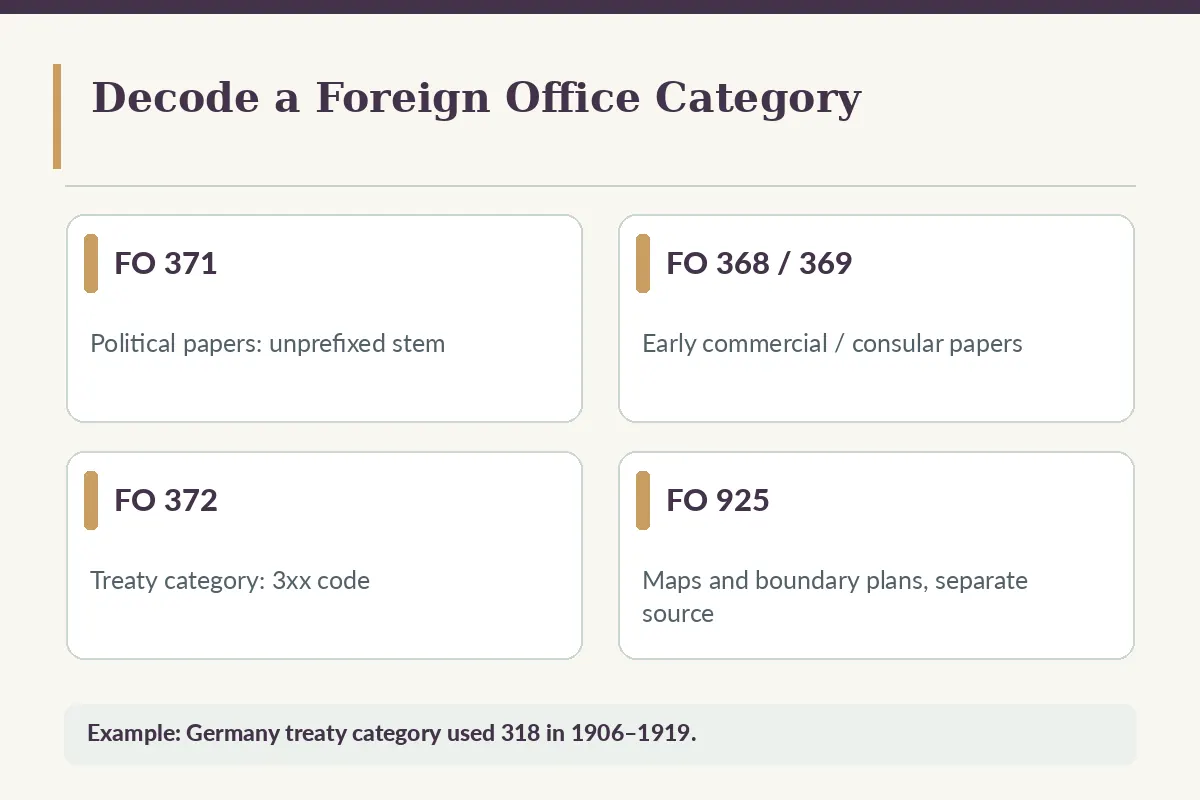
The first routing decision is record function. The Foreign Office used different correspondence series for political, commercial, consular and treaty matters. In broad terms, FO 371 covers political papers, FO 368 commercial matters in the earlier system, FO 369 consular matters and FO 372 treaty matters. A genealogy question about an overseas marriage may belong in a consular or civil register, not a treaty department file merely because it involves two countries.
Decode the 1906–1919 Country Stem and Category
The 1906–1919 correspondence guide provides examples of numerical stem coding. For Germany the stem was 18: 18 for political FO 371, 118 for commercial FO 368, 218 for consular FO 369 and 318 for treaty FO 372. These are category codes, not dates, page numbers or proof of diplomatic action. The official guide notes further wartime coding changes and special groups such as prize correspondence.
Start with the country, topic and year in a Foreign Office index or register. Record the exact code and paper number and use it to locate the FO 372 correspondence. Do not treat an “318” search hit as an FO piece number by itself. The stem numbers are not stable descriptions of a person, and a subject may have cross-references in more than one department. Search both treaty and political categories when the original administrative question crosses those boundaries.
Use the 1920-Onwards 3xx Treaty Category Carefully
The post-1920 guide explains that three-digit country/category codes in the 300s normally indicate treaty correspondence in FO 372. The same table assigns unprefixed two-digit stems to political correspondence and the 200s to consular correspondence. Codes are finding aids; they do not prove a matter was resolved, and not every year has a surviving name or subject index.
For 1954–1958 and from 1960 onward, the official guide states that no registers or indexes are held for those years. That does not mean the departmental files themselves are necessarily absent. Use catalogue file titles, references and date filtering where the guide directs. Keep a dated note of which indexing mechanism was actually available; importing an early code lookup into a later year may produce a false negative.
Find the Paper, Then Establish What It Says
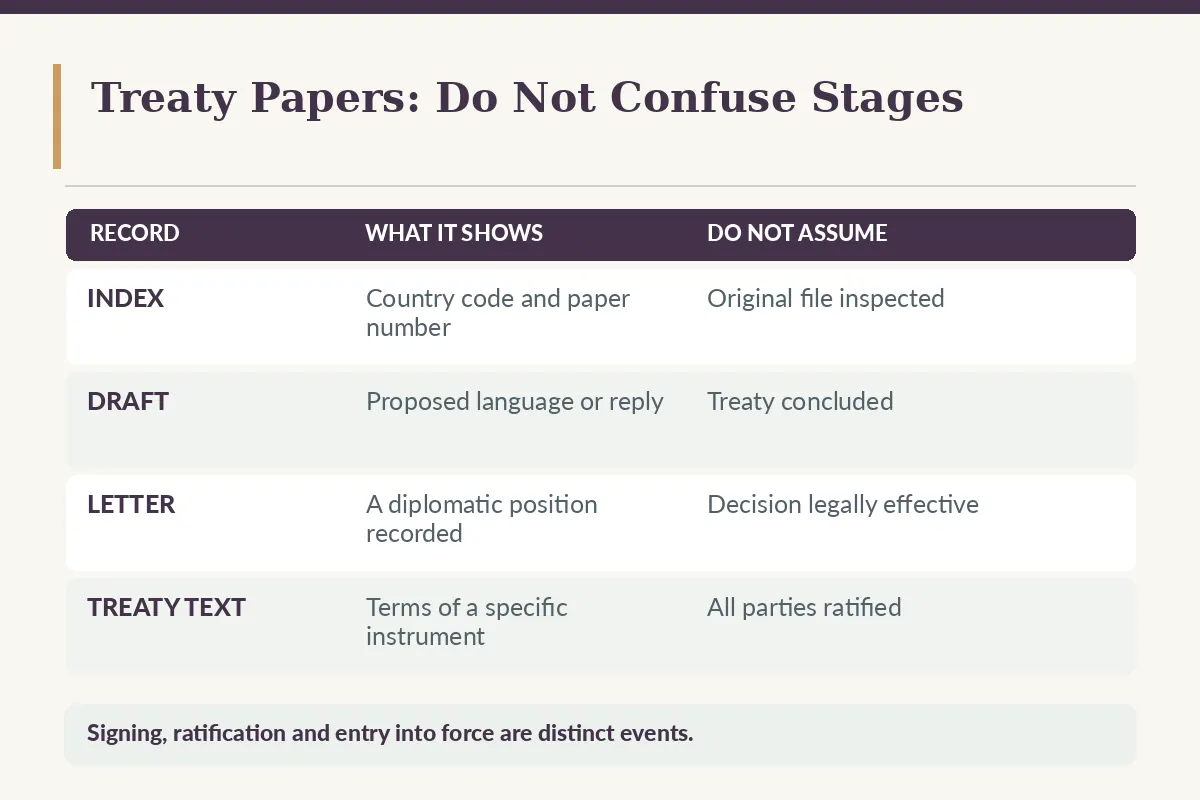
A correspondence index points to a file, sometimes with multiple letters, enclosures and internal minutes. When viewing the file, separate incoming correspondence from draft replies, departmental notes and copies circulated for comment. A draft wording is not the same as an agreed clause. Similarly, a file discussing a treaty is not a certified instrument of ratification. For the treaty text, inspect the appropriate official treaty series or published instrument as a second source.
Mark each date precisely: a letter was written, logged, circulated or answered; a treaty was negotiated, signed, ratified or brought into force. These are distinct events. If a family-history hypothesis rests on an official’s posting abroad, use service, diplomatic or consular records to test the assignment rather than treating a name in a treaty file as a complete employment history.
Use Boundary Maps and Other Series as Alternatives
The National Archives guide to international boundaries identifies FO 925 as an important map and plan collection and FO 372 as treaty department correspondence. An accompanying map may clarify which location or frontier a letter discussed, but it does not independently identify residents or prove a family’s citizenship. A local place name can change after a border settlement; record the historical geography without imposing modern jurisdiction on earlier records.
If the search actually concerns consular registration, route it to FO 369 or the appropriate vital event series. If it concerns political intervention, test FO 371. A person can be named in several papers generated by one dispute, and all may ultimately derive from the same applicant’s statement. Corroboration requires evaluating who knew the underlying fact, not merely counting references.
Record Paper Numbers and Evidence Limits
For each file log the date span, country stem, category, paper number, actual FO 372 piece, sender, recipient and exact assertion. Record whether the item is a catalogue description, index, internal memorandum or original letter. Write an explicit uncertainty note for a proposed action that has no evidence of completion. A narrow citation is more useful than a citation to the whole FO 372 series.
Where personal names recur, compare office, role, signature, dates and independently documented postings. Two officials with the same surname or a clerk who copied a memorandum should not be folded into one biography. The primary discovery task is tracing a government decision or negotiation; personal identity is a second question with its own evidentiary chain.

More Records and Archives Guides
How We Research a Treaty-Department File
We choose a country, year and administrative matter, decode the correct Foreign Office category, locate the index or file-title route appropriate to the period, then inspect the FO 372 correspondence. We separate original communications, drafts and final actions. We do not characterize an unsigned document as an enacted treaty or an indexed person as a verified diplomatic official.
The citation preserves the original paper number and any catalogue references without conflating them. A paid finding aid never changes the document’s legal status. Readers can review our affiliate disclosure; our conclusion states the specific recorded administrative act and the evidence still needed to verify it.
No. It is Treaty Department correspondence and may include drafts, discussions and related papers.
For Germany, the National Archives guide uses 318 as the treaty-category code leading toward FO 372.
In the official coding scheme, 3xx generally signals Treaty Department correspondence in FO 372.
Not necessarily. Later periods may need catalogue file-title or other reference searching.
Not by name alone. Compare independent personnel and diplomatic appointment evidence.