
HO 45 and HO 144 are major National Archives series of registered Home Office correspondence. An entry in an original register can refer to a paper number used by the Home Office rather than the modern HO piece number now shown in Discovery. This distinction is the key to a reliable search. Start with a dated subject or historical event and follow the relevant departmental register to its original paper number before attempting to identify a surviving file.
Home Office Paper Numbers Are Not Modern Catalogue References
The official Home Office correspondence guide explains that date blocks and surviving files have different arrangements. HO 45 and HO 144 are not general indexes of named people. Letters can mention an individual as correspondent, witness, official, prisoner, petitioner or subject of an allegation, each with different implications. A departmental reference does not authenticate every assertion enclosed in a file.
Choose the Date Block Before Searching
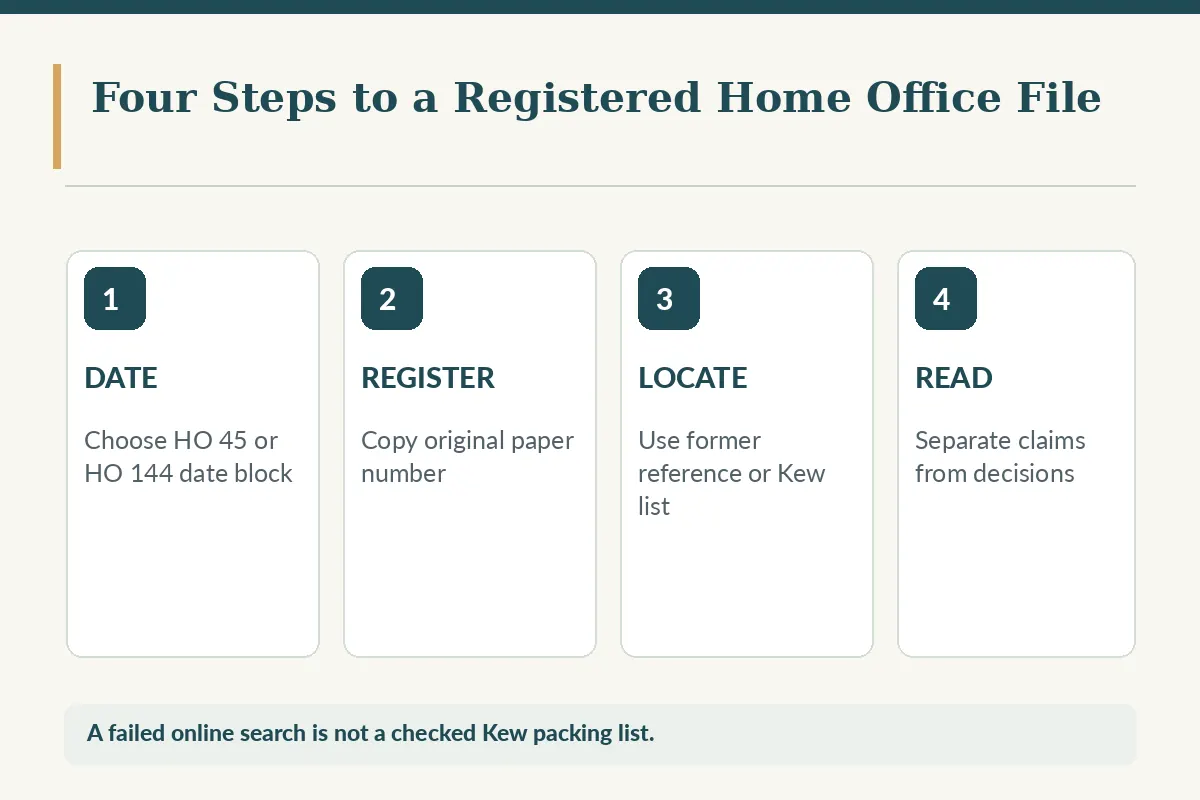
For HO 45, the official routing table distinguishes 1841–1855, 1856–1871, 1871–1878, 1879–1900, 1901–1909, 1910–1919 and 1920–1949. HO 144 overlaps only some later periods in that table. Selecting the correct year block is essential: the system used to connect paper numbers with modern catalogue references changed, and a search shortcut for one period need not work for another.
The guide recommends trying the paper number in the advanced catalogue “former reference” field for selected date blocks. For many 1879–1919 cases it instead directs researchers to packing lists. Do not present those lists as publicly searchable digital registers: the National Archives says the printed lists are kept in the reading rooms at Kew. Plan for the access requirement before drawing a negative conclusion from an unsuccessful online search.

Locate the Register Entry and Original Paper Number
Search the relevant Home Office register or index by date, subject, place, department and appropriate period terminology. Copy the exact heading, name variants, any cross-references and the paper number. A file might be registered under the principal administrative issue rather than the most prominent person in a modern family history. An application, report and later decision may have separate numbers that are related but not interchangeable.
Then consult the date-specific routing table before trying to form an HO 45 or HO 144 piece. If the table indicates the catalogue shortcut, place the original number in the former-reference search box and add the other criteria recommended by the official guide. Record negative results, including date and field used. If the table indicates packing lists, use that route rather than guessing a piece number from a name or a year.
Understand the Packing-List Gate at Kew
The National Archives notes that the packing lists sit with printed versions of HO 45 and HO 144 and can be needed to connect a historic paper number to the archive piece that survives. Some date blocks cannot reliably be searched without them, and the guide recommends consulting the lists even where a direct catalogue result appears. This is a custody and finding-aid problem, not evidence that a person’s correspondence was destroyed.
If working remotely, distinguish a catalogue search from a checked packing list and from a viewed original file. Seek the archive’s current access options instead of claiming that every named HO 45 file can be downloaded. Where the register cites a paper but the later file is absent, record that narrower outcome and look for associated correspondence, parliamentary papers or local administrative records.

Read the File as a Chain of Administrative Stages
An original file may contain a petition, a local report, marginal notes, draft replies, internal recommendations and a final decision. Read each as a separate source statement with its own date and author. A petition’s allegation is not a judicial finding. A Home Office recommendation is not proof that a pardon was granted or that a government action took effect. Use the actual wording and date rather than describing the whole bundle as a single event.
When identifying a named ancestor, keep role, occupation, place and other anchors beside the surname. A minister or clerk who forwarded a letter may not have witnessed what the petitioner described. Administrative copies can reproduce one original story without adding a second independent witness. Where a criminal or institutional file touches a living person’s family, avoid sensational claims and respect access limits.
Cite Both the Original Number and the Modern Piece
A useful source note captures the register or index volume, its date, the historic paper number, the packing-list result where applicable and the final HO 45/HO 144 reference. Then add the actual letter or minute date, folio or page if visible, and the author’s role. This chain lets another researcher retrace the conversion from old filing system to modern archival custody without relying on an unexplained catalogue hit.
If multiple paper numbers refer to one sequence, identify whether the relationship is explicitly recorded. Do not infer that numerically adjacent paper numbers concern the same person. For incomplete searches report the inspected registers, online catalogue fields, Kew finding aids, date blocks and spelling variants. There is a meaningful difference between a confirmed missing document and an unsuccessful search in an incomplete finding aid.
More Records and Archives Guides
How We Research an HO 45 or HO 144 File
We begin with the actual administrative issue and event year, locate the original Home Office register, and apply the official date-block routing before consulting the modern catalogue or Kew packing lists. We preserve both old paper numbers and new piece references, and we separate petitioner statements from recorded decisions. If a finding aid was not accessible, we mark that fact rather than claiming a complete search.
Every citation is tied to the precise original item examined. We avoid fabricated family links or outcomes and distinguish catalogue descriptions from original documents. Our general statement about commercial links is available at our affiliate disclosure. The research result is a traceable correspondence chain, not a manufactured official verdict.
Not automatically. It is an older registry number and must be resolved using the correct finding aid.
The National Archives says printed packing lists are available in its Kew reading rooms.
No. The official guide routes many cases in those date blocks through packing lists.
No. It proves a claim was recorded; evaluate evidence and the actual administrative outcome separately.
The register or old paper number, final HO piece reference, date and a specific letter, minute or folio if available.