
Home Office Disturbances HO 40 is useful only when its record type answers the question you actually have. Start with the historical place and date, determine what the creator was trying to document, then retrieve the original piece or image. An archive index is a locator rather than a substitute for the underlying record. This guide separates documented facts, official or personal reports and claims that still require independent verification.
Define the Disturbance Before Searching for a Name
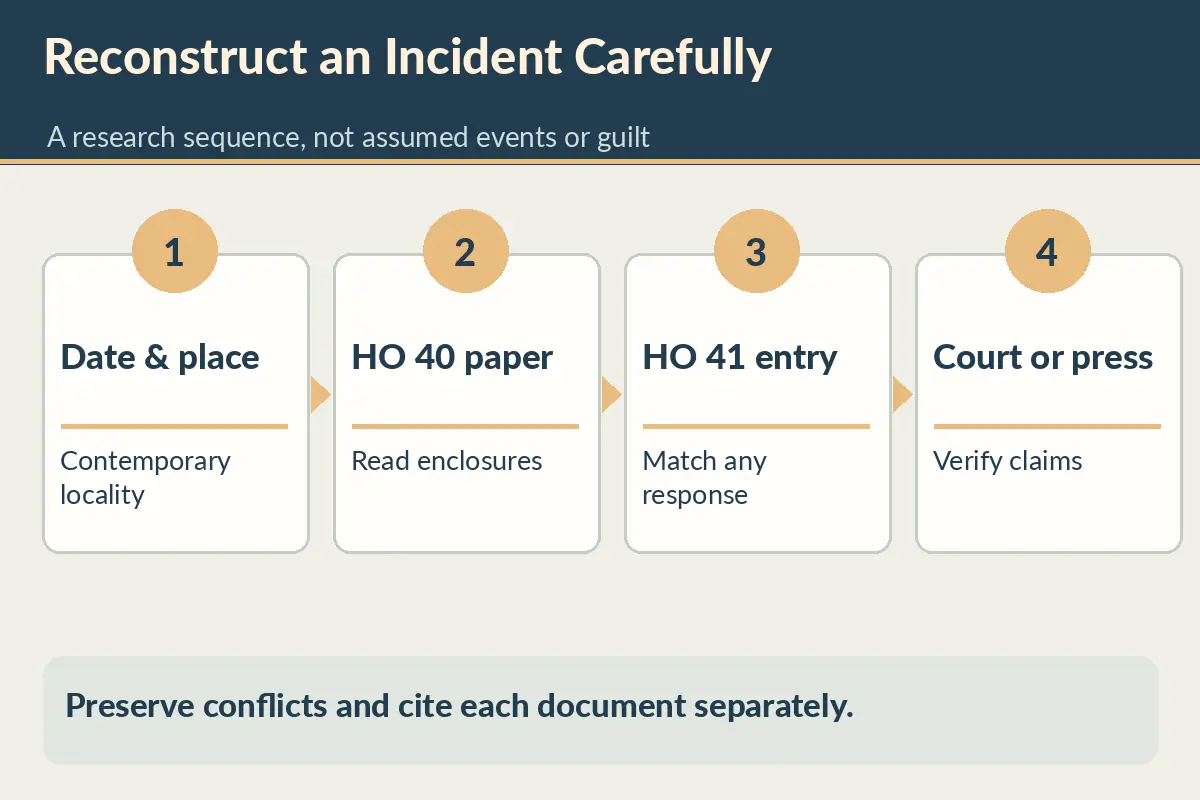
HO 40 preserves Home Office papers about riots, strikes, political meetings and other disturbances, not a systematic list of protesters. An event may be described by the market town, crowd, employer, date of meeting, military response or official who wrote the report. Build an event card before entering a family surname: record the locality as contemporaries wrote it, the narrow date window and an alternate description of what happened. An individual might appear as a magistrate, constable, injured bystander, organizer or alleged participant. Those are distinct roles, not interchangeable proofs of guilt.
The National Archives identifies HO 40 for 1812–1855. Within that period, cataloguing varies. An absence in a name-keyword search can mean the person is mentioned only inside an unindexed image, or the subject was filed under a place or event description. Start with place and year; write down which pieces you actually viewed.
Find an Original HO 40 Piece by Event and Date
Use Discovery with HO 40 as the series filter and try three searches: place-name variants, the broad event type, and dates surrounding the known incident. Record the complete piece reference rather than a web result title. The Archives permits digital-microfilm access for this series; an image sequence can contain several letters, copies and enclosures whose dates are not the catalogue date. Read the beginning and end of an exchange as well as the page containing a name.
Transcribe the correspondent, office, claimed source of information and any quoted or enclosed testimony. A complaint sent to the Home Secretary proves that an allegation was made, not that an investigation proved it. A newspaper cut out and enclosed in official papers remains a newspaper report. Put editorial summary, original letter and an enclosure into different rows in your citation log.

Check HO 41 Without Inventing a Letter Sequence
HO 41 contains disturbance entry books and is browsed by date; the Archives notes that it can reference material in HO 40. It is therefore a useful parallel route for official outgoing responses, not a guaranteed next volume of the incoming papers. A date in HO 41 may lead back to a relevant HO 40 case or reveal that the department responded to a different correspondent. Transcribe the date, addressee and subject exactly.
Make two columns headed INCOMING REPORT and OUTGOING RESPONSE. Do not draw an arrow unless a reference or textual connection joins the two documents. Search neighboring dates because responses may lag. If the entry book mentions a letter that is not preserved in HO 40, describe the evidence as an entry-book reference only and do not reconstruct the missing wording.
Use Other Home Office Series Only When Needed
The early correspondence guide names HO 44, HO 42, HO 52 and HO 40 as overlapping in subject or date. Their catalogue arrangements differ: some are keyword-searchable, while others require county, alphabetic place range or date browsing. If a HO 40 search is empty, identify the date and the administrative reason a different file could hold the correspondence. That is a planned alternative, not proof of lost records.
For a local prosecution or arrest, seek assize, quarter sessions, magistrates records or local newspapers in the appropriate jurisdiction. A trial can postdate a demonstration, and the legal charge may concern a narrower act than the public meeting itself. The Sunderland sailors strike documented by The National Archives shows how Home Office reports and assize records can describe related but not identical evidence.

Separate Witnesses, Accusations and Proven Events
Draw an evidence grid with columns PERSON, RECORD ROLE, WORDS USED, DATE, AND INDEPENDENT TEST. A named informant may describe a crowd without recognizing its members. An official may repeat rumors; the same rumor in two copied papers is still one information chain. An arrest or an indictment does not establish a conviction. Note whether the name was signed, quoted, printed on an enclosure or later supplied by a historian.
To test identity, compare age, occupation, parish and residence with censuses, parish registers, trade records or contemporaneous court files. If two men of the same name appear locally, do not assign both documents to one until a stable detail joins them. Avoid printing unsupported accusations about people as settled family history.
Create a Citation That Can Be Reproduced
Cite The National Archives, HO 40 piece and image or folio, name of correspondent and document date. When you use HO 41, cite its separate piece, entry date and position in the book. Describe how you reached the image: catalogue search, date browse or a printed finding aid. A careful result states that a letter reported an incident and named a person in a given role. It does not say the person was a rioter merely because a name appears near an official inquiry.
If no family member appears, the papers can still establish why an employer closed, why a military unit arrived or how a town responded. Treat that as community context and explicitly distinguish it from evidence of the ancestor’s own actions. The research product should be a dated, reproducible account rather than a dramatic but unsupported story.
How We Research Archival Evidence and Its Limits
We reviewed the principal National Archives research guide and a second official archival guide on 28 October 2026, then checked their statements on series scope, historical dates, finding aids, custody and evidence limitations against this article’s diagrams. This was an editorial check of publicly described holdings, not an inspection of every original piece. Any stylized document in the cover illustration is an illustration, never an authentic manuscript or archive scan. Search results, translations and reported testimony are identified separately. A zero-result search in a catalogue is not proof that an event never occurred.
More Records and Archives Guides
Build Reproducible Citations and Ethical Conclusions
The primary guide establishes that HO 40 disturbances correspondence covers 1812–1855; HO 41 disturbance entry books are date-browsed; early HO 42, HO 44 and HO 52 may overlap.. The second helps verify that Home Office disturbances correspondence includes letters concerning riots, strikes, political meetings and unrest, and is available as digital microfilm.. When reporting a new discovery, identify the creator, series and piece, original date, folio or page, names and their roles, how the document was accessed, and the exact claim it supports. Mark contradictions for review rather than merging names on intuition. Protect potentially living people where records contain sensitive details. GenHis explains relationships and referrals in its affiliate disclosure; these archive citations are not claims of commercial endorsement.
No. It consists of selective official correspondence, reports and enclosures, not a complete attendance list.
HO 40 holds disturbances correspondence; HO 41 consists of date-arranged disturbance entry books recording official out-letters.
No. An allegation or even a report of arrest must be tested against the relevant court record.
Images and catalogue descriptions may be arranged by place, date or subject rather than each individual named inside.
Series and piece, document date, correspondent, image or folio, and the precise assertion that the document supports.