
Henry III Fine Rolls C 60 is useful only when its record type answers the question you actually have. Start with the historical place and date, determine what the creator was trying to document, then retrieve the original piece or image. An archive index is a locator rather than a substitute for the underlying record. This guide separates documented facts, official or personal reports and claims that still require independent verification.
Know What a Fine Roll Actually Records
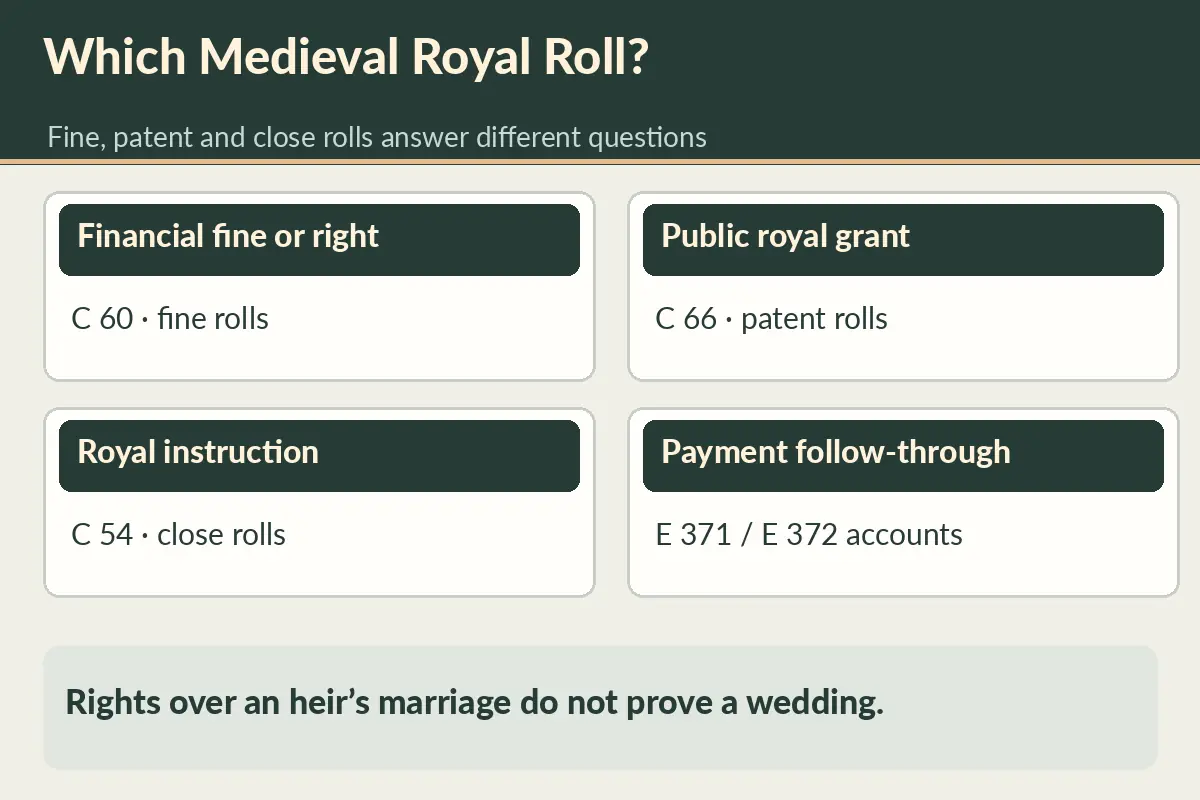
A medieval fine in these rolls was commonly an agreement or payment obligation made to the Crown for a favor or right, not simply a modern fine for a wrongdoing. Henry III’s fine rolls are especially valuable for tracing royal wards, lands, tenants, marriages and people involved in negotiations. They are not parish registers, and a right to arrange an heir’s marriage is not the record of a wedding ceremony. Read each entry for its verbs, financial terms and the named person’s role.
The National Archives points researchers to C 60 and the free Henry III Fine Rolls resource, which includes images and English translations for 1216–1272, covering C 60/8–69. A text search may find a translated personal name, but the manuscript’s Latin spellings and the editorial index are separate layers of evidence.
Match the Translation to the Original Roll
Search the Henry III Fine Rolls resource by a known person, lordship or local place, then record the regnal year and the reference supplied with the result. Inspect the original image for context and retain the complete C 60 piece and membrane when shown. A published English rendering is an essential access tool but still an interpretation of an abbreviated Latin record. If a name seems surprising, preserve the original form and consult the editorial notes.
Kings’ reign dates cross modern calendar years, so do not convert a regnal year to a single guessed January-to-December year without checking the entry date. A summary in a modern catalogue may omit a surety, a sum or a condition that controls what was granted. The entire clause matters when reconstructing obligations.
Identify the Grantor, Beneficiary, Heir and Surety
Write the people in an entry into distinct roles. The king might accept a fine from one individual who seeks custody of a deceased tenant’s land or heir; another person may guarantee payment. A reference to the heir’s marriage could confer a valuable right, permit a proposed marriage or restrain a rival’s claim. None automatically identifies the heir’s eventual spouse. Transcribe each name with its grammatical or legal relation and the property mentioned.
If the roll says a widow may remarry, that statement concerns permission and right, not the date or identity of a subsequent husband. Follow names into other royal records, local charters, inquisitions or ecclesiastical material as appropriate. Document every jump. A later surname shared by two households cannot retroactively prove the heir’s parentage.
Compare Financial Entries With Pipe Rolls
The Archives guide links fine rolls with originalia rolls in E 371 and Exchequer pipe rolls in E 372. A promise recorded in C 60 may generate a debt or accounting entry elsewhere. Search the linked financial records by county, year, name and sum if a later payment question is important. The obligation to pay and the actual discharge of that obligation are different claims and may not have equally complete surviving evidence.
A Latin formula about payment at Easter or Michaelmas describes installments or deadlines; it is not proof that the person paid everything on time. When sums differ, ask whether a balance, remission, fee or separate fine is involved. Do not invent a family relationship simply because one person appears as a pledge for another.

Do Not Confuse Fine, Patent and Close Rolls
The medieval Chancery maintained several distinct roll types: C 60 fine rolls, C 66 patent rolls and C 54 close rolls. Each recorded different royal business, although matters may overlap. A grant or instruction may have related enrollments in more than one series without requiring that every family appear in all three. Decide whether you are trying to prove a financial arrangement, a public grant or the king’s instruction to an official.
An entry concerning wardship establishes royal administration of rights at a given time. It does not automatically prove permanent ownership, continuous occupation or a complete descent chain. To study land tenure, compare the relevant property with later deeds and inquisitions, giving full historic county and manor names.

Produce a Cautious Medieval Family Finding
A useful finding is narrow: a dated fine-roll enrollment names a person as seeking custody, paying a sum, furnishing a surety or receiving a right. Cite C 60 piece and membrane, regnal and converted date with a note on conversion, plus the translation or digital facsimile you actually consulted. Add a person-role table and list any uncertain readings.
If the original names an heir, look for an independent source linking that named heir to the family already documented. Do not turn the word “marriage” into an asserted ceremony or use the name of a royal grantee as a guaranteed ancestor. The value of the record is that it exposes a testable legal relationship at a precise historical moment.
How We Research Archival Evidence and Its Limits
We reviewed the principal National Archives research guide and a second official archival guide on 28 October 2026, then checked their statements on series scope, historical dates, finding aids, custody and evidence limitations against this article’s diagrams. This was an editorial check of publicly described holdings, not an inspection of every original piece. Any stylized document in the cover illustration is an illustration, never an authentic manuscript or archive scan. Search results, translations and reported testimony are identified separately. A zero-result search in a catalogue is not proof that an event never occurred.
More Records and Archives Guides
Build Reproducible Citations and Ethical Conclusions
The primary guide establishes that Fine rolls in C 60 include grants of wardship and marriage and can mention families with dealings at royal government level.. The second helps verify that Henry III fine rolls 1216–1272 are available with images and English translations; their original pieces C 60/8–69 can be connected to the Exchequer records.. When reporting a new discovery, identify the creator, series and piece, original date, folio or page, names and their roles, how the document was accessed, and the exact claim it supports. Mark contradictions for review rather than merging names on intuition. Protect potentially living people where records contain sensitive details. GenHis explains relationships and referrals in its affiliate disclosure; these archive citations are not claims of commercial endorsement.
It commonly concerns a financial agreement or obligation to the Crown, not only a criminal penalty.
The National Archives points to searchable images and English translations for 1216–1272, original C 60/8–69.
No. Rights concerning an heir’s marriage must be distinguished from a later completed ceremony.
Give C 60 piece and membrane when possible, the date or regnal year, and the translation or facsimile used.
Usually not by itself; seek independent evidence of kinship, identity, and any later land transfers.