
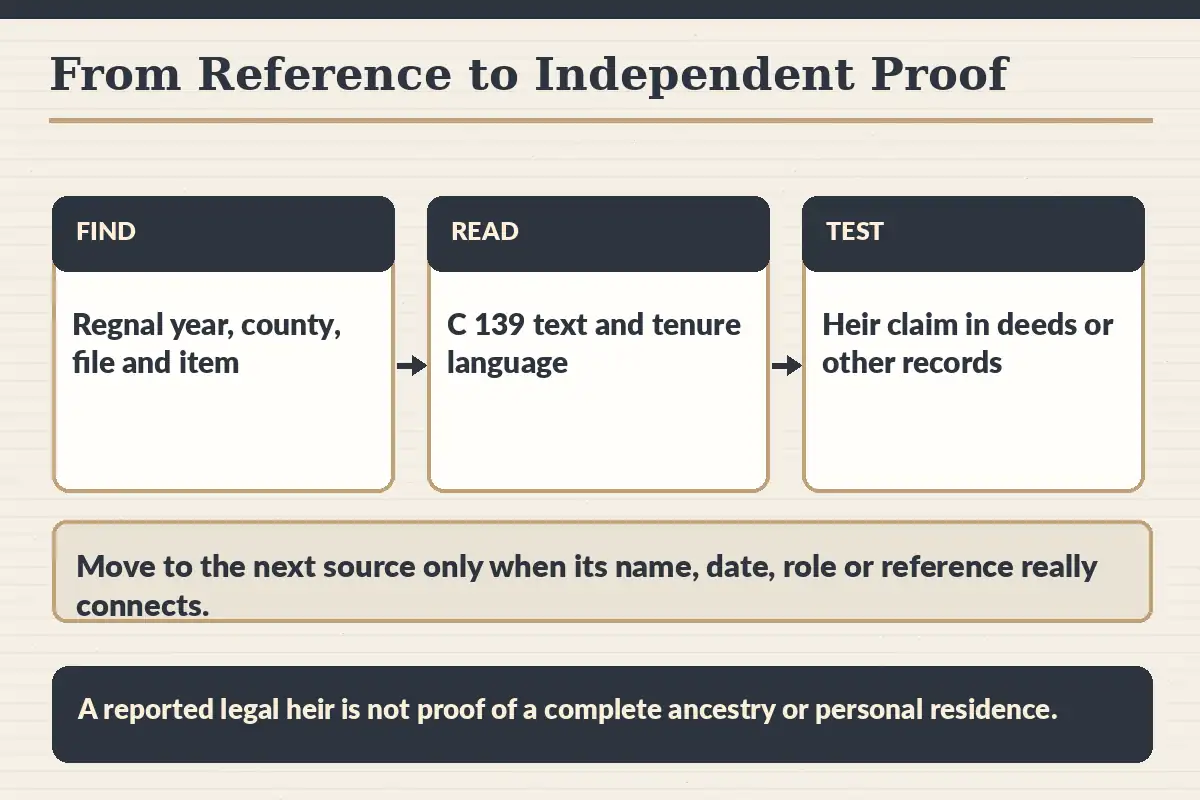
Chancery inquisitions post mortem in C 139 can identify lands and report who was found to be a deceased tenant’s heir during the reign of Henry VI, 1422–1461. They do not automatically prove a modern genealogical pedigree or that a named heir ever occupied every estate mentioned. Begin with the date, county and person investigated, read the inquisition’s specific finding, and test the claimed relationship in independent records.
The National Archives assigns Henry VI Chancery inquisitions to C 139, alongside related Exchequer material in E 149. Its Calendar of Inquisitions Post Mortem coverage extends to 1447, but later fifteenth-century research relies more directly on original documents and lists. An older printed reference and a modern C 139 piece number are not the same thing; preserve both and record an item number within the file.
Choose the reign and county before the family name
Inquisitions post mortem were not modern death certificates. They investigated lands held under tenures of interest to the Crown and reported legal matters such as holdings and succession. A name can be repeated across generations; identify the specific person by regnal year, county and an associated estate. The date when an inquisition was taken need not be the date of death, and a statement about tenure should not be flattened into modern fee-simple ownership.
Keep a county-by-county worksheet because an estate holder could hold lands in several counties. Multiple inquisitions can refer to the same death yet report slightly different holdings or heir information. Conversely, a record bearing a familiar name in another county might concern a namesake. Comparing place, tenure and chronology is essential before you collapse several entries into one biography.

Use the 1447 calendar boundary correctly
The Calendar of Inquisitions Post Mortem provides detailed edited accounts across 1236–1447, with variation in editorial practice. For a Henry VI matter in the covered years, use the printed calendar to obtain the relevant old file and item reference. Treat the published entry as a finding tool and edited summary; the original may contain wording, witnesses or amendments not reproduced in the printed text.
The official guide describes later fifteenth-century material as requiring direct use of originals and paper lists. Do not describe 1448–1461 as a missing record era solely because a familiar calendar volume stops at 1447. Search the C 139 catalogue by name, title and county, and make a note of any separate Exchequer record if it answers the same tenure question.
Convert a printed citation to an orderable reference
Historical publications often cite documents by reign and file rather than a modern TNA series number. The TNA guide explains converting references for Chancery inquisition files and retaining item-level detail. For Henry VI, identify the C 139 piece using the correct reign-to-series mapping; the item number locates a particular inquisition within that piece, even if the reading-room order uses the shorter piece reference.
Write down three fields separately: exact wording of the old printed citation, modern C 139 piece number and item number. If a digitized description or book uses another shorthand, retain it as a variant, not a replacement for the original. This eliminates a common false match in which a genealogist copies an item number as if it were a separate piece.

Read heir statements as legal findings with limits
A medieval inquiry may give an heir’s age and a family relationship, but the report was made for a specific legal and fiscal purpose. “Son and heir” in one file is useful evidence about the inquiry’s conclusion, yet it does not identify every child, confirm an unmentioned spouse or prove that later people of the same name descend from that heir. Ages may be rounded or reported rather than documented by birth records.
Quote the heir language precisely and record whether the inquisition reports the deceased holder, an infant successor or a joint interest. Distinguish land held of the king from other holdings where the text permits. A list of holdings is not a directory of the individual’s residences: manors could be managed by tenants, stewards or other family members. Interpret the legal relationship rather than inventing a household.
Compare C 139 with E 149, deeds and tenure records
The National Archives lists the Exchequer inquisition series E 149 as a parallel route for the period. Copies, summaries and related extracts can differ in completeness. A repeated name in the parallel source is not always independent testimony; ask whether it derives from the same inquiry. Deeds or court records created for a separate transaction may better test a claim about a transfer or a later holder.
Make an evidence table for every specific claim: reported heir, age, estate location, tenure and later possession. Beside each claim, name the document and whether its statement is firsthand or an administrative finding. If a claim conflicts with a dated deed, preserve the contradiction until the evidence can be reconciled. A single surname or manor name is not enough to establish a lineage.
Cite the original inquiry and leave missing branches open
A final citation should allow the next researcher to locate the same piece and item, including the original date, county and repository. When relying only on a printed calendar, say that you consulted an edited summary rather than the original. A search that stops with a calendar result does not justify attributing fine-grained wording or seals to an unexamined inquisition.
A responsible conclusion might report that a named person was found to be an heir at a stated date while the proposed connection to a later same-named individual remains unproved. Keep a short list of the deeds, parish histories or other medieval records that could test the next link. Distinguishing legal succession from kinship reconstruction makes C 139 valuable without overstating it.
Build a claim-by-claim source ledger
A useful research ledger records the full repository and piece reference, original document creator, item date, reported event date, precise place, name and documentary role of every relevant person, actual quotation, scope of the source, access method and search terms tried. Include a column for the claim not proved. For Henry VI, use calendar coverage through 1447 when available, then an original-focused search for later years; C 139 and E 149 are related archival alternatives. If a piece does not cover the relevant interval, a failed search is only a failed search of that portion of the archive, not evidence that the event did not occur.
Once you have a likely entry, connect it to a separately created record that actually speaks to your question. A reported legal heir is not proof of a complete ancestry or personal residence. If two sources repeat the same statement, note that they may not be independent. Do not substitute a catalogue result for an inspected original, and never turn a missing name into an invented identity. Record disagreements and competing hypotheses with a concrete next document that might resolve them.
More Records and Archives Guides
How We Research and Verify the Sources
We consulted the official archival research guidance on 2026-11-03. The National Archives lists C 139 for Henry VI, E 149 as a related series, the printed calendars up to 1447 and reference conversion or post-1447 original-search limits. This establishes the documented route and limitations, not proof that a particular ancestor appears in the collection.
We consulted the official archival research guidance on 2026-11-03. The official citation guide uses C 139 as an example of a series whose exact title and piece references must be preserved in scholarly citations. This establishes the documented route and limitations, not proof that a particular ancestor appears in the collection.
Our original illustrations are explanatory artworks, not reproductions of an archival item. We do not imply any paid affiliation or access arrangement. See the affiliate disclosure.
C 139 is the Chancery inquisition post mortem series assigned to Henry VI, whose reign ran from 1422 to 1461.
No. The detailed calendar series cited by the Archives runs through 1447; later material calls for original-focused searches.
No. It is an edited summary and must be cited and evaluated as such.
No. It supports the specific legal finding reported, while additional kinship links require separate evidence.
No. Tenure and possession are distinct from where a person physically lived.