
1801 Parish Acreage Returns HO 67 is useful only when its record type answers the question you actually have. Start with the historical place and date, determine what the creator was trying to document, then retrieve the original piece or image. An archive index is a locator rather than a substitute for the underlying record. This guide separates documented facts, official or personal reports and claims that still require independent verification.
Understand Why the 1801 Returns Were Made
In 1801 the British government faced wartime pressure from high grain prices and fears over food supplies. The Home Secretary asked for information on arable acreage in England and Wales. The National Archives identifies HO 67 as containing the resulting parish returns. These are local agricultural statistics, not a roll of everyone who owned or farmed land. Read them as evidence of what an administrative area reported about its crops at a particular moment.
Before searching an ancestor, find the historic parish and county. An early nineteenth-century township may have belonged to a larger parish, and later county names may not match the collection’s organization. Establish the parish from a contemporary map or gazetteer and keep neighboring places separate until you understand their administrative boundaries.
Search HO 67 by Parish and Administrative Area
Use the Archives agricultural-statistics guide and Discovery to identify the HO 67 return for the parish and date. The guide notes that a published transcript of the 1801 returns and references to earlier 1790s surveys can be found in List and Index Society volumes 189, 190 and 195. Record whether you consulted the original image, an edition or an archive description. Each has a different likelihood of preserving marginal notes or manuscript qualifications.
A search for a family name in a summary is usually the wrong method, even when the ancestors were farmers. Search by parish, then document crop headings and units in the original form. If a category is unclear, do not silently convert it to a modern farming definition; look for contemporary explanations and note the uncertainty.

Read Crop Acreage as Aggregate Data
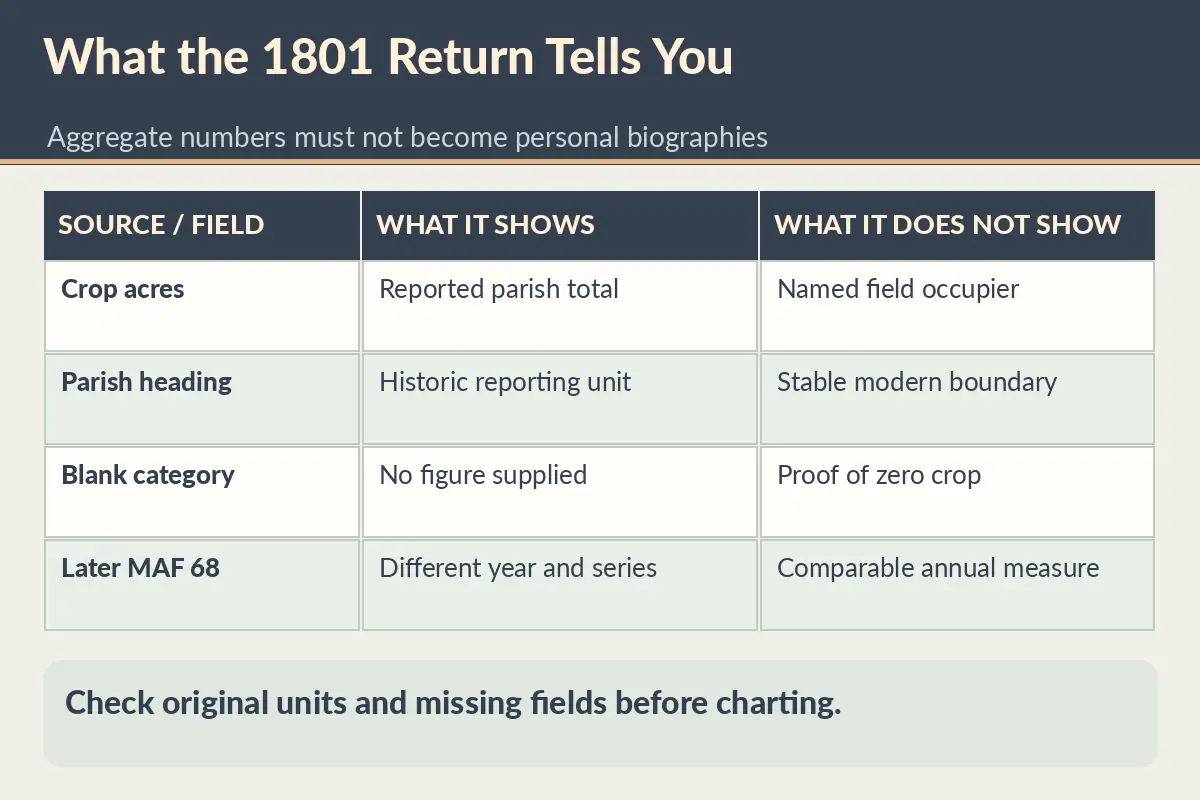
The Archives explicitly distinguishes parish summaries from names of owners or details of individual holdings. A return might quantify wheat, barley, oats or land use for a place. The totals do not identify which person cultivated an acre, rented a field or possessed legal title. No ratio of parish acreage to surviving households can produce an actual list of farm owners. Treat reported crop totals as an environmental and economic context, not personal lineage evidence.
When comparing two returns, check whether they cover the same boundary and use comparable units or definitions. The archive guide warns that early responses were unstructured and detail inconsistent; later templates did not guarantee accuracy. An empty category may represent omitted information, not zero production. Preserve the original number and label with each calculation.
Compare 1790s, 1801 and Later MAF Material Carefully
The Archives lists returns in HO 42 for the mid-1790s and 1800, HO 67 for 1801 and later MAF 68 parish summaries from 1866–1988. These are different official record systems and cannot be treated as a yearly uninterrupted series. For a comparison, record each year, unit, parish boundary, responsible authority and data availability. An apparent rise in acreage can reflect changing boundaries or reporting as well as actual land-use change.
A century-long chart may be visually attractive but will mislead unless its measures are genuinely comparable. Show gaps and explain why some crop categories were created or changed. Never insert a missing value solely to make a graph smooth. Report a numerical finding as the return’s statement rather than the exact physical reality of every field.
Find Names in Land Records Rather Than Statistics
A family-history question about whether a named person occupied or owned a farm requires a different source. Tithe apportionments, rent rolls, leases, deeds, land-tax assessments, manorial records or maps may describe an individual holding, depending on locality and year. Ownership, occupation and tax liability are different relationships; choose the record for the claim you want to test. Do not assign parish-wide wheat totals to a particular household from a shared surname.
Create two ledgers: one for parish environment, one for person-level land evidence. Link them only after you have independently located the farm in the right historic parish. If a parcel cannot be identified, it is still legitimate to describe the regional agricultural economy without implying that the family cultivated a specific plot.

Write an Accurate Parish-Level Conclusion
A sound conclusion might say the 1801 return reports a specified area under crops in a named parish, as transcribed from a cited HO 67 piece. It should not announce that an ancestor owned the land or harvested that quantity. Include the source format, piece and page when possible, historical units and any doubts about damaged figures or inconsistent reporting. If an edition normalizes the data, cite it as an edition as well as the archive original if inspected.
Use the material to develop a targeted hypothesis: agricultural change may explain why land, tenancy or wages are worth investigating. Then seek records that name the people. A useful genealogy article separates the context established by aggregate returns from the identities established by household or property records.
How We Research Archival Evidence and Its Limits
We reviewed the principal National Archives research guide and a second official archival guide on 28 October 2026, then checked their statements on series scope, historical dates, finding aids, custody and evidence limitations against this article’s diagrams. This was an editorial check of publicly described holdings, not an inspection of every original piece. Any stylized document in the cover illustration is an illustration, never an authentic manuscript or archive scan. Search results, translations and reported testimony are identified separately. A zero-result search in a catalogue is not proof that an event never occurred.
More House and Local History Guides
Build Reproducible Citations and Ethical Conclusions
The primary guide establishes that HO 67 holds 1801 parish acreage returns; individual holdings or owner names are not documented by parish summary statistics, and early return quality varies.. The second helps verify that The Home Secretary requested an 1801 arable-land survey during wartime anxiety over grain prices and food supply, preserved in HO 67.. When reporting a new discovery, identify the creator, series and piece, original date, folio or page, names and their roles, how the document was accessed, and the exact claim it supports. Mark contradictions for review rather than merging names on intuition. Protect potentially living people where records contain sensitive details. GenHis explains relationships and referrals in its affiliate disclosure; these archive citations are not claims of commercial endorsement.
No. The 1801 parish acreage returns are agricultural summaries, not owner or tenant name lists.
Wartime concern over high grain prices and national food supplies prompted a Home Office survey.
The National Archives guide points to MAF 68 for parish summaries from 1866 onward.
No. Early returns were inconsistent and relied on reporting that could be incomplete or unreliable.
Use tithe, deed, lease, tax, rent or manorial records suitable for the place and date.