
The National Archives inventory for Record Group 67 identifies twelve panoramic images in series FAP from 1917–1919. They depict installations of the West Virginia Coal and Coke Company at Coalton and Bower, the Hitchman Coal and Coke Company at Wheeling, and one unidentified coal-and-coke community. These are exceptionally useful for studying industrial geography. They are not a roster of the men and women who worked at those sites, nor a directory of households in nearby buildings.
Begin with the archive’s naming distinction: three named locations and an explicitly unidentified scene. A long panoramic photograph may show a coke battery, railroad sidings, tipples, buildings or surrounding hills, but the visual detail alone does not identify an employee. If your family story connects someone with a company, treat that as a separate proposition requiring contemporaneous documentary evidence. Photograph the evidence chain in your notes instead of adding a name to a panoramic view on the basis of resemblance.
Start With the FAP Series and Its Twelve Views

NARA lists FAP under the U.S. Fuel Administration still pictures, not in a general West Virginia census collection. The RG 67 inventory also lists forty-three photographs of administration facilities and personnel in series A. These two groups have different purposes, and an FAP panorama should not be cited as if it belonged to the personnel group. Search and request an individual FAP frame with the exact archival identifier, repository information, caption wording and available reproduction data.
The twelve-image count is the guide’s series description, not a promise of twelve digitized online files. If a catalog result displays only a series record, inspect its hierarchy and ask whether a specific panoramic print has a separate item record. Preserve every original title and any uncertain spelling as evidence. A modern search page can reformat a caption, and a web thumbnail can crop a long view so that useful structures or rail alignments disappear.
Choose Coalton, Bower, Wheeling, or an Unknown Community
The primary decision is geographic. If the caption names Coalton or Bower, treat the scene as associated with the West Virginia Coal and Coke Company, subject to the original item label. If it names Wheeling, NARA associates the pictured installation with the Hitchman Coal and Coke Company. The unidentified scene remains unidentified until evidence is found. Do not force it into one of the named towns simply because the plant shapes look similar.
Place names can change, and industrial settlements may not match modern town limits. Search contemporary road maps, railroad alignments, topographic sheets, company reports and county records for independently identifiable landmarks. Distinguish a caption that merely says “near Wheeling” from a legally described site. Record which landmarks you actually match—such as a bend in a river or a rail connection—and keep an alternative hypothesis when the scene could depict more than one place.
Read a Panorama Without Inventing a Workforce
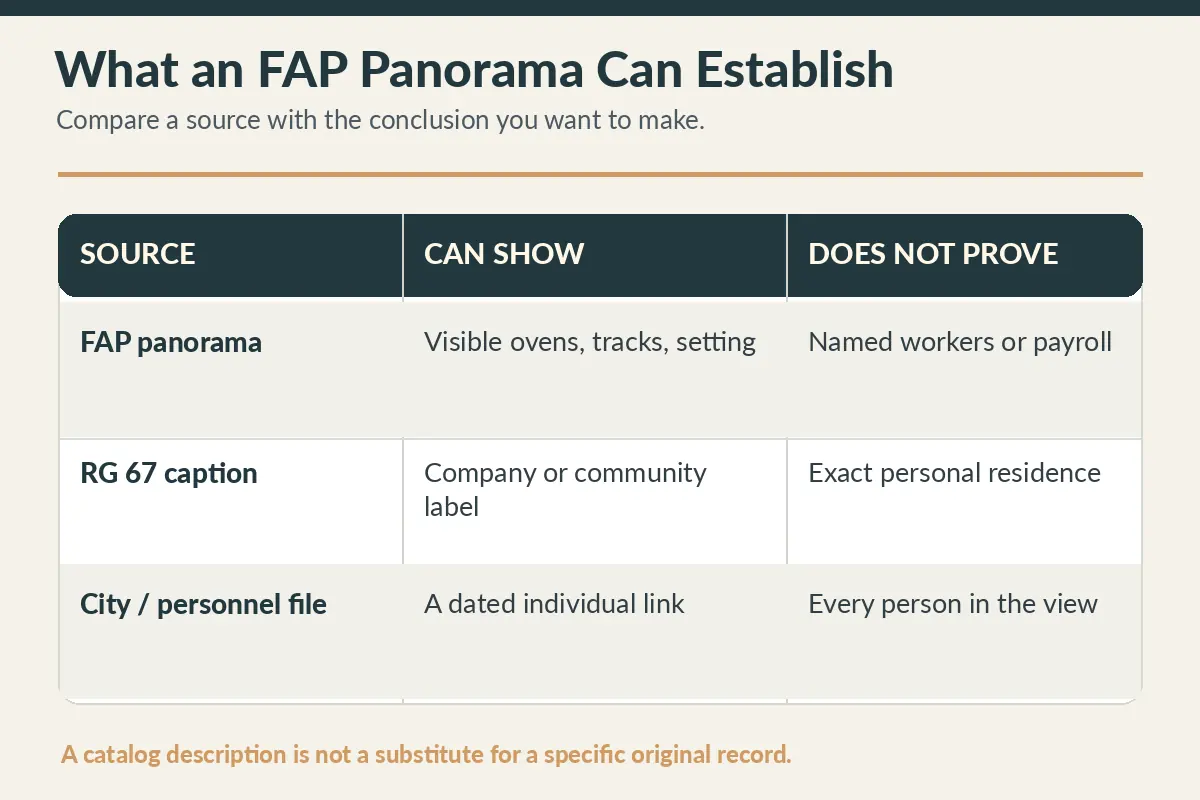
A panoramic print may show rows of ovens, conveyors, waste piles, housing-like structures or groups of people. It does not establish whether the factory was operating at the moment shown, the number of workers on the payroll or whether a pictured individual lived in an adjacent building. The panoramic technique itself can also complicate the apparent geometry of buildings and distance. Use the full image and inspect the original margins before assigning measurements.
Build a three-column ledger: visible feature, caption or corroborating source, and unresolved claim. “Coke ovens visible” belongs in the first column; “FAP caption associates the location with Coalton” belongs in the second; “my grandfather worked this furnace” remains unresolved without a pay or personnel record. This discipline protects the value of a family history even when an evocative scene invites a stronger story than the evidence supports.
Connect a Company Name to Labor and Residence Sources
If you have a relative’s name, start with evidence that is actually about that person: federal or state census entries, local directories, marriage or death certificates listing an occupation, tax lists, employment papers if preserved, union material, or a contemporaneous letter. Check the date of each source against the 1917–1919 FAP date range. A 1930 miner in the same county is not automatically an employee of the same plant in 1918.
Then test the company link. A residence within walking distance of a mine or coke works is only a possibility, not an employer attribution. Workers might commute, be hired through contractors, or change jobs seasonally. Conversely a manager’s address might be far from the plant. Preserve original employer wording where a record gives it, including corporate abbreviations, and investigate successor names before assuming two similar company titles refer to the same business.
Compare Administrative Records Without Treating Them as Pay Lists
RG 67 contains much more than pictures. The U.S. Fuel Administration maintained records on production, conservation, prices, distribution and transportation during wartime. A report about coal allocations can illuminate why a plant was economically significant, but it does not necessarily identify miners, laborers or tenants. Read the scope of a file before asking it to answer a personnel question that it was not created to answer.
Production or distribution totals should be quoted with their units, dates and geographic coverage. If a report concerns bituminous coal nationally, it cannot be automatically transferred to a particular coke battery in Wheeling. When two administrative documents appear inconsistent, check reporting periods and the agency office responsible. A photograph can establish context alongside a policy file, but neither substitutes for a named individual’s employment record.
Create a Defensible Industrial Site Timeline
Organize the final account by independently dated observations: the FAP print’s archival date, a contemporary map, a company notice and any person-level record. Keep separate lines for plant construction, plant operation and the family’s residence. The year attached to a photographic series is not necessarily a precise exposure day, much less a construction or demolition date. If the image lacks a day and month, say so in the caption.
A comparative view can become persuasive when landmarks and documentation align, but avoid drawing property boundaries from the factory silhouette. Modern aerial imagery may show altered roads, removed tracks, reclaimed tips or infilled riverbanks. Cite the historic and modern sources separately; explain the matching features and identify what remains speculative. For preservation or a community exhibit, display “site not independently identified” rather than assigning a false town to the fourth FAP subject.
Worked Example: A Family Story Near a Coke Battery
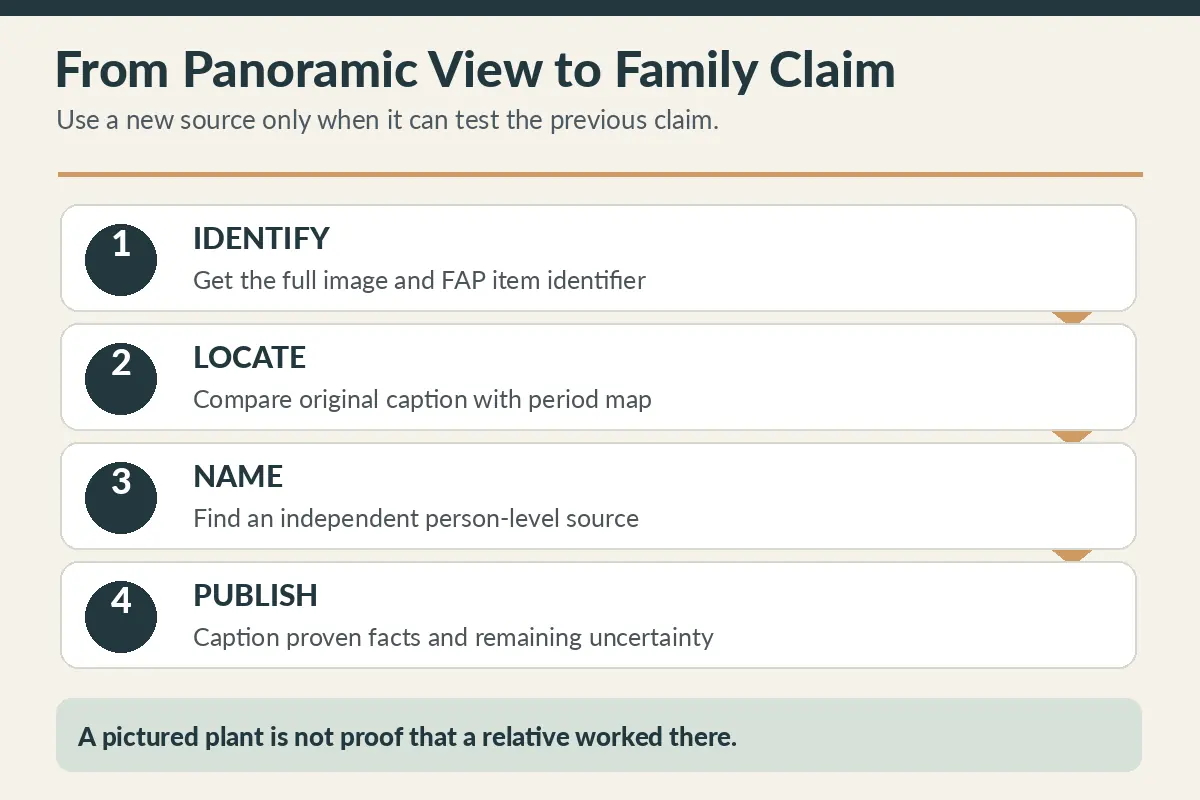
Suppose a 1918 postcard from a relative mentions work “at the coke ovens,” and a family album contains a cropped panorama. Search RG 67 FAP first, compare full frames and their original captions, and determine whether the view can be assigned to Coalton, Bower or Wheeling. The postcard may make an occupational connection plausible, but until the sender’s workplace is explicitly named it does not place that person at the photographed installation. This example is hypothetical, not an identification of a NARA image.
Write two sentences in the research log: one about the photograph’s documented subject and one about the sender’s reported work. Follow both with the missing link: a payroll, city directory, employer mention or another source that places the person at that installation. If it is unavailable, the responsible family-history statement is that the image illustrates a contemporary industrial setting, rather than the verified workplace of the individual.
More House and Local History Guides
How We Research and Verify the Archive
We checked the RG 67 guide against the NARA Still Picture Branch holdings guide. The count, date range, company names and the unidentified-community qualification come from RG 67 section 67.7. Neither online inventory establishes the identity of an unnamed worker, the exact date of a particular exposure or immediate item-level digital access.
The research workflow keeps photographic subject, place attribution, corporate activity and individual employment in separate evidence columns. The diagrams are modern illustrations, not historical photographs or transcriptions. For information about website disclosures, see the GenHis affiliate disclosure. No unverified paid research service is required.
The official RG 67 guide describes twelve FAP panoramas from 1917–1919.
No. The guide explicitly mentions an unidentified coal-and-coke community alongside the named company locations.
Not from a small or unnamed figure alone. An original caption plus independent personal evidence would be needed.
No. The guide distinguishes A photographs of administration sites and people from the FAP panoramas.
No. The 1917–1919 series dates do not establish the plant’s opening, closing or precise construction date.