
For a historical British assurance company, the National Archives guide to companies and businesses identifies returns made to the Board of Trade from 1912 to 1968 in ACT 1/104 and ACT 1/632. These records concern regulated companies and their reporting obligations. They are not automatically lists of policyholders, people insured or claims paid. A company’s return may be useful when researching the insurer behind a family paper, a building sign or a local employer, but it should not be mistaken for a personal insurance contract.
Start by asking whether you need evidence about the business or about one insured person. The National Archives companies and businesses guide points to ACT 1 for the former. For the latter, you may need an original policy, probate correspondence or records retained by the insurer or a successor company, if they survive.
Identify the legal company behind a familiar brand
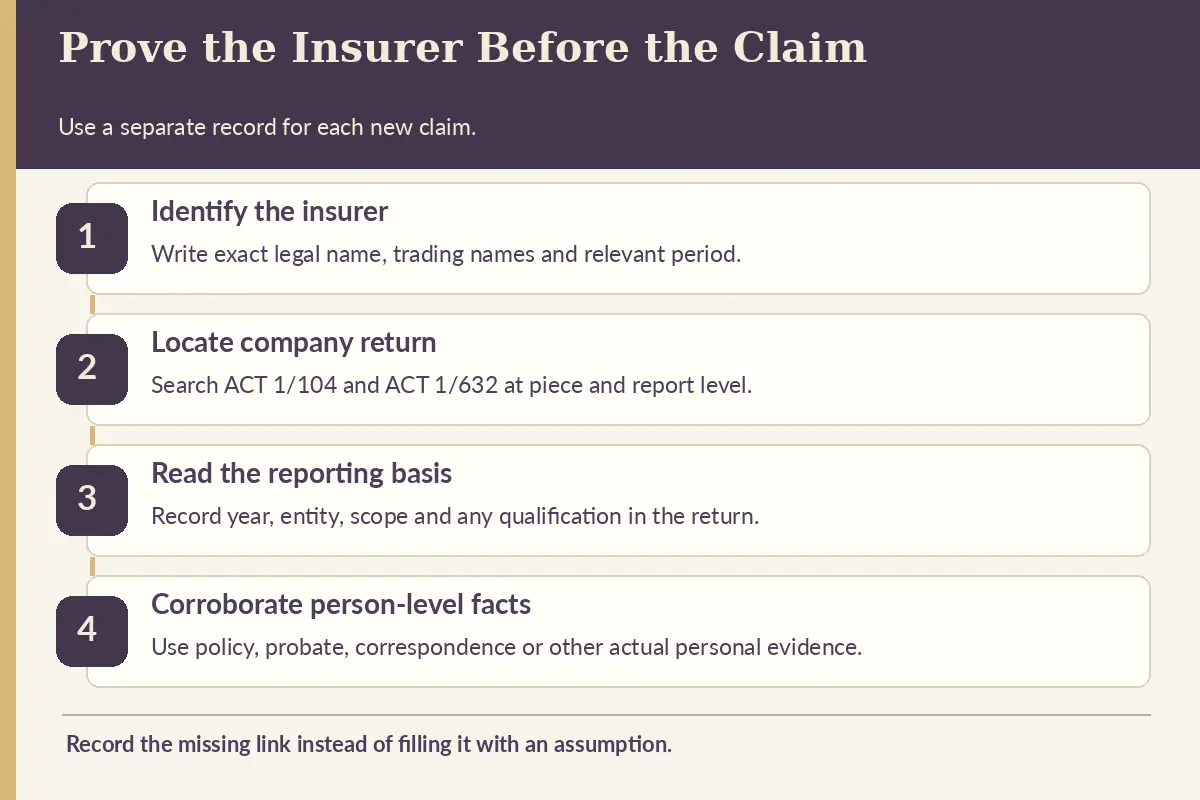
An assurance business may appear under a trading style, a former legal title or a successor’s name. Before looking in ACT 1, write down the exact name on the dated advertisement, policy envelope, receipt or city directory, and note its date and address. Do not merge similar names merely because both contain “life” or “assurance.” When a business absorbed another company, the later name should not be projected backward onto earlier returns.
A simple corporate identity timeline can include the documentary name, documented dates, office location and source for any merger or renaming claim. If you cannot yet prove that two names belong to the same legal organization, leave a visible question mark. This distinction matters when several competing insurers operated in one city and used broadly similar branding.

Search the two cited ACT 1 references carefully
The National Archives cites ACT 1/104 and ACT 1/632 specifically; do not assume every ACT 1 file is a statutory assurance return. Use Discovery to examine the descriptions and their own date ranges. A return for the correct company but an irrelevant year may not test the claim you care about. Record the piece reference, heading, reporting year and whether the document is an original return, compiled copy or summary according to its actual wording.
The overall 1912–1968 span is a guide-level coverage statement, not a guarantee of an annual surviving return for every company. Check any internal schedules and notes before treating a number as the size of the business. Financial and regulatory headings may have changed over the decades; do not compare figures from different years without confirming the basis on which they were reported.
Read company reporting without inventing customers
Depending on the particular return, the evidence may concern accounts, classification of business or formal administrative information. Its relevance should be assessed at the level of the exact statement. A company’s total business in a given category cannot be divided into an invented number of individual ancestors. The company appearing in a return proves neither that the firm employed a named relative nor that a family’s policy was valid at the report date.
If the family owns a policy certificate, extract the full insurer name, policy number, issue date and named parties from that separate item. Then use ACT 1 as contextual evidence about the insurer. Keep those citations distinct. Where a policy’s legal rights or payout are disputed, a historical archival guide is not a substitute for the actual terms or appropriate professional advice.

Correlate a company with property and employment evidence
Company returns can help situate the business in a local commercial history, but ownership of a branch building or employment of a clerk needs a different source. For a building, compare leases, deeds, historic rate books, directories and dated photographs. For a worker, seek payroll, trade directories, staff magazines or surviving employer papers. The mere presence of a corporate name in an annual return does not put any particular person at a particular address.
If a company changed hands, trace the legal relationship through dated corporate filings and reliable contemporary notices. Avoid assuming that a successor automatically inherited every archive or policy document. Company groups sometimes used separate legal entities. Construct a two-column timeline: “What the regulator return states” and “What independent evidence establishes.” This prevents the attractive but unsafe leap from company survival to family-level conclusions.
Write an auditable history of the insurer
A responsible finding states the reporting year, exact legal company name and ACT 1 piece used, and describes the specific statement that was inspected. If the return is missing for the target year, make that a coverage note rather than inventing a zero value or a closure. List any unresolved name variants, changes in reporting classification or uncertain connections to the family’s documents. Keep each assertion traceable to its source.
The finished account may establish that an insurer submitted a return to the Board of Trade in a specified period, but not that a family received compensation or held a particular policy. Include the original policy or named payout record only when available. Save a research log of searched company aliases and years so another researcher can test the same business identification without repeating mistakes.
More House and Local History Guides
How We Research and Verify These Archive Routes
This guide is grounded in The National Archives research guidance, which identifies the collection purpose and relevant series. We retain the exact piece reference using Discovery, and read the original item whenever possible before assigning a date, role or person to a specific event. A catalogue description establishes a route to evidence, not every fact that the original item might contain.
Our diagrams are original explanatory illustrations, not photographs or facsimiles of archive documents. Dates given for a series are not guarantees of complete survival or personal indexing. This guide does not assume a paid relationship with any archive or copying provider; our affiliate disclosure explains the site’s editorial approach.
The National Archives identifies them as assurance company returns made to the Board of Trade, covering 1912–1968.
No. They are company returns, not universal records of individual insured customers.
Not without a document actually identifying and recording that claim or payment.
Compare dated legal names, addresses and corporate filings before treating two brands as one company.
The exact company title, reporting period, ACT 1 piece, cited page and the statement actually supported.