
ADM 50 contains official journals kept by Royal Navy admirals and officers acting in flag rank, with records dated 1702–1916. The National Archives explains that their formats and completeness vary, and that the search route changes with time: up to 1855 search by admiral; from 1856 onward search by admiral, station or squadron. This is a particularly useful way to reconstruct command-level context when a family account connects a ship or ancestor with a fleet operation.
The distinction matters because an admiral’s journal is not a crew register. Orders, movements and observations may describe what a command was doing, but the record does not automatically identify every sailor serving on each ship. Use the National Archives guide to naval log books to choose ADM 50 for command context and separate ship or personnel records for an individual claim.
Start with the command structure, not just a surname
Gather the ship name, approximate voyage date, claimed theater, admiral’s name and possible station or squadron. A family memoir may mention a flagship while the relevant order concerns a much wider force. Treat “under Admiral X” as a testable command relationship, not a claim that the admiral ever met the individual. If a ship moved between stations, the admiral serving above it may also have changed.
Create a command worksheet with the fields: date range, admiral, rank or acting flag status, squadron or station, named ships and source for each relationship. Avoid collapsing those fields into one vague “fleet” label. A later historian’s summary may use retrospective names for a campaign; try contemporary spellings as well as a modern geographical term. If there is more than one admiral with a similar name, use dates and rank as discriminators.
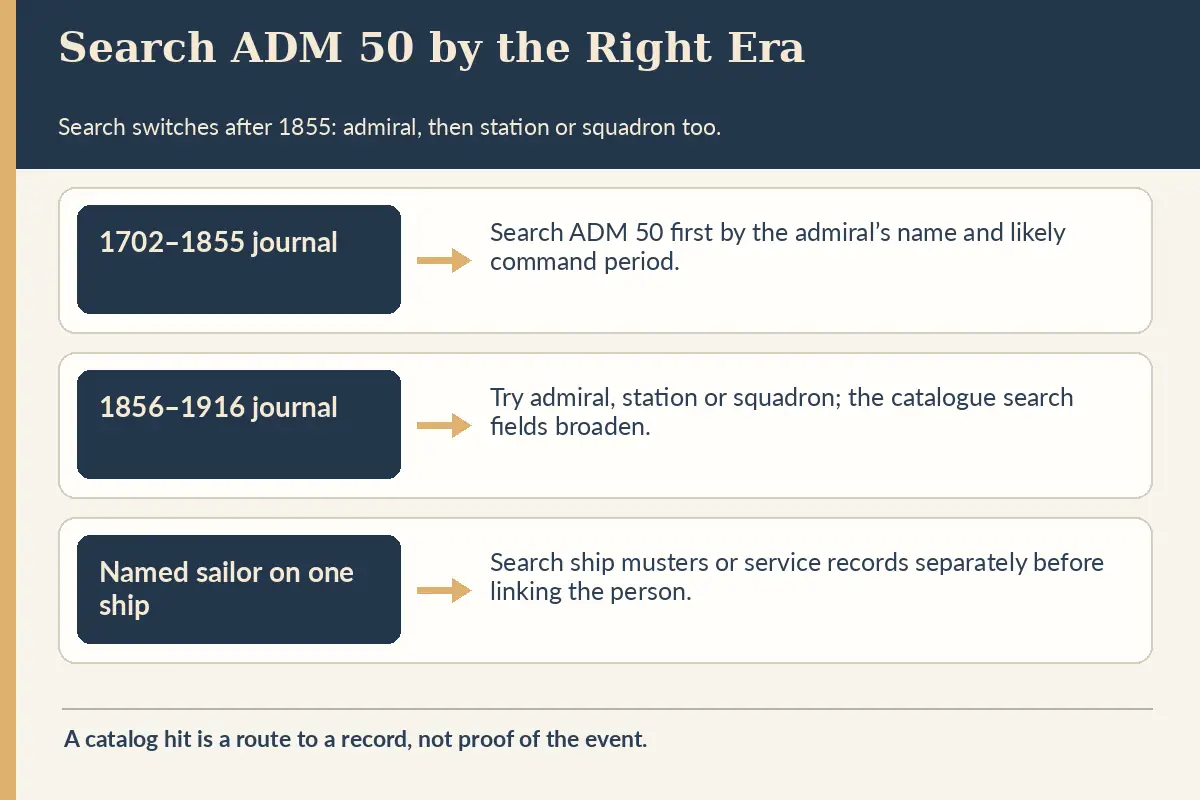
Follow the 1855–1856 catalogue boundary
The official guide gives a genuine search switch: by admiral up to 1855; by admiral, station or squadron from 1856. That does not mean that the journals themselves were reorganized into identical fixed fields or became more complete. It tells you how to approach the archival descriptions. In Discovery, constrain a search to ADM 50 and check the descriptions for name and date coverage. Keep the full piece reference rather than relying on a hit title alone.
When inspecting the journal, note the first and last covered dates, whether entries were made regularly and the level of detail. A journal can report an order to sail, a report received or an observed arrival. Those are different events. Distinguish the date the order was issued from a later date when compliance was reported. A gap in a journal is not evidence that nothing happened during the interval.
Relate a squadron order to a particular ship
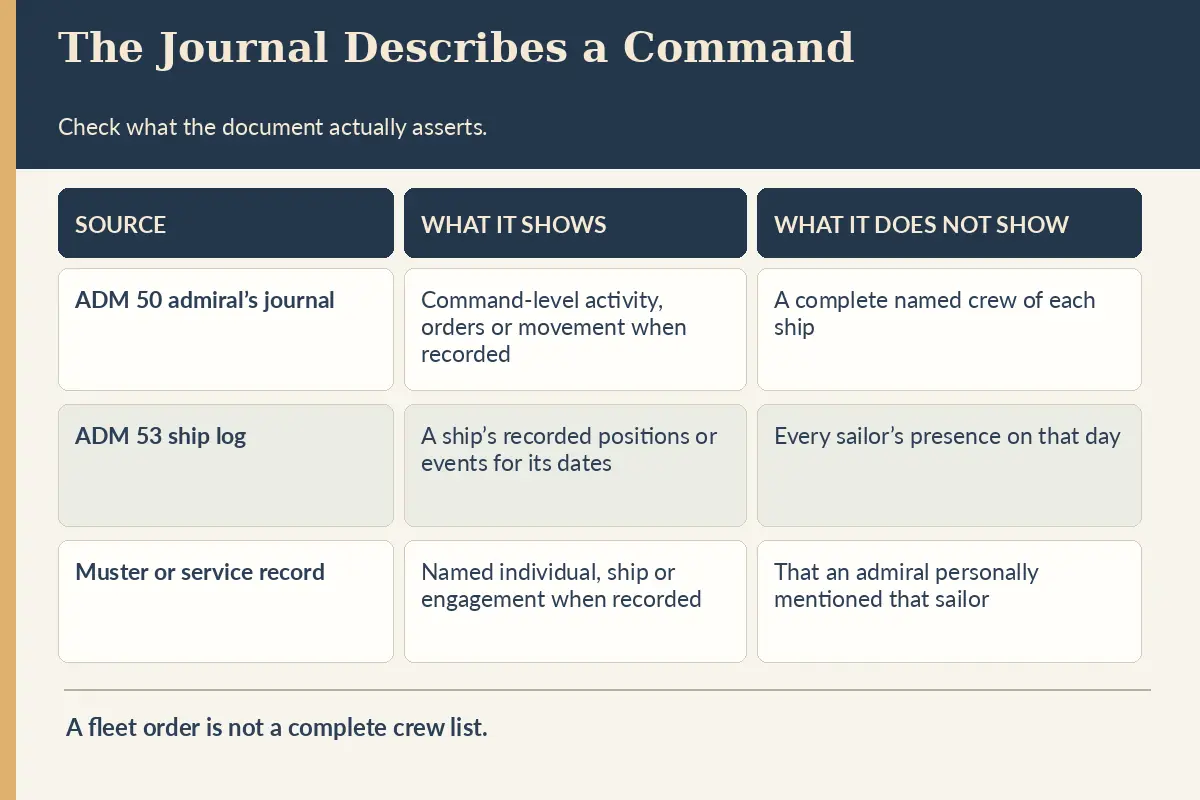
A command-level journal can establish that an admiral communicated with or directed named ships, if those names are actually recorded. That still leaves several open questions: did the ship receive the instruction, carry it out, or leave the squadron before the event? Check the ship’s own log for date and movement. The National Archives identifies ADM 53 for many ships’ logs from 1799 onward and ADM 51 for captains’ logs through 1852. Coverage differs by period and record type.
Write each connection as a separate evidence statement: journal says an order was sent; ship log says the vessel sailed; muster says the sailor was borne on the ship. Never draw a single arrow from admiral’s headquarters directly to a named ancestor without the intervening evidence. When exact days disagree, compare the documents’ reference times and the nature of their entries rather than inventing an exact sequence.
Keep an operation’s geography and identities separate
Fleet stations have historical meanings that can differ from present-day political boundaries. A squadron label may span a broad operational area; it is not a residence statement. A journal citing a particular coastline does not mean the admiral or every ship was physically present at each named harbor. Check whether the entry records a received report, a proposed route or direct observation. Maritime weather, signals and logistical delays can explain why instructions and ship logs diverge.
For family history, resist the temptation to infer service from a ship list copied into an admiral’s journal. A person’s assignment requires muster, pay or service record evidence. If the ancestor’s name appears directly, still verify identity against rank, age, service number where applicable and other known details. Keep historical ship-name repetitions in mind: vessels of the same name may have served in different decades.
Build a traceable naval narrative without false precision
A useful final narrative distinguishes three levels: command, vessel and person. Cite the ADM 50 piece and entry date for the command assertion. Cite the appropriate ship log separately for a movement. Add muster or personal papers for the sailor. Where one level is missing, state precisely which link remains hypothetical. A journal can be valuable even when it does not resolve the identity of the crew member in the family story.
Record any conflicting accounts in a table rather than silently harmonizing them. Copy page or folio numbers, log dates and relevant place names exactly as written, followed by a clearly labeled modern interpretation where necessary. If a Discovery description is the only source viewed, say so. These habits make a fleet history both readable and auditable without overstating the evidence held in ADM 50.

More Records and Archives Guides
How We Research and Verify These Archive Routes
This guide is grounded in The National Archives research guidance, which identifies the collection purpose and relevant series. We retain the exact piece reference using Discovery, and read the original item whenever possible before assigning a date, role or person to a specific event. A catalogue description establishes a route to evidence, not every fact that the original item might contain.
Our diagrams are original explanatory illustrations, not photographs or facsimiles of archive documents. Dates given for a series are not guarantees of complete survival or personal indexing. This guide does not assume a paid relationship with any archive or copying provider; our affiliate disclosure explains the site’s editorial approach.
The National Archives describes admirals’ and acting flag officers’ journals from 1702 to 1916.
Up to 1855 search by admiral; from 1856 onward use admiral, station or squadron.
No. Command journals are not complete crew lists; use musters and service records.
Not without a person-to-ship link and sufficient evidence of that ship’s participation.
ADM 51 includes captains’ logs, and ADM 53 contains many ships’ logs, each with its own coverage.