
ADM 339 contains surviving personnel records of the Royal Naval Division. Match names and service details, then test unit reports separately. Begin with the official archive guidance, distinguish a catalogue entry from an original image, and review our affiliate disclosure before choosing paid collections.
Why a Naval Rating May Have an Army-Like War History
The Royal Naval Division was formed in 1914 from personnel drawn from several naval and military organizations. It fought on land, so a man whose papers identify him as a sailor may appear in a story about trenches, battalions and Army command. The Archives places surviving individual service records chiefly in ADM 339. Begin by determining whether the ancestor actually joined the Division rather than assuming every member of the Royal Naval Volunteer Reserve was an RND serviceman. Write down the original evidence for the affiliation, its date, and the exact unit name.
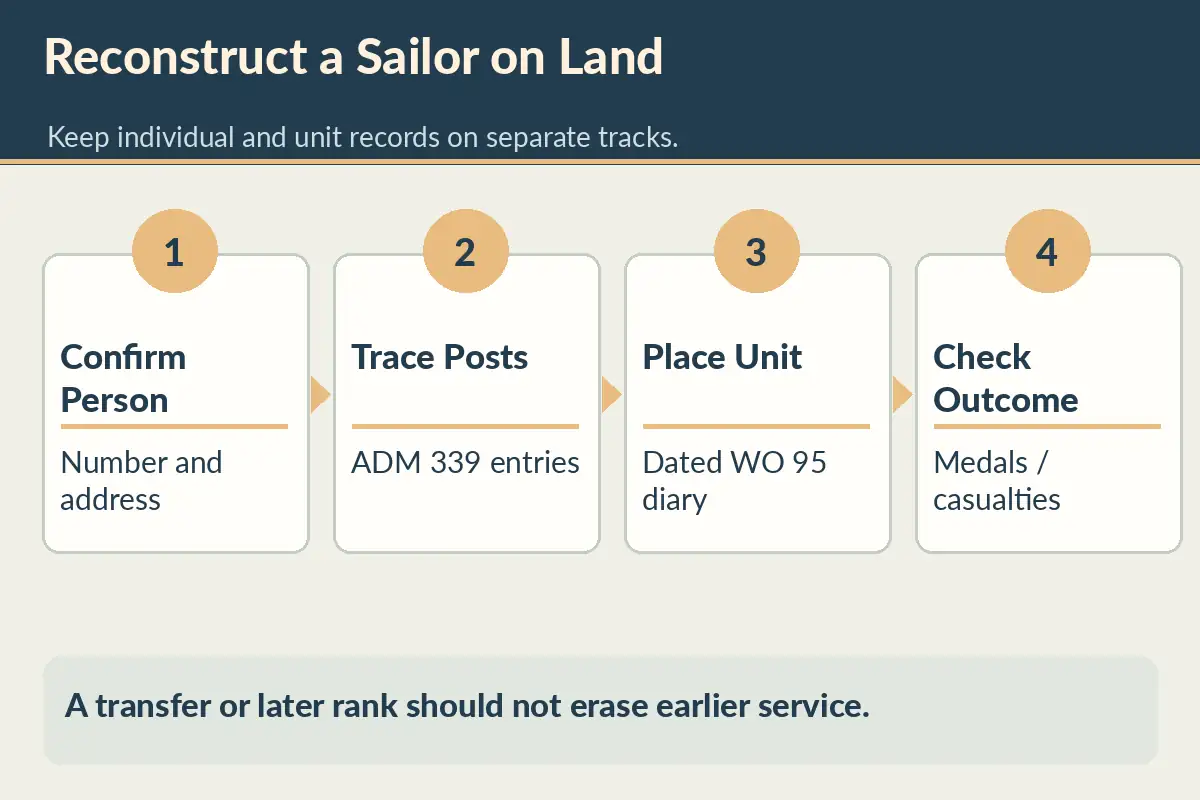
The National Archives describes ADM 339 as surviving service files for those who joined during 1914–1919, while its broader personnel guide labels searchable records 1914–1922. These statements describe accession and document coverage, not a guarantee that every member served throughout those years. A man could have transferred between branches or moved between units. Record each dated posting as its own fact. A later medal roll, memorial entry or family story cannot by itself establish the administrative organization at an earlier moment.
Search ADM 339 by Name Without Losing a Namesake
Use The National Archives Discovery search with surname, initials and any known middle names. Its ADM 339 guide says the lookup is a keyword search of catalogue descriptions; quoted full names can be too restrictive, especially where a middle name intervenes. Try broader combinations and compare the description of each candidate before buying a download. Keep a search log recording variants, year ranges and whether the result is an original service record or merely an indexed catalogue description. A no-hit query does not establish that the man never served.
ADM 339 papers can contain home address, occupation, religion, next-of-kin details, postings, wounds and hospital treatment. Many ratings also have physical descriptions, birth information or distinguishing marks. Transcribe service numbers, birthplaces and next-of-kin relationships only where the actual document says so. A next-of-kin field identifies an administrative contact at a particular date; it does not prove biological parentage or the date of a wedding. In a two-candidate comparison, a matching service number and independent address generally outperform a shared surname and regiment label.

Read the Personnel File in the Order It Was Written
Do not flatten a multi-page file into one fictional biography. Create a sheet with the document date, writer, event reported, rank, battalion or company, and the source page. Service files may show changes in address or next of kin, wounds or captivity, as illustrated in the official guide. A later update can correct an earlier entry. When a record refers to a hospital, the notation is not necessarily a diagnosis; when a service file calls someone absent, it is not necessarily a desertion finding. Preserve the official wording and the surrounding chronology.
When two dates look inconsistent, determine whether one is a posting date and another a report or approval date. Distinguish when the man joined, when an order was issued, and when the unit noted him present. Interpret abbreviations using adjacent forms and the repository guidance, not an unsupported internet glossary. Some papers are typed, but handwritten additions may alter a conclusion. Identify the original piece and image or page, then state where the evidence was found rather than treating a derivative transcription as a separate corroborating record.
Connect a Man to a Unit Diary Without Inventing His Actions
The National Archives points RND researchers to war diaries in WO 95/3118–3119 and additional operational material including ADM 137. A diary describes the activities of a unit or headquarters on a given day. It usually was not designed to list every man present or injured. First prove the person belonged to the named unit on the date in question. Only then consult the corresponding dated entry, and preserve a distinction between what the unit did and what a named individual can be shown to have done. A unit attack does not prove that every soldier personally joined it.
Build two columns: the ADM 339 posting or casualty entry and the relevant diary account. Check the battalion title and location, because reorganization or transfer can make a visually similar name misleading. Cross-check a reported wound against a medical notation or casualty source rather than assuming the unit diary records it. The 1916 change to Army control does not automatically mean the man’s original Royal Navy papers ceased; administrative and operational custody can diverge. A precisely attributed unit context is valuable even when it supplies no personal detail.

Where to Go if ADM 339 Does Not Yield the Officer
Not all officers’ papers were filed in the expected Royal Naval Division series. The archive explicitly recommends examining ADM 337, ADM 196, WO 339 and WO 374 for some officers missing from ADM 339. Which branch is useful depends on their commission and later service, not on a rule that all four series are consecutive parts of one file. A service officer’s initial rank might differ from the rank on a later memorial. Search with the name and commission date while maintaining a separate list of unverified candidates.
Medal cards in WO 372 and Royal Navy medal rolls in ADM 171 are other kinds of evidence: they can support entitlement or administrative recording, but not a complete daily service history. Casualty databases can add further leads; verify the date, unit and source behind a memorial. Do not treat a missing ADM 339 file as proof of no wartime service. Record whether the case is absent from the index, located in another collection, inaccessible or found but insufficient to match identity. Each result calls for a different next action.
Write a Reproducible RND Service Summary
An evidence summary should open with the verified individual, then list dated postings and known changes of unit. Add unit-diary context with an explicit statement that it concerns the organization, not an automatic eyewitness account of the serviceman. If a file names a family member, cite the exact next-of-kin entry and check the relationship in civil or church registers. For every assertion include ADM 339 piece, page and the corresponding date. Avoid decorating the account with an invented front-line scene just because a battalion was in combat.
Finish by asking which finding would change the proposed identity. A different birth year, service number, address or mother named in another original file could separate two people of the same name. Note unresolved wounds, long gaps and changes of rank without trying to explain them from guesswork. The most useful result may be a cautious, properly sourced route to another document. If a record includes addresses or kin who may be living, do not post their details indiscriminately; the archival record’s age does not make modern sharing automatically appropriate.
How We Research This Specific Archival Claim
Our review first distinguishes the office that created the records from the later catalogue, digital provider and modern interpretation. We check the repository’s period, surviving extent, original arrangement, access rules and description of each series. Every source is read for exactly what it reports: an original statement may be accurate about one event yet inadequate for a family relationship, legal outcome or residence claim. We test competing namesakes with independent dates, places and record identifiers, keep conflicting claims in separate rows and document precisely which portions of a collection were searched. A negative online search is not a negative archival finding without a documented coverage assessment.
More Records and Archives Guides
Archive Sources and Their Evidentiary Limits
The primary archival guide explains Describes surviving ADM 339 service records for men joining the Royal Naval Division in 1914–1919, available personal details, and officer exceptions.. An additional official research source confirms Explains the mixed naval and army personnel, transfer to Army control in 1916, WO 95 war diaries, medal and casualty leads.. These institutional descriptions establish the existence and general scope of records; only the original document can establish what it says about a particular person. Date your retrieval, cite the full piece and page, and keep unresolved namesakes open rather than borrowing unverified details from a published tree.
No. It was assembled from naval and other personnel and served ashore alongside the Army.
No. ADM 339 contains surviving records; some officers are documented elsewhere.
No. It provides a dated administrative statement that should be checked against a marriage record.
No. Unit operational accounts must not automatically be converted into individual participation.
Try the archive’s named alternatives, including ADM 337, ADM 196, WO 339 and WO 374.