
ADM 102 hospital musters can identify patients at naval institutions. Match institution, dates and register purpose before claiming treatment. Consult the National Archives research guidance for custody and coverage. See the GenHis affiliate disclosure before choosing any commercial access service.
Begin With a Hospital and a Plausible Year
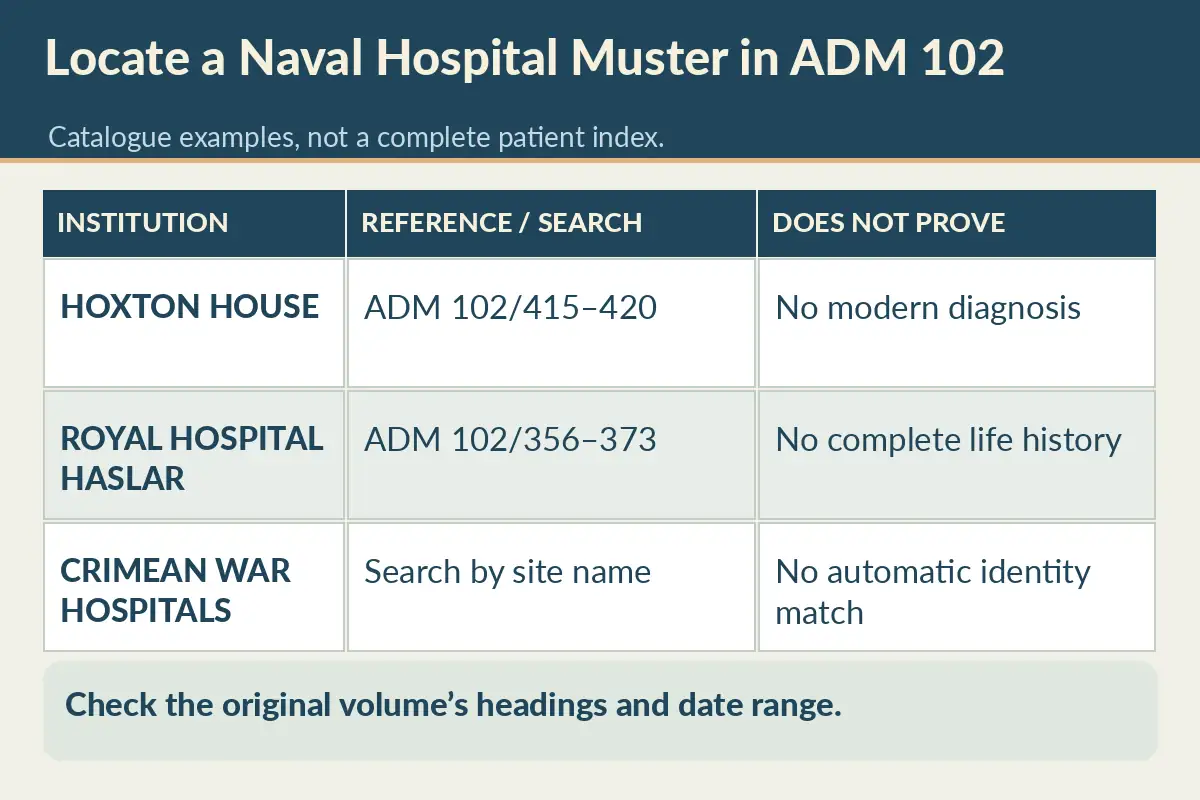
ADM 102 comprises Admiralty hospital muster material; these are not all-purpose medical case files. The National Archives identifies hospital musters for Hoxton House in ADM 102/415–420 covering 1755–1818 and Royal Hospital Haslar in ADM 102/356–373 covering 1818–1854. Its Crimean War guide also recommends ADM 102 searches using hospital or location names such as Therapia, Malta, Lewes and Belle Isle. Start with the institution and date, not an invented universal patient index.
Gather the sailor’s name variants, any service number or ship, the suspected illness or transfer date if recorded elsewhere, and the relevant naval hospital. A family story that someone “was in hospital after the war” is too broad to identify a piece. Some hospitals treated military and other categories of people over changing periods. Record the catalogue’s full title and access information before deciding that a matching institution actually holds the type of entry needed.
Read a Muster as an Administrative Patient List
A hospital muster generally serves an institutional counting and accounting function, not the same purpose as a surgeon’s detailed clinical journal. Read the entry headings to determine which facts are present: name, date, unit or vessel, admission or departure status and other administrative fields where supplied. Do not assert that every ADM 102 volume records the same columns or that a named patient’s underlying case notes necessarily exist.
Extract the name exactly as written, the hospital, dated line, page and any linked vessel. A record may be copied or corrected after the event, so distinguish the heading date from the person’s event date. Use an evidence ledger with “observed in original,” “given in catalogue” and “family interpretation.” When the line merely says a patient was present, it does not support a diagnosis, condition severity or definitive discharge destination.

Separate ADM 102 From ADM 101 Surgeons’ Journals
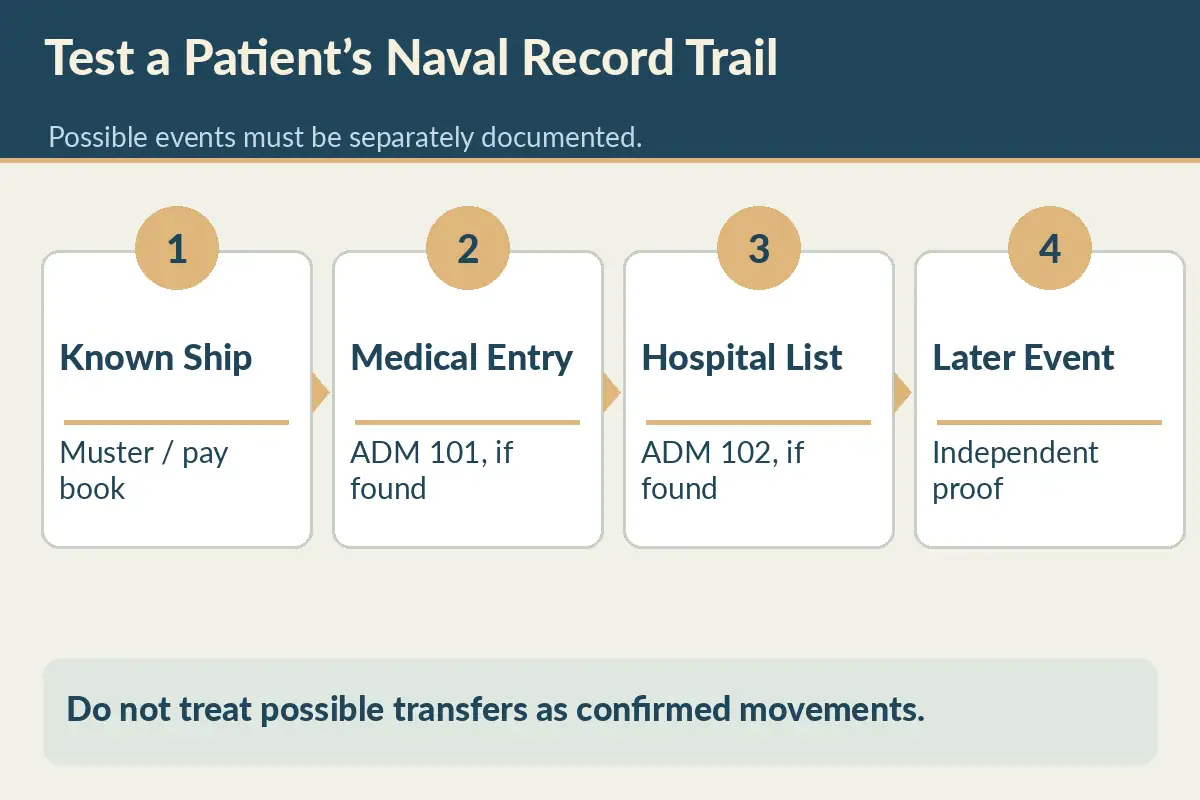
ADM 101 medical officers’ journals describe medical circumstances on ships and other Admiralty settings, while ADM 102 hospital musters are institutional lists. The difference matters if a researcher finds a man in an ADM 101 sick list and assumes that he was later admitted to Haslar. A shipboard medical reference is a candidate clue for a hospital search, but the transfer must be separately documented. A patient’s absence from a journal does not negate a hospital entry.
Capture the exact ship, voyage and date in ADM 101, then use hospital muster dates that could reasonably follow. A patient may have changed ships or care settings, and naval place names can be repeated. Avoid drawing a solid arrow from “sick aboard” to “hospital admission” unless a transfer or matching entry is documented. If the link remains uncertain, represent the relationship as a hypothesis and seek pay or muster records for intervening service.
Handle Historical Mental Health Labels Respectfully
The National Archives lists naval asylum-related musters at Hoxton House and Haslar within ADM 102. Those records were created under historical administrative and medical categories, many of which are obsolete or stigmatizing. Preserve an archival term only when needed for an accurate quotation, identify it as historical language, and do not turn it into a modern diagnosis. Institutional registration can tell us something about a person’s circumstances without revealing their full experience.
Family historians should avoid speculation about the cause of admission, behavior or mental capacity. If a later witness described an illness, attribute the claim to that witness. Compare admission and discharge dates carefully and consider that records might be closed, lost or incomplete. Information about relatives and living descendants deserves discretion even when a historic register is legally accessible. No diagnosis should be inferred simply from an institutional name.
Trace Service and Movement Outside the Hospital
Naval ship musters and pay records in ADM 31–39 and related Admiralty series may help establish where a rating served before or after a hospital admission. Their dates, fields and survival differ from ADM 102, so use them as independent sources rather than duplicates. A transfer notation needs particular attention: a muster may record that someone was sent to hospital, while a hospital return may record only the time that person was actually present.
Make three parallel columns: ship service, hospital entry and family or civil event. A service record may use a different spelling, age or ship designation, and a hospital patient may share a common name with others. Confirm identity with date alignment, rank, number, birthplace or next of kin when available. If a later death is claimed, search a death or burial record; neither hospital admission nor discharge alone proves a death.
Cite the Record and State What Remains Unknown
A careful written finding might read: “A muster in ADM 102 lists a patient of this name at this naval hospital for the recorded period.” Where the individual’s identity depends on a linked ship, explain the match criteria rather than treating the name alone as sufficient. Quote only relevant original text and note any illegible words. The archive guide helps locate series; it does not mean a particular patient’s manuscript has already been inspected.
Next steps depend on the question. For the clinical story, seek a genuinely surviving journal or hospital file rather than filling gaps imaginatively. For service, inspect ship musters and pay lists; for a family event, use independent registration or parish evidence. Preserve both the administrative category and the human uncertainty, and avoid presenting a patient’s institutionalization as either proof of wrongdoing or a comprehensive medical history.
How We Research Adm 102 Naval Hospital Musters
We first define the record creator and its administrative purpose, compare the repository’s exact date span with the research question, and distinguish a catalogue description from an original image or manuscript. Namesake identity requires at least one independently created source, not a shared surname alone. We record the reference, date, field wording and uncertainties; a negative result is limited to the actual periods, places and holdings examined. We cite official archive guidance without pretending that it confirms the contents of an individual document we have not seen.
More Records and Archives Guides
Official Records and Research Limits
Check the primary archive guide for the specific series and periods: Identifies ADM 102/415–420 Hoxton House 1755–1818 and ADM 102/356–373 Haslar 1818–1854 among naval patient musters.. The second authoritative guide gives a separate comparison: Confirms ADM 102 Royal Navy hospital musters and location keywords such as Therapia, Malta, Lewes and Belle Isle during Crimean War research.. Verify each piece’s current access rules in Discovery; a search result, indexed entry, downloadable image and original item are not interchangeable. Preserve the record creator’s wording and avoid claiming completeness where the archive identifies losses.
No. Hospital musters primarily record administrative patient information.
The archive cites ADM 102/356–373 for Haslar, 1818–1854.
Try hospital and place terms including Therapia, Malta, Lewes and Belle Isle in ADM 102.
No. ADM 101 contains medical officers’ journals, a different type of evidence.
No. Both require evidence that explicitly records the event.