
WORK 30 includes plans of coastguard stations and officers’ houses, 1844–1914. Search by historic station name, not the surname alone. Consult the National Archives research guidance for custody and coverage. See the GenHis affiliate disclosure before choosing any commercial access service.
Search for the Historical Station Rather Than a Surname
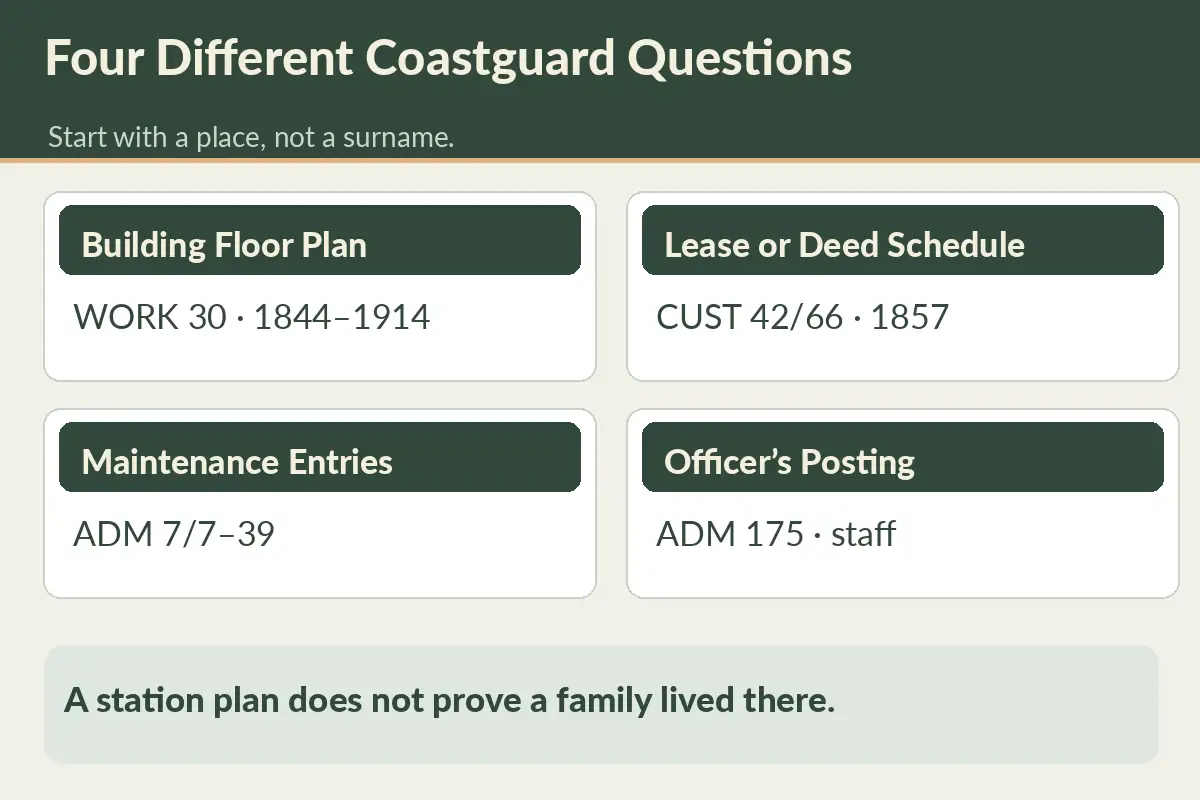
WORK 30 holds selected plans of coastguard stations, officers’ houses, watchrooms, gun batteries and related buildings, generally 1844–1914 according to The National Archives. These are place and property records, not alphabetic personnel lists. Begin by fixing the station’s historic name, coast or county, and the period when a family supposedly lived nearby. Spelling and administrative labels can change as a station moved or merged.
Search Discovery using “coastguard station” with the place name and alternative forms. Examine the catalogue’s “Held by” field, date and record reference; not every result belongs to WORK 30. A plan described for a named station is a candidate for the building of interest, not automatic proof of the present-day structure’s age or of its residents. Record the precise plan title and drawing date before interpreting it.
Read Drawing Dates, Rooms and Alterations Separately
An architectural plan can identify intended room arrangements, officer cottages, stores, watchrooms or a proposed extension. It may show a scale, orientation, site boundary and annotations. But a proposed layout is not evidence that the building was completed, occupied on a particular date or constructed exactly as drawn. Look for labels such as “proposed,” “existing,” “alteration” or “approved” on the original, and distinguish separate sheets in a building project.
Build a dated sequence: survey or proposal, approval if recorded, later repair or modification, and independent evidence that the station operated. Historic maps, photographs, county building files and local newspapers can support construction claims. If a set contains two different plans, do not force them into a single building footprint; one may represent an earlier location, replacement or alternative scheme. Keep north arrows and map scale visible when comparing sites.
Keep Staff Residence Apart From Ownership
The station may include rooms or cottages for serving officers, but a government building was not necessarily owned by the family recorded at that address. Even proof of residence in official quarters would not establish title. A census address, officer posting and floor plan represent three different observations. To establish ownership or lease terms, search contemporary deeds or the administrative schedule of coastguard premises rather than transferring a surname from a household return to the plan.
The National Archives points to a schedule of deeds and leases for Great Britain in 1857 at CUST 42/66. That schedule can guide questions about premises and legal interests, but it does not identify every household occupant. An officer’s recorded appointment to a station might be in ADM 175; check date and location before pairing it with a particular cottage. Avoid assuming wives or children automatically resided at the official property.
Use ADM 7 for Building Maintenance, Not Personnel Proof
Registers ADM 7/7–39 record repairs, equipment supply and replacement for coastguard establishments for 1828–1857. They can help test whether a known station was receiving maintenance during a target period. They are not a substitute for a named officer’s service record. Read expenditure references, dates and site description to see whether the administrative unit truly matches the station shown in WORK 30.
If a plan in WORK 30 depicts a larger building than a local map, look for a maintenance or alteration reference without assuming it proves a reconstruction. A repair entry documents a recorded administrative act; it may not specify which room was repaired or when labor was finished. Use exact references and record the evidentiary limit. Combining plans with maintenance can establish a site history, not an unbroken family occupancy chain.

Route Officers to ADM 175 Without Creating False Occupants
The National Archives separates coastguard station administration from officer employment research. ADM 175 contains establishment books, appointments and some later service cards, with uneven periods and geographical arrangement. A person documented in ADM 175 at a station in 1870 may help focus a property question, but the series may not list which official cottage that person used. Compare a dated census or local directory rather than inserting an officer’s name into an unlabeled room.
Coastguard duties and administration changed during the nineteenth century, and predecessors included revenue cruisers and the preventive services before formation of the Coastguard in 1822. Historical county and station boundaries need careful checking. A similar station name in another coastal district is a real risk when a family moved. Maintain a station identity card: alternate names, district, map position, operating dates and sources that independently locate it.
Write a Building History With Proof Levels
An accurate final claim may be: “A plan catalogued in WORK 30 describes a proposed coastguard station at this locality on the stated date.” State separately whether it shows an existing structure, whether a repair register supports later work, and whether a person is proved to reside there. If the original plan has not been viewed, cite it as a catalogue description, not as personal inspection of the drawing.
For the next search, choose a historic map when the exact parcel is unclear, CUST 42/66 when lease status is at issue, ADM 175 when a posting needs proof, or a census when family residence is the question. Avoid conflating a lease, an assigned residence and ownership. A building-centered dossier will be useful even if no ancestor can presently be shown to have lived within it.

How We Research Work 30 Coastguard Plans
We first define the record creator and its administrative purpose, compare the repository’s exact date span with the research question, and distinguish a catalogue description from an original image or manuscript. Namesake identity requires at least one independently created source, not a shared surname alone. We record the reference, date, field wording and uncertainties; a negative result is limited to the actual periods, places and holdings examined. We cite official archive guidance without pretending that it confirms the contents of an individual document we have not seen.
More Records and Archives Guides
Official Records and Research Limits
Check the primary archive guide for the specific series and periods: Describes WORK 30 coastguard station and house plans 1844–1914, 1857 CUST 42/66 leases and ADM 7 repair registers.. The second authoritative guide gives a separate comparison: Explains separate ADM 175 records that establish officer postings and the limits of those personnel registers.. Verify each piece’s current access rules in Discovery; a search result, indexed entry, downloadable image and original item are not interchangeable. Preserve the record creator’s wording and avoid claiming completeness where the archive identifies losses.
No. It concerns plans of buildings; personnel may appear in ADM 175.
The archive identifies WORK 30 station plans for approximately 1844–1914.
No. Government service quarters and legal title are different matters.
The guide points to ADM 7/7–39 for registers from 1828–1857.
The guide says station administration records are not online; check catalogue access and ordering options.