
HCA 30 is a large collection of Admiralty miscellanea, spanning material dated roughly 1530–1948. It is a valuable second route when a ship, maritime legal dispute, or court official has not been located in a neatly labeled case series. But “miscellaneous” matters: a letter, warrant, extract, or related paper can document an issue without preserving its judicial outcome. It must not be promoted into a verdict simply because it is kept within High Court of Admiralty records.
The National Archives’ High Court of Admiralty guide expressly recommends searching HCA 30 alongside more narrowly defined series. For prize cases, for example, HCA 32 concerns prize papers and HCA 34 includes sentences and interlocutories. The correct research order depends on the kind of case and question, not on the attractiveness of a ship name found in a miscellanea description.
Classify the maritime question before choosing HCA 30
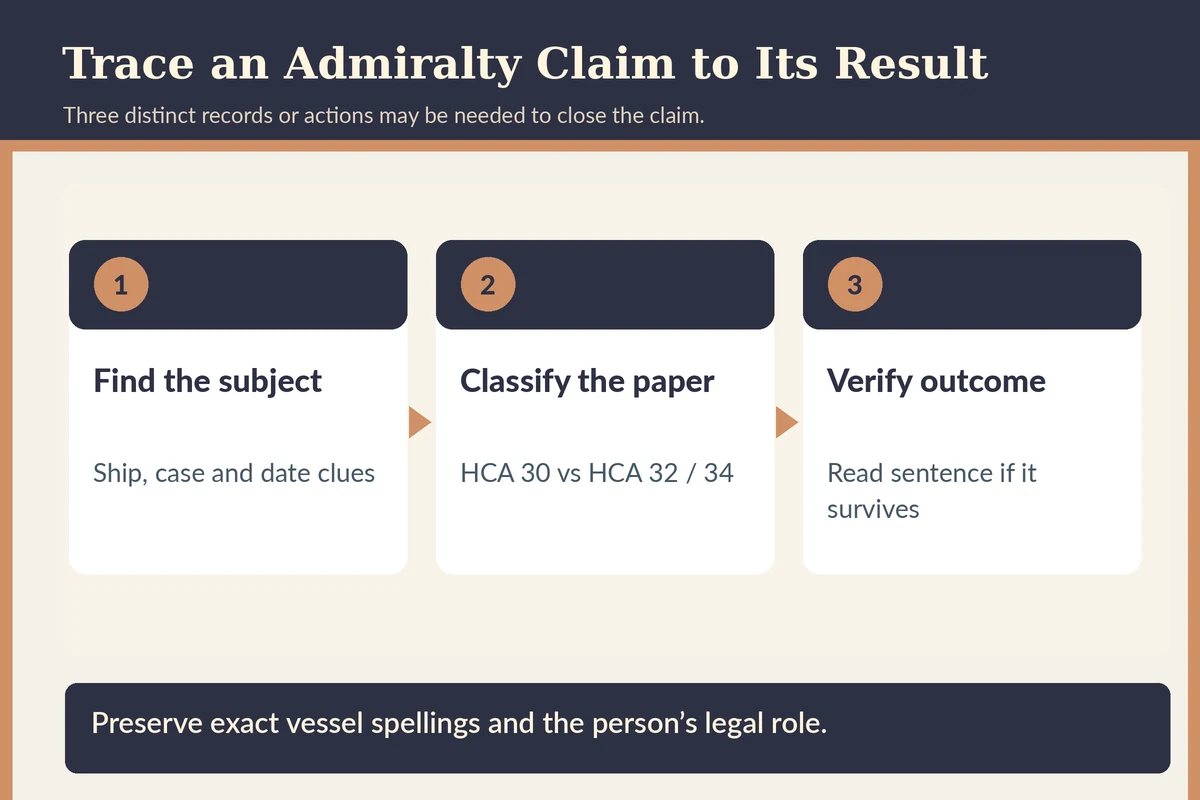
Start with a one-sentence research claim: a vessel was captured; an officer made a complaint; a seafarer testified; a proctor practiced before the court; a ship’s property was disputed. Write an approximate date and any original spellings of the ship, master or litigant. These claims point toward different court proceedings and records. A single general search for “Admiralty” can return a large number of documents without proving that the named person was part of the particular litigation.
When the issue concerns a prize capture, consult the guide’s dedicated prize categories before treating HCA 30 as a master series. HCA 32 is especially helpful for prize papers when the ship name and date are known; HCA 34 concerns sentences and interlocutories. HCA 30 may supply extra context, but it is not a simple chronological replacement for those records. For another sort of dispute, use the guide to identify the relevant instance-court or other records.

Search ship names and people with variant spellings
The National Archives recommends restricting an advanced Discovery search to the HCA department and trying ship names, masters, officers or shipping companies. Search likely alternate spellings and translations. In a prize case, a vessel might be referred to by an English rendering rather than a foreign-language original. Keep the exact form appearing on every document; otherwise two apparently different references may actually concern one ship, or two similar names may be merged in error.
Use the catalogue reference as a location clue, not an itemized transcript. A piece description may tell you only the broad contents. Note the date range and any related correspondence to determine whether the document belongs near the purported event. If the catalogue lacks a named individual, the original contents may still mention that person. The opposite is also true: a name in a description can refer to a case subject, a correspondent, or a later archival summary.
Identify the document’s voice and legal function
When inspecting an HCA 30 piece, first label what it is: complaint, note, copy, petition, warrant, exhibit, testimony or other material. Then ask who made it and why it survived. A complaint records someone’s allegation; a witness statement records reported knowledge; a warrant authorizes an action; a court sentence records an adjudication. The papers may contain contradictory assertions. None should be presented as an uncontested sequence merely because they were bundled together.
The court-related vocabulary also depends on the period. Some materials may use technical legal formulas unfamiliar to a modern reader. Retain the original wording, and record the date and document reference before paraphrasing. If a claim concerns confiscated cargo, a valuation is not necessarily proof of final distribution or ownership. A list of names in an exhibit may refer to witnesses or interested parties, not every crew member who sailed the voyage.

Use the specialist Admiralty series as crosschecks
For prize matters, compare HCA 32 papers with HCA 34 sentences and, where relevant, court minutes, warrants, or appeals. The National Archives identifies prize appeal series HCA 41–47, each with different functions. Treat these as conditional alternatives: not every case had an appeal and not every surviving dispute will have an intact set of records. The aim is to locate a document whose function matches the claim you want to make.
For questions about a legal professional rather than a ship, the research guide to lawyers points researchers toward HCA 30 for proctors’ admissions and HCA 50 for certain appointment warrants. That is an example of how miscellanea can preserve administrative career evidence without establishing participation in a particular lawsuit. Do not use a named proctor in one document as proof that the individual represented the litigant in another case.
Create a case-record comparison before summarizing
Prepare a table with ship name variants, incident date, archival series, document date, role of each person, document type, exact claim and confidence. Put complaint, deposition and sentence into different rows even if they share a case name. Cite the physical or digital document and page or folio when available. Make a separate note for whether you have located the document itself or only an online catalogue description. A clear negative result specifies what was actually searched.
Then write a two-part conclusion: what the evidence directly demonstrates and which broader question remains open. An HCA 30 item may establish that a particular allegation was filed or that a proctor’s admission was recorded. It may not reveal whether a prize was condemned, whether compensation was paid, or where a ship sailed later. A court outcome requires an outcome document or clearly supported equivalent, not an attractive interpretation of the first surviving paper.
More Records and Archives Guides
How We Research Admiralty Miscellanea
Our method uses HCA 30 as a deliberate supplementary source, not as a shortcut around the structure of the Admiralty courts. We identify a document type, verify its period and provenance using the official guide, and compare it with series designed for the central issue when possible. The exact relation between a complaint and a later sentence must be demonstrated by matching case details, not inferred from the chronological proximity of two documents.
We also mark differences between the original paper and an online portal or catalogue record. The National Archives notes online prize-paper access, but digitization and name-level indexing vary by material. The final audit preserves the known ship or person, each source reference, the claim supported, and the next missing record. A defensible statement of uncertainty beats an invented judgment for an ancestor or vessel.
For information about external links and editorial transparency, see the GenHis affiliate disclosure. These archival references are independent research citations, not a claim of affiliation or endorsement.
It is the High Court of Admiralty’s large miscellanea series spanning diverse document types, rather than a complete single-type case index.
It might contain relevant material, but dedicated sentence records such as HCA 34 should be checked before claiming a verdict.
Try its known name and date, then consult the Admiralty guide for HCA 32 prize papers and related court series.
Yes, some proctor-admission materials are found there; confirm appointments or career details using appropriate related records.
No. A name may be a party, witness, officer, petitioner, or cataloguing term; determine the person’s role from the document.