
Find the Dispute Before Claiming Its Result
The High Court of Admiralty heard instance-jurisdiction disputes about seamen’s wages, collisions, salvage, pilotage and commercial matters. Its papers can reveal a complaint involving a historic ship without proving that the complainant won. Begin with the vessel, approximate year and kind of disagreement; do not begin by assuming that a court file is a complete biography or a final decision.
The National Archives separates these civil instance papers from prize jurisdiction, which concerned captured ships and cargo in wartime. This guide focuses on the less glamorous but genealogically useful everyday maritime disputes. A sailor’s request for arrears may contain names, claimed service and an account of events; each remains a statement to be weighed against other records.
Write a tightly framed question such as “Was the disputed voyage connected to the schooner in the family letter?” Record the historical ship spelling, home port when known, master’s name, approximate voyage dates, and any rival vessels with similar names. Treat those as search keys rather than verified facts until the documents establish them.
Choose the Instance Series by Date and Search Method
The archive’s date bands overlap: HCA 15 covers 1586–1788 and includes some prize material; HCA 16 covers 1772–1806; HCA 17 covers 1807–1839; and HCA 18 covers 1840–1859. The overlap is real, not an error to be corrected. Search by the actual filing period and document type, and inspect multiple series near a boundary.
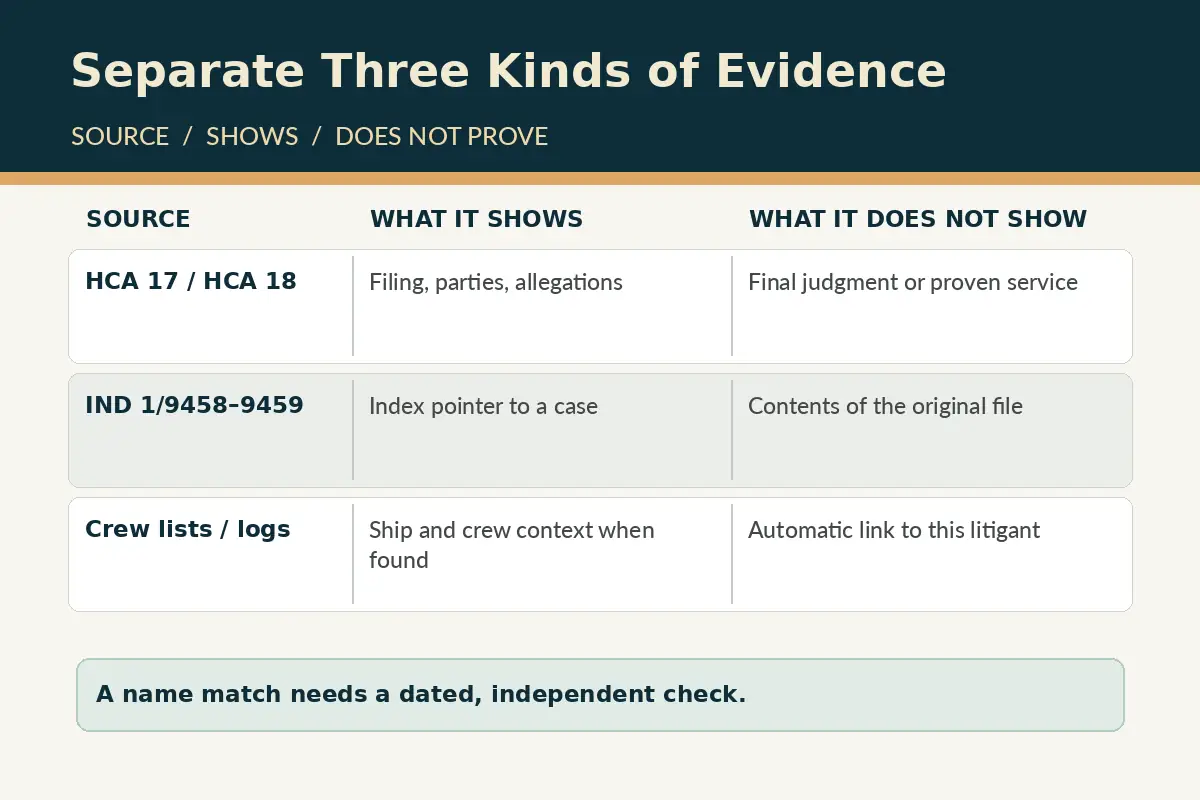
HCA 17 and HCA 18 can be searched by ship and master, according to the archive guide. Earlier HCA 15 and HCA 16 research often needs a more deliberate index approach. IND 1/9458 is identified for HCA 15–17, while IND 1/9459 serves HCA 18. The number of a paper within its sequence is not an Admiralty ship registration number.
If the year is uncertain, use a short range rather than one guessed day. If the claimant’s name is missing from searchable descriptions, search the ship and master first, then consult the appropriate index. Do not claim that an unreturned keyword search means no litigation occurred: cataloging detail, historical spelling and index coverage vary.

Read Pleadings as Claims, Not Findings
Once a piece has been located, note whether it is an allegation, answer, witness statement, exhibit or later judicial action. The documents are not interchangeable. A wage claim may assert that service took place on particular dates but cannot itself establish that the wages were actually owed or paid; an opposing answer could contest the amount, circumstances or employment relationship.
Make a claim-level evidence ledger with the speaker, the event or amount alleged, the date to which it refers, and the page or folio. Mark every fact as “asserted,” “acknowledged,” “documented separately,” or “unresolved.” Where the document is illegible, preserve the uncertain reading rather than silently normalizing a surname or ship’s name.
Court participants are not automatically family relations. A master, owner, sailor, agent, proctor and witness have different legal roles. Even a matching personal name does not establish identity without additional details. Compare witnesses and claimants with shipping registers, known voyages or crew agreements before attaching a court passage to an ancestor.
Build a Ship and Person Corroboration Trail
Create two timelines. Put court filing dates and procedural steps in the first; put the ship’s route and the individual’s demonstrable movements in the second. A voyage described in litigation might predate filing, and a later copy or index entry may postdate both. Do not flatten these into one event called “the voyage.”
The National Archives guide to Merchant Navy ship records gives a separate route through crew lists, musters and logbooks. Identify the relevant year, flag and available vessel details, then determine whether the appropriate crew evidence survives in a national or other repository. A crew-list name linked to a ship and voyage is stronger evidence of service than merely a defendant naming a sailor.
For a worked hypothetical example, suppose a family letter names the vessel Mercy and an 1821 wage dispute is found under HCA 17. Record the file’s parties and alleged dates; next look for independent crew or shipping evidence for the correct Mercy. If another ship shared the name, a master or port difference is a reason to keep them separate.

Record Gaps Without Inventing a Judicial Outcome
The existence of an indexed paper does not establish that the complete proceedings survive. A litigant might settle, discontinue or appeal; the surviving evidence may not disclose which occurred. Consult relevant procedural or judgment records if the question needs an outcome, and clearly identify the source of that outcome instead of inferring it from the initial filing.
Check HCA 30 only as an additional miscellaneous-search possibility; it is not a guaranteed continuation of every instance cause. Equally, prize papers in HCA 32 are not the default next step for a dispute about wages. The archive’s subject distinctions prevent wasting searches on an attractive but unrelated collection.
A final research note should state: the specific reference, filing or document date, parties, ship or master, question raised, direct evidence and still-unproved inference. Even a failed search is useful when you record the exact years, spellings, series and indexes examined. That makes the next search reproducible rather than merely optimistic.
More Records and Archives Guides
How We Research Maritime Court Records
We use the National Archives High Court of Admiralty guide to distinguish instance from prize jurisdiction and to check HCA 15–18 and IND 1 references. We use its merchant-ship records guidance for an independent, vessel-focused service check. Neither guide guarantees an individually named court file.
Our example vessel is fictional; it is not presented as an actual HCA discovery. For a real case, record the record creator, reference, original title, paper or folio, the archive consulted, access details and transcription uncertainties. Quoted speech and administrative summaries carry different weight from a final recorded order.
Before considering paid record access, read our affiliate disclosure. The method works without any assumed commercial partner. The next defensible step is to test one ship-and-year combination in the correct series and record precisely what the result can and cannot establish.
It concerns civil maritime disputes such as wages, salvage, collisions, and pilotage; it differs from wartime prize cases.
HCA 17 spans 1807–1839; begin there and consult the relevant IND 1/9458 index route.
No. It is a litigant’s claim until supported by crew or other independent voyage records.
No. Their date ranges overlap, and HCA 15 also contains some prize material.
Only if the surviving source explicitly records an outcome; a filed pleading alone is insufficient.