
Begin an HCA 32 Prize Papers search with the captured ship, master and approximate date. Ship papers, private letters and court proceedings have different meanings; a name in a packet is not proof of passage or family connection. Read our affiliate disclosure.
Begin With the Captured Ship and Approximate Date
The HCA 32 Prize Papers are neither ordinary immigration passenger lists nor a general directory of sailors. They are materials associated with ships captured in war and examined under the English or British High Court of Admiralty’s prize jurisdiction. The official Admiralty guide recommends starting with a ship name and approximate capture date.
Add the master’s name where known because vessels often shared names, changed spelling or sailed under different flags. Record the claimed voyage, reported capture location and whether the original lead comes from a court document or a later family narrative. A name mentioned in seized correspondence may identify a sender, recipient or business partner rather than someone who was aboard.
Distinguish the Court File From Impounded Papers
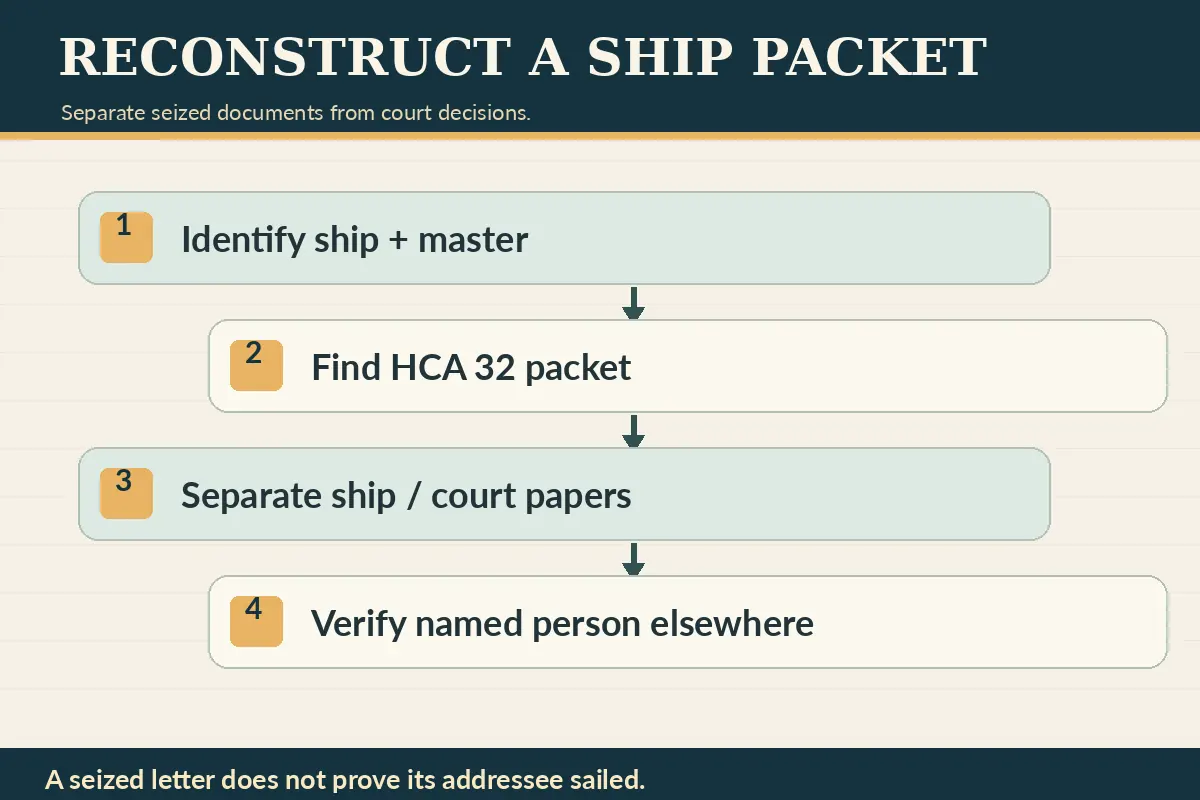
A captured ship might produce court papers written for the legal proceedings and ship papers taken aboard the vessel. The two have different evidentiary purposes. Ship’s papers can include bills of lading, commercial accounts, crew-related notes, letters carried as mail and other documents. Court papers can contain depositions, allegations, examinations and eventual decisions about whether a ship or cargo was lawful prize.
A business letter is testimony to communication, not automatically proof of a passenger journey. The same packet can contain multiple languages and even contradictory accounts. Classify each document before extracting names, and do not convert the legal label of a neutral or enemy vessel into the ethnicity of every individual mentioned.
Navigate HCA 32 Series and Periods
The National Archives guide lists HCA 32 as prize papers with holdings from 1592 to 1855, although the principal digitization collaboration focuses on records of 1652–1815. The 1740s HCA 32 packets were extensively catalogued, and the official description highlights records of the War of the Austrian Succession. Coverage for other conflicts or dates is not equally itemized.
Search by ship and master in Discovery and record the actual HCA 32 piece rather than assuming all records share the same access level. Court-minute books and sentencing material can fall in HCA 28, HCA 29 or HCA 34, serving separate legal tasks.
Use the Digitization Portal Where It Applies
The Prize Papers Portal is an official open-access route for digitized materials from ships taken by British privateers and naval vessels. It describes an ongoing ship-by-ship and document-by-document effort, with the originals held in British archival series including HCA 30, HCA 32 and HCA 45. If the portal does not yet show a packet, consult the National Archives’ catalogue and access notice before labeling it lost.
Keep the digitized document’s identifiers together with the underlying archival reference. A translation supplied by a project is helpful, but check whether it is a complete text, an abstract, or a caption prepared for a public exhibit. The difference matters for family claims.

Worked Example: A Named Letter on a Captured Ship
Imagine a fictional packet from a 1744 captured trader named *Le Rose*, with a letter addressed to Marie Laurent in Nantes. That addressee is not thereby a passenger, crew member or relative of the shipmaster. Transcribe the outside address, date, sender, recipient, and any place names; separately record the vessel, master and reason the paper is in HCA 32.
Compare another dated letter, parish record or merchant account before asserting that Marie Laurent was the ancestor under investigation. A trade invoice might name a firm, not an individual owner. If the court later condemned the ship, that ruling answers a property-law question and does not establish every biographical detail alleged in testimony.
Search Beyond HCA 32 Only When Needed
Prize proceedings can lead to related minute books, orders, appeals or administrative material in other High Court of Admiralty series. Decide the new research question first: a request for the legal disposition of a vessel differs from a search for a sailor’s family. If the captain’s testimony is missing from a surviving packet, look to a related court series and document the access or survival gap.
For personal identity, independent parish, port or probate sources may be more relevant. Captured correspondence ranges across many languages and trading regions, so preserve names in the original script when possible and keep speculative English spelling variants in a separate field. Do not assert ownership or family connection solely from proximity in a bundle.

Describe Capture and Judgment as Different Events
An encounter at sea might lead to seizure, confiscation of papers, depositions and a later ruling. A packet’s existence establishes that papers were retained in an archival legal context, but not necessarily the final legal outcome. The Admiralty guide explains that the court could either declare a vessel lawful prize or find in favor of its owners.
Distinguish seizure date, place of questioning, hearing date and decision. When a catalogue mentions a ‘master,’ note the vessel and period before inferring a given person held command for earlier voyages. Cite the specific leaf and any translation, and clearly distinguish a family-history deduction from the wording of the source.
More Records and Archives Guides
How We Research Names in Prize Papers
We anchor the enquiry to ship, master, capture period and HCA 32 reference, then sort the surviving packet into court papers, ship papers and correspondence. Names are tagged by role—master, witness, sender, addressee, merchant—and their statements are checked against a second record when a family claim depends on them. We document the project’s uneven digitization status and never present a portal no-result as proof that a packet is missing.
The final research note separates what the ship’s document literally records from what a court eventually held and what independent evidence establishes about the people involved. This keeps international maritime history useful without inventing passengers, convictions or descendants.
Foreign-language spelling requires a careful transcription strategy: preserve the written name, record who wrote it and identify the language of the document before making a modern standardized form. A captured ship may carry letters that never reached the addressee, so the document’s physical presence in a court packet cannot establish delivery. Keep a delivery-status field marked unknown unless independent evidence resolves it. Similarly, an invoice for cargo destined for one port does not guarantee arrival. A family might have correspondence with a vessel without anyone in the family boarding the ship. Ship identity, paper provenance and personal identity should therefore be assessed on separate evidence lines. This is especially important when a packet contains court-created translations alongside an original private letter.
No. Surviving packets vary; court examinations, letters or ship papers can name some people without providing a complete crew list.
No. Capture and court decision are separate events; prize jurisdiction could condemn a ship or find for its owners.
It is a growing digitization project, not proof that every HCA 32 packet is online. Check the Discovery access status for the specific piece.
Documents aboard captured vessels were impounded as potential evidence, including mail intended for delivery, often in French, Dutch, Spanish and other languages.
Include HCA 32 piece and sub-item, vessel and master, date, document type or court/ship-paper identifier, and where the image or original was seen.