
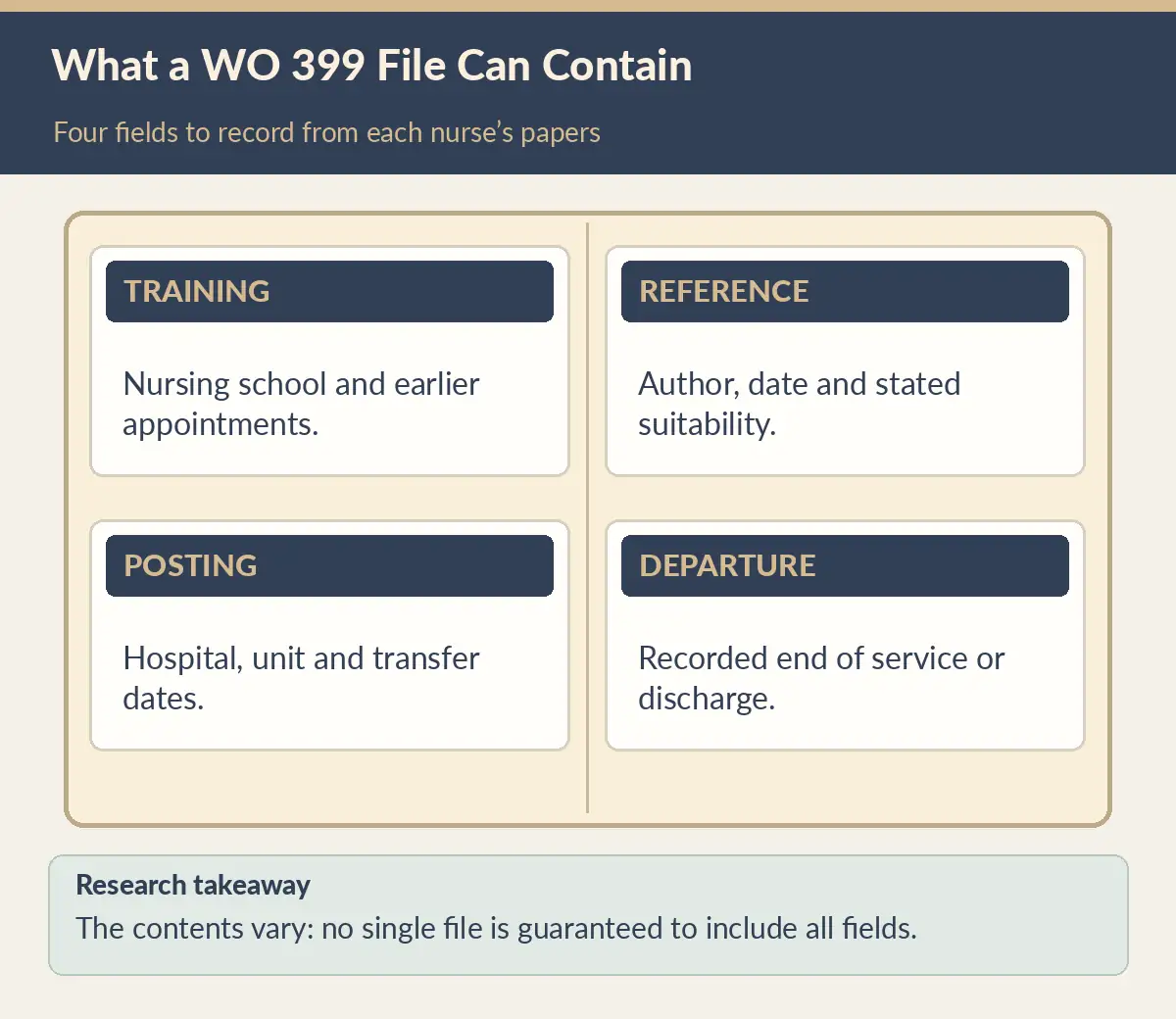
To research a British Army nurse from the First World War, search her name in the National Archives WO 399 nursing service collection. Files may give training, references, hospital postings and departure from service. Do not infer a nurse’s birthplace, marriage or a particular battle solely from a unit posting or administrative evaluation.
Identify Which Army Nursing Organization Served
WO 399 includes personnel records from the Queen Alexandra’s Imperial Military Nursing Service (QAIMNS), its Reserve and the Territorial Force Nursing Service (TFNS). The names of these branches matter because similar uniforms or family recollections of “an Army nurse” do not automatically specify the organization.
The National Archives says the collection holds more than 15,000 service files, predominantly from the First World War, with some earlier and later service details and no records in this set after 1939. Start a worksheet with the nurse’s documented name, initials and any known nursing organization. Preserve spelling changes and aliases, especially where family papers use a married surname different from a wartime record.
Search WO 399 by Name and Inspect the Full File
The National Archives states that WO 399 records can be searched and downloaded through Discovery, generally subject to a charge for files. Search surname and given names, then try initials and name variants. An index result is a starting point: inspect the original pages for multiple spellings, crossed-out fields, references and dates.
Do not assign a file because it bears a familiar surname in the right county. Check identifying details such as nursing training institutions, earlier appointments, references or any confirmed address. Record the WO 399 piece and document date separately from the online vendor’s search label.

Read Training and Qualification Evidence Cautiously
A nursing service file may specify where a nurse trained, sometimes before the First World War, and can contain letters assessing her suitability. Those are historically valuable professional clues but must be described according to their documentary role. A supervisor’s reference is a named person’s assessment, not necessarily a definitive measure of competence or character.
If the file names a nursing school or hospital, search that institution’s separate training registers or employment records for a contemporaneous match. Also watch for dates showing a civilian appointment before military service. A record of qualification should not be confused with a modern professional registration or proof of family relationships.
Map Hospital Posts Without Inventing Front-Line Service
WO 399 can name hospitals, field ambulances, casualty clearing stations and other medical units where a nurse served. Record each posting with start and end dates exactly as shown and mark uncertain handwriting or later amendments. A posting to a medical unit does not by itself identify all geographic sites where it operated, all patients treated or the nurse’s physical presence at a particular battle.
Use unit histories or institutional records if precise locations matter. A location appearing in a memo or reference may relate to an administrator rather than the nurse. Keep a timeline showing source, date, organization and whether the item was a transfer order, report or later recollection.
Separate QAIMNS, Reserve and TFNS Naming Changes
The wider National Archives nursing guide describes the Territorial Force Nursing Service as established in 1908 and renamed the Territorial Army Nursing Service in 1922. QAIMNS and earlier Army Nursing Service terminology can also appear in records. A later administrative heading does not retrospectively make every wartime TFNS nurse a member of a differently named organization at the earlier date.
Copy the name used in each original document before normalizing a timeline. If two similar initials appear under different branch labels, compare training and postings rather than forcing a merger. Such distinctions matter most when a reader tries to match photographs or medal references to a particular woman.
Distinguish Personal Assessments From Established Events
A file might contain confidential evaluations, correspondence about sick leave or a letter concerning conduct. Identify who wrote each paper, the purpose of the communication and whether a response or finding survives. An allegation or supervisor’s opinion is evidence that the statement was made; it does not automatically validate the underlying claim.
Similarly, an administrative departure or discharge record may not state a complete reason. Do not add diagnoses or personal details that are not present in a historical source, and avoid republishing sensitive details about potentially living people. Historical professional records deserve the same careful attribution as court depositions.
Resolve Two Nurses With the Same Given Name
Imagine an Annie Wilson appears in several service-file search hits. Build separate profiles and note each candidate’s training hospital, nursing branch, first appointment date, references, last posting and home address if actually documented. Compare those details with a civil registration or nursing college source.
A single service date coinciding with a family story is not enough, because the period involved thousands of women in similar roles. If one file records hospital training that conflicts with your family source, mark it as a conflict and investigate rather than quietly discarding it. Identifying people means testing discrepancies, not simply collecting confirming keywords.
Account for Incomplete Coverage and Later Careers
WO 399 concentrates on specified First World War Army nursing services, not every British woman who worked in a military hospital. It does not provide a universal register of civilian VAD volunteers, private nurses or all post-1939 military nursing personnel. A person absent from the index may have served through another organization, appear under a different name or have no surviving file in this collection.
Search alternate service routes only when evidence points to them. Likewise, a file noting departure in 1919 does not prove that a nurse stopped practicing in civilian hospitals. Continue with registration and institutional documents if later employment is the research question.

How We Research a WO 399 Nursing Career
We start with a concrete person, an approximate wartime interval and any independent evidence of a nursing organization. We search WO 399 by name variants, inspect actual file images, and record the title and date of each training reference, posting, medical-unit entry and departure paper.
We compare these observations with independent hospital or civil sources before accepting identity. We do not turn a headquarters correspondence address into a personal residence or interpret every posting as service at the front. The affiliate disclosure explains our editorial practice; official archival references remain the basis of any conclusion.
More Records and Archives Guides
Cite Service References and Retain Uncertain Posts
Cite The National Archives, series WO 399, piece or individual file, nurse’s full recorded name, document title, document date and folio or image where possible. Distinguish an original service sheet from a later summary or a family photograph caption.
An evidence log should list the organization, training institution, unit posting, departure date, source type and confidence in the person match. If a transfer date is illegible, record the literal uncertainty rather than assigning an exact day. End with a narrow career chronology whose every substantive statement can be traced to a dated document and whose gaps remain visible.
QAIMNS, QAIMNS Reserve and the Territorial Force Nursing Service are principal groups.
No. It covers specific British Army nursing services, not every civilian volunteer.
Often yes, but the entry does not establish presence at a specific battle.
Some records identify prior nurse training and professional references.
The National Archives offers searchable downloadable files, often for a fee.