
For an ancestor described as bankrupt or insolvent in England, first establish the approximate legal date, city and occupation. The National Archives guide routes you between Gazette notices, B 6 registers and surviving B 3 or B 9 files. An advertisement or creditor allegation should not be presented as proof of final adjudication without examining the relevant record.
Distinguish Bankruptcy From Insolvent Debtor Proceedings
Historically, legal bankruptcy and insolvency were not always available to exactly the same groups of people. Debt imprisonment and bankruptcy rules changed over time; imprisonment for debt ended in 1869 and non-traders gained a broader route to apply for bankruptcy in 1861. That context matters when a newspaper calls someone an insolvent debtor rather than a bankrupt merchant.
Begin with the actual words on the earliest dated record, not a modern umbrella term. Record the petitioning creditor, occupation, business partnership and town separately. People sharing a surname in the same trade can have unrelated proceedings, so do not build a family relationship from a list of creditor names.
Use The Gazette as a Dated Entry Point
Search The Gazette for the named debtor, town, occupation and appropriate years. Official bankruptcy notices can identify a petition, hearing, adjudication, trustee, creditor meeting or subsequent procedural step. Not all such stages indicate the case was completed, and a first notice may precede the final outcome by months or years.
Save the issue date, page, notice type and spelling. Search variant initials, trading names and business partners. When a notice gives a legal date, use that date to target court registers instead of randomly browsing decades of material. A news summary may omit a correction printed later.
Route Early Case Files Through B 3 and B 4
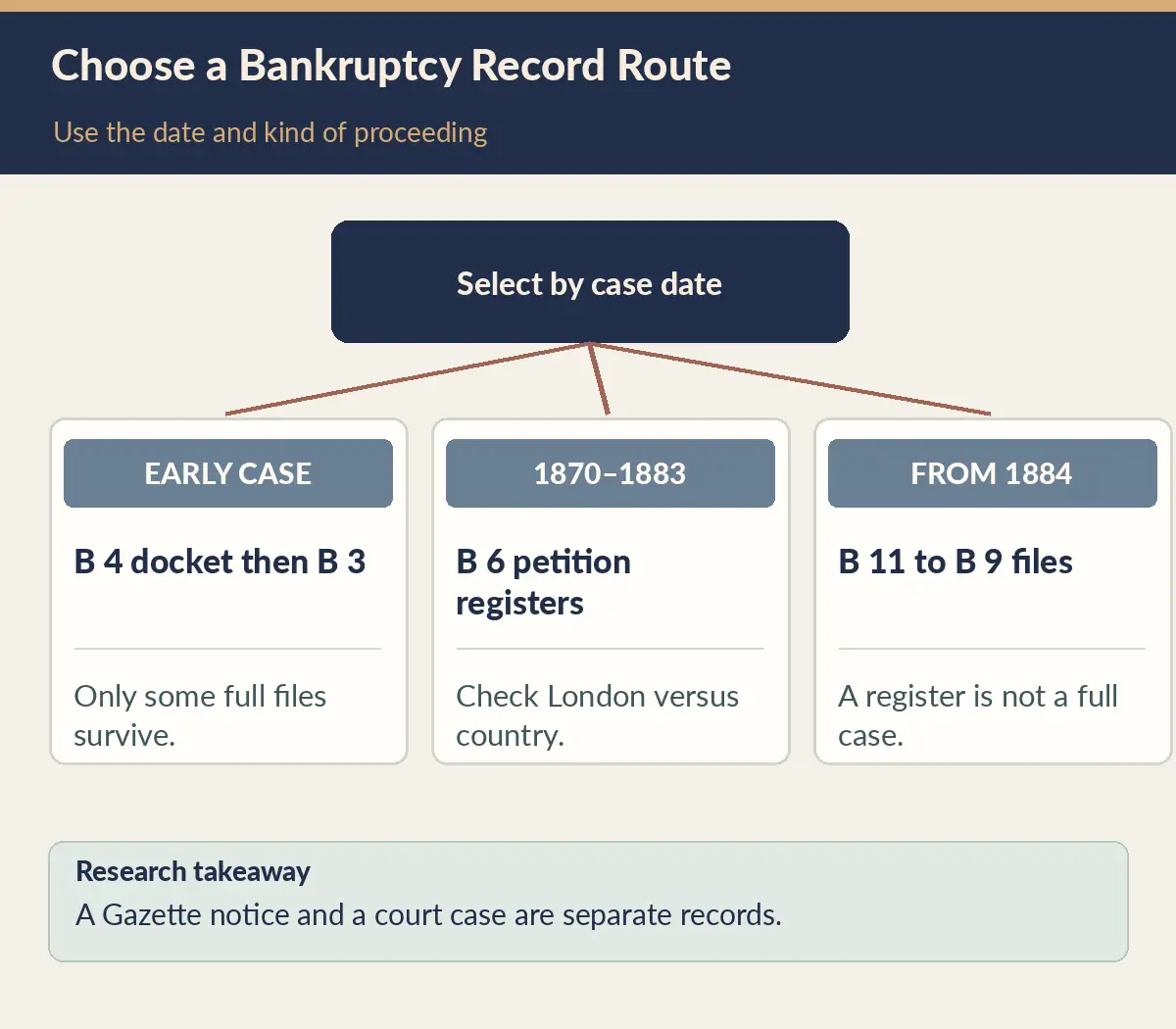
The National Archives describes B 3 as a small sample of bankruptcy case files from 1753 to 1854; name, address or trade searches can help find a surviving file. Docket and commission registers in B 4 can clarify whether a case proceeding was initiated. Some register marks point to associated B 3 material, but a missing case file can simply reflect selection and survival.
Record both the legal event described by the register and the physical reference for any file. Never describe a docket entry as a full balance sheet or witness deposition. The case record may have very different granularity from the searchable catalogue description.
Read B 6 and B 8 as Finding Tools
B 6 includes registers relating to insolvency, declarations, petitions, creditor details and associated deeds across several periods. Indexes to registers and related documents occur in B 8. The guide identifies particular B 6 subdivisions for declarations of inability to pay and for creditors’ petitions.
A register may record an amount due, addresses, trustees, the date of adjudication or a Gazette notice, but the precise fields vary. Transcribe the original column heading as well as the entry. Where the index supplies a volume number, go from that finding aid to the appropriate register page; do not infer the indexed person appears in every associated subseries.
Choose the Right Post-1869 Bankruptcy Register
For London proceedings in 1870–1883, the National Archives recommends beginning with creditors’ petition registers B 6/178–183. Those registers may give the debtor and petitioning creditor, occupation, legal act, hearing dates, trustee and final dividend or closure details.
B 6/184–197 covers petitions for London and country cases but is much sparser, typically name, address and occupation. From 1884, registers of petitions to the High Court occur in B 11; case files in B 9 survive selectively. Distinguish the geographical scope of each register and note whether a file was sampled, lost or never searched before calling an investigation complete.

Ask What Surviving B 9 Papers Actually Include
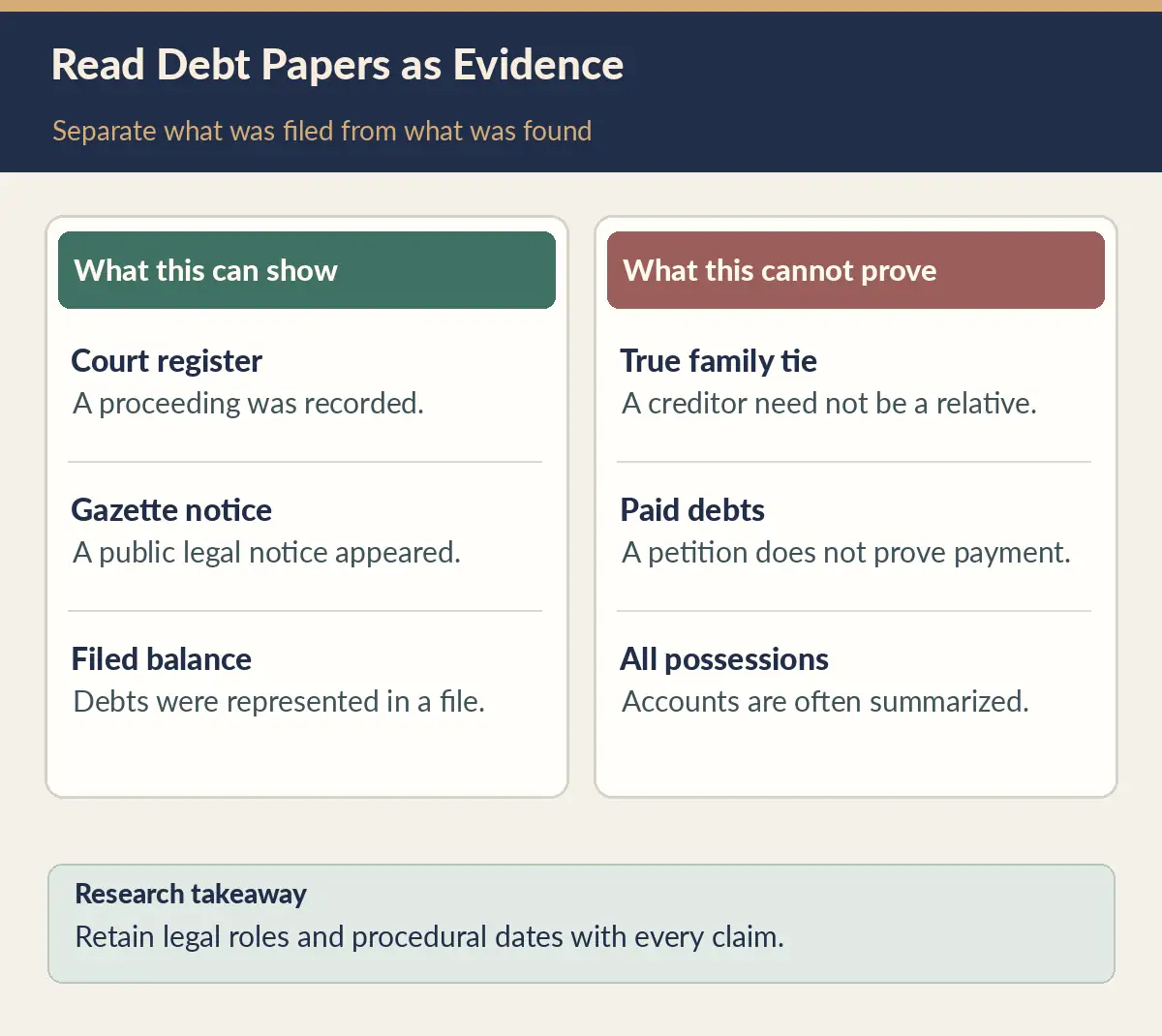
B 9 contains a limited selection of bankruptcy case files, searchable by surname and trade, spanning nineteenth- and twentieth-century cases. Files can contain general balance sheets and assignees’ accounts, but they need not preserve a line-by-line record of every household possession. Treat liabilities and balances as claims and accounting records generated within the insolvency process.
Never assume a petitioner named as a creditor was a friend or relative; commercial litigation can connect strangers. Conversely, a list of debtors with the same surname may be incidental. Compare the file with independently dated directory listings, partnerships and probate material before identifying the same person across decades.
Build a Debtor Identity Matrix Before Linking Names
Consider two William Turners described as tradesmen in a city over a decade. Create independent profiles with trade, street address, creditors, petition date and later Gazette notices. Use directories to test whether a business moved, and consider changes in a proprietor’s trading name.
Repeated use of the same trustee is weak identity evidence: professional agents served many unrelated cases. A sequence with matching occupation and a distinctive address is more useful, but still requires independent documents. Do not treat an insolvency register as proof of an individual’s birthplace, child or marital relationship unless the underlying document specifically supports that claim.
Account for Missing Case Files and Access Costs
Many bankruptcy files survive only in samples. A well-indexed Gazette notice does not imply a comprehensive case packet is waiting for download, nor does a search failure establish that the proceeding never occurred. Verify date scope, the court, the filing location, name variants and the availability of B 6 or B 11 registers before drawing a negative conclusion.
The original documents may require an archive visit or order, even when the basic notice is available online. Note precisely which pages were read rather than assuming the whole series was examined. A reproducible negative search identifies the court, collection, interval and document type checked.
How We Research a Historic Bankruptcy Case
We begin with a sourced date and occupation, then search Gazette notices and record each separate procedural stage. Next we route the date to the appropriate B 4, B 6 or B 11 registers, using B 8 where a printed or archival index points to the volume.
We check for a surviving B 3 or B 9 file without assuming there must be one. We compare legal roles and addresses with independent directories or deeds, preserving alternative same-name candidates. The affiliate disclosure provides editorial transparency; a searchable notice is a lead to primary procedural records, not their replacement.
More Records and Archives Guides
Record Citations and Limits of the Debt Claim
A complete citation identifies the repository, series and piece, register date, folio or entry and the debtor’s name. Add Gazette issue and page when the procedure is reconstructed from official published notices.
If a B 9 file was accessed, cite each specific balance sheet or petition separately with its document date. Your conclusion should say, for example, that a creditor petition was recorded, not that debts were judicially proven or settled, unless later evidence shows that. Distinguish the debtor from trustees, petitioning creditors, assignees and partners, and record any correction or conflicting legal result discovered after the first announcement.
No. Read the type and stage of notice and check later records.
The National Archives points to B 6/178–183 creditors’ petition registers.
No. Only a limited sample of historical case files survives.
B 8 supplies indexes to bankruptcy registers and related documents.
No. Commercial and legal roles need independent genealogical evidence.