
MEPO 6 contains Metropolitan Police Criminal Record Office registers and related material, including historical records about people officially categorized as habitual criminals. The National Archives dates the series to 1834–1959 and cautions that many records have closure restrictions. A discharge entry, a wanted notice and a portrait circular do different jobs: none should be flattened into a statement that an ancestor committed every offense mentioned nearby. Begin by identifying the actual document type, then test aliases, physical details and dates against court and civil sources.
Decide Whether You Found a Register or a Notice
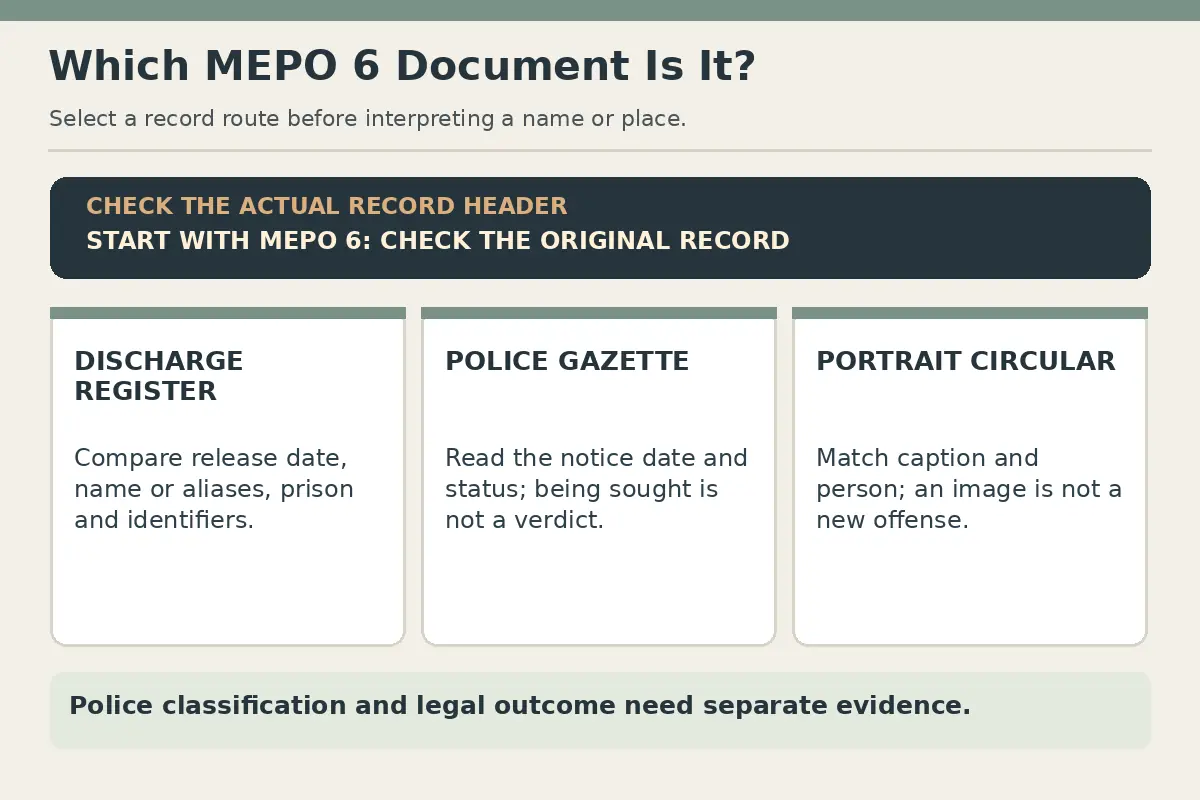
The heading and arrangement are part of the evidence. A discharge-related register may record identifiers associated with a person released from custody. A Police Gazette entry can be a request for information or apprehension, reflecting what the police were seeking at publication. A photograph circular may help recognize a listed individual but still records an institutional category rather than a complete judicial history.
Set up separate working tabs for discharge entries, wanted notices, and photographs. Record issue date, register number where present, office of origin and exact wording. Do not combine an undated printed notice with a later register entry merely because the names match. Administrative labels such as “wanted” and “habitual” must be quoted as contemporary classifications and explained in their historical context.
Search Aliases Alongside a Stable Date Anchor
The same person can appear under more than one name, but two shared aliases do not create a proven identity. Start with the strongest known date: release, conviction, newspaper report, or residence. Expand the search with documented surname variants, first names and initials. The collection may be searchable on partner services for selected material; check which pieces and years are included rather than assuming complete electronic coverage.
Create a match matrix with columns for reported name, alias, age or birth details, height or marks if printed, prison or court, and document date. Unusual marks and exact event dates can be especially useful; generic complexion descriptions and common occupations are weak evidence alone. If an entry fails to provide enough identifiers, maintain it as a candidate, not as a new branch in a pedigree.
Use Physical Descriptions Without Overclaiming Identity
A record may contain height, hair, eye color or distinctive marks, but availability depends on the specific book and period. Transcribe abbreviations as printed, and distinguish physical observations from police interpretations. Photographs can be copied, cropped or mislabeled; check the caption, issue, page and whether the image and adjacent text actually belong to one entry.
A portrait is valuable as a visual document of an administrative process, not a license to identify descendants or infer inherited characteristics. If two police descriptions conflict, compare the time elapsed, units and context, and note the unresolved difference. Measurements might be approximate or transcribed incorrectly; a near match can strengthen a hypothesis but should not override a contradictory birth or court record.
Distinguish a Conviction From a Search or Surveillance Entry
A historical police notice might say someone was sought, believed to be present, under supervision or previously convicted. These statements have different evidential meanings. A request to apprehend is not evidence that an apprehension happened, and an arrest is not itself a conviction. Use the named court and date to locate a trial, conviction or dismissal record before writing a conclusion about an alleged offense.
Where the register reports a conviction, cite the entry as proof that the police recorded it, then compare a court calendar or other independent legal record when possible. A newspaper report can add context but may also repeat police wording. Separate independent corroboration from the same claim reproduced through a second medium. Modern descriptions should avoid sensational language about the people recorded.

Understand Access Restrictions and Missing Volumes
The National Archives reports a general seventy-five-year closure practice for MEPO 6 and indicates that only selected materials have been made available through partner sites. A search returning no indexed person does not mean an individual was never monitored. Check the catalogued piece range, document date, legal access status and whether a particular volume has been digitized or indexed.
Do not attempt to reconstruct sensitive information about people who may still be living, or bypass a closed record. For legitimate historical work, record that an access restriction limits the search and use public records within their lawful availability. If a commercial service reports a surname match without image access, say you have a derivative finding only and reserve judgment about its content.
Work Through a Fictional Alias Conflict
Imagine that an 1890s notice names “William Baker, also called William Black,” while a discharge register in another year includes a William Black of similar age. The alias link is a candidate, not proof. Compare date of birth, physical description, place of conviction, release date and actual record numbers. If only two common names coincide, keep two individuals separate in the research log.
Suppose a later newspaper reports the same alias was acquitted. That report does not erase a historically recorded prior conviction, and the earlier police notice does not prove the newly reported charge. List the allegation, trial outcome and prior entry on distinct dated lines. This invented example illustrates why a careful family historian can document the administrative record without repeating a potentially false accusation.
Preserve Exact Citations and Respectful Language
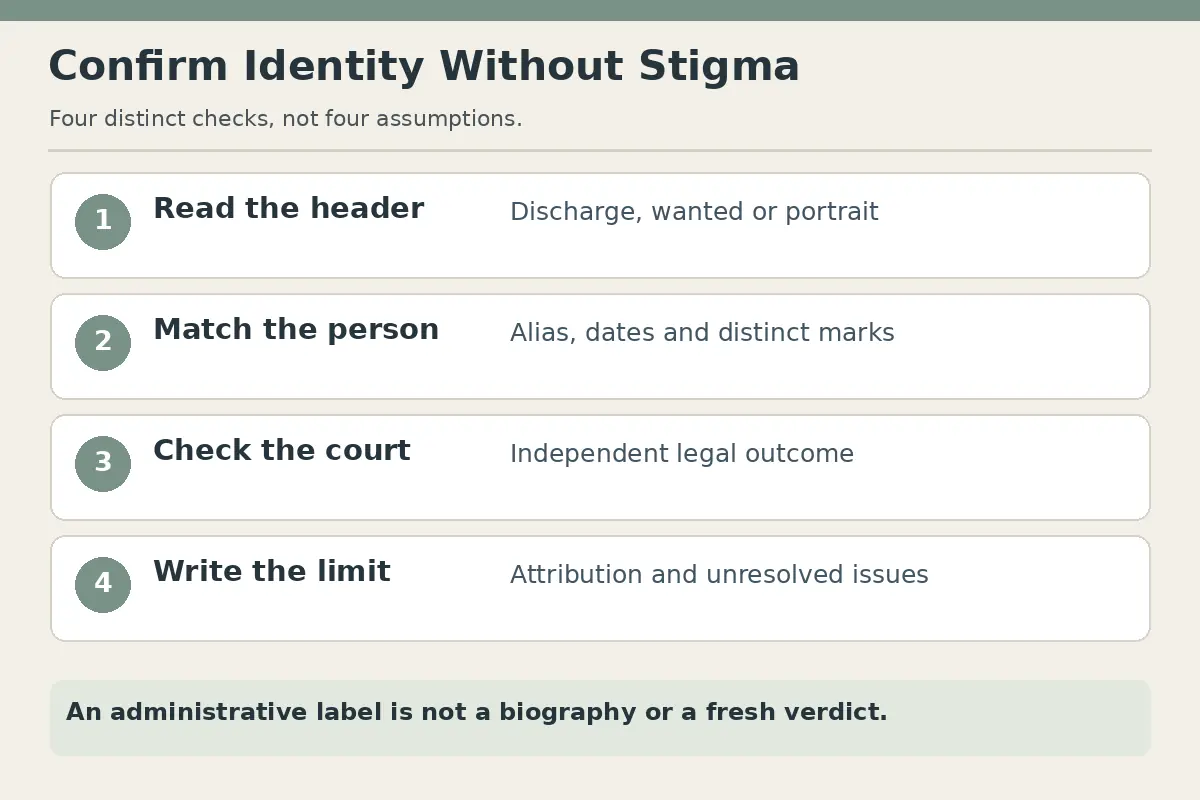
Record The National Archives, MEPO 6, specific piece, volume or issue, page, register number, date and the exact category of document. If an image was accessed on a genealogy website, add the image reference and access route. Write down whether your citation identifies an original page or only a transcript. Maintain separate transcription, normalized name and editorial commentary columns.
Report a result in appropriately narrow language: “a police register lists a person under this name on this date,” not “my ancestor was a habitual criminal.” The latter requires a verified identity and contextual interpretation. If a description is contested or access remains limited, explain exactly what is missing and what official court or civil records might resolve it.
More Records and Archives Guides
How We Research the Archive and Check Historical Claims
Our starting point is the relevant official research guidance, cross-checked with a separate authoritative description. We distinguish the series purpose from the contents of a particular piece and from family or local claims made later. A source may be an original, an official summary, a commercial transcript or a modern interpretation; each deserves an explicit label. The original date, jurisdiction, informant and document’s administrative purpose determine which proposition it can support. Illustrative scenarios in this article are invented for teaching, not disguised transcriptions.
Availability depends on the particular item: indexes can be incomplete, paper files may need an archive visit or copy request, and some records have legal access restrictions. We describe verifiable research routes, not guaranteed individual results. We do not infer sponsorship from citing a repository, and we do not recommend unconfirmed commercial links. See our affiliate disclosure for site policies. Where evidence conflicts or a necessary piece has not been examined, we preserve that uncertainty in the conclusion rather than filling the gap with a convenient story.
No. The National Archives notes closure periods and availability of selected records through partner sites.
No. A wanted or information notice must be tested against a separate court outcome.
No. Compare dates, original descriptions, court or prison information, and independent civil evidence.
No. The content varies among registers, notices and portrait circulars.
As an attributed administrative classification with its exact source and historical context.