
Metropolitan Police Pension Registers MEPO 21 offers an evidence-based path to a specific historical question. First identify the right administrative series and original record, then separate a reported assertion, a dated decision and an unverified family inference. This article shows where to search, how to interpret the source, and what independent record should test the conclusion.
Start With a Retirement Question, Not a Surname Alone
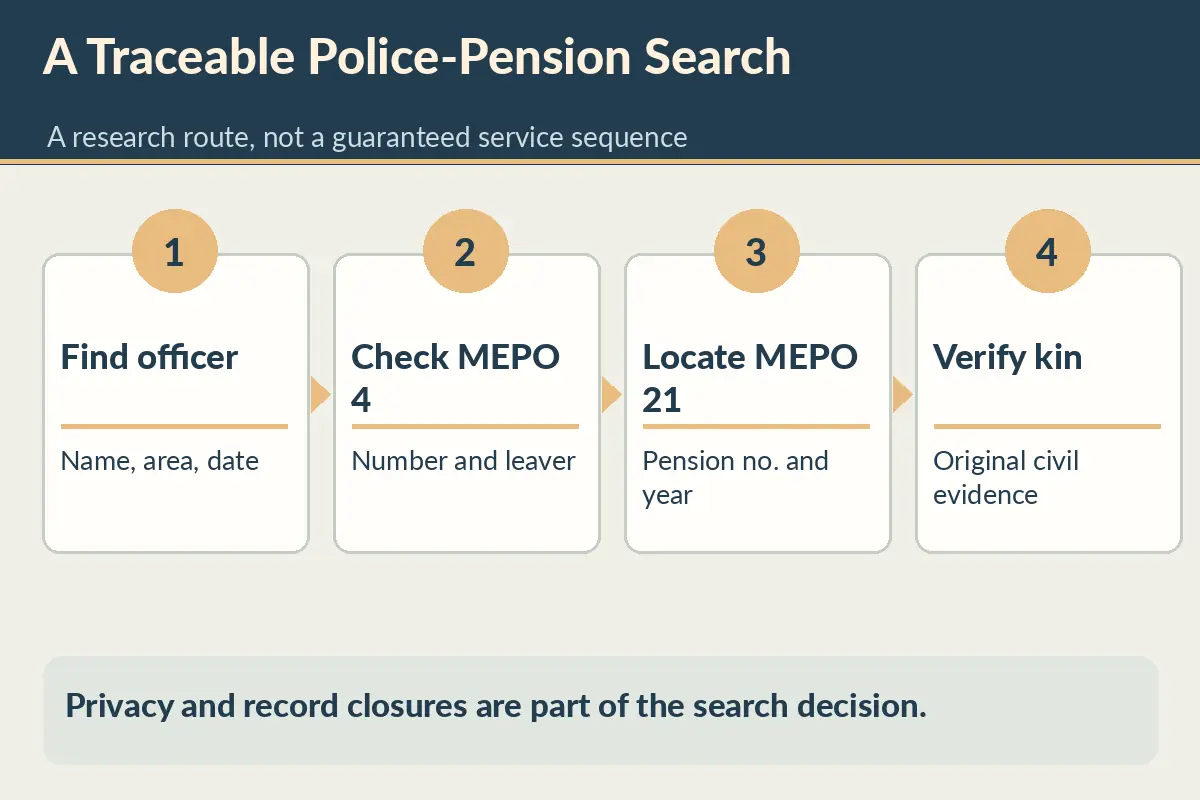
MEPO 21 comprises original Metropolitan Police pension records at The National Archives, not a roster of everyone who ever joined the force. A pension ledger can anchor a service end date, rank, recorded entitlement and personal details, but eligibility changed and a missing pension entry does not prove the officer never served. Start with a known name, possible division, date of leaving and, when available, warrant number.
The Metropolitan Police and the City of London Police were separate forces. A story about a constable who worked near the City does not identify which employer kept the file. Establish jurisdiction before selecting MEPO. Put variants of the surname beside any known place of birth and age so that a plausible pensioner is not silently merged with a namesake.
Choose the 1852–1932 Name-Search Route
The National Archives identifies MEPO 21 registers for 1852–1932 as searchable by first and last name on Ancestry, normally through a paid collection. The provider describes original images organized by pension number, with entries containing service and, in some instances, kinship details. View the original image rather than copying fields uncritically from a search-result snippet.
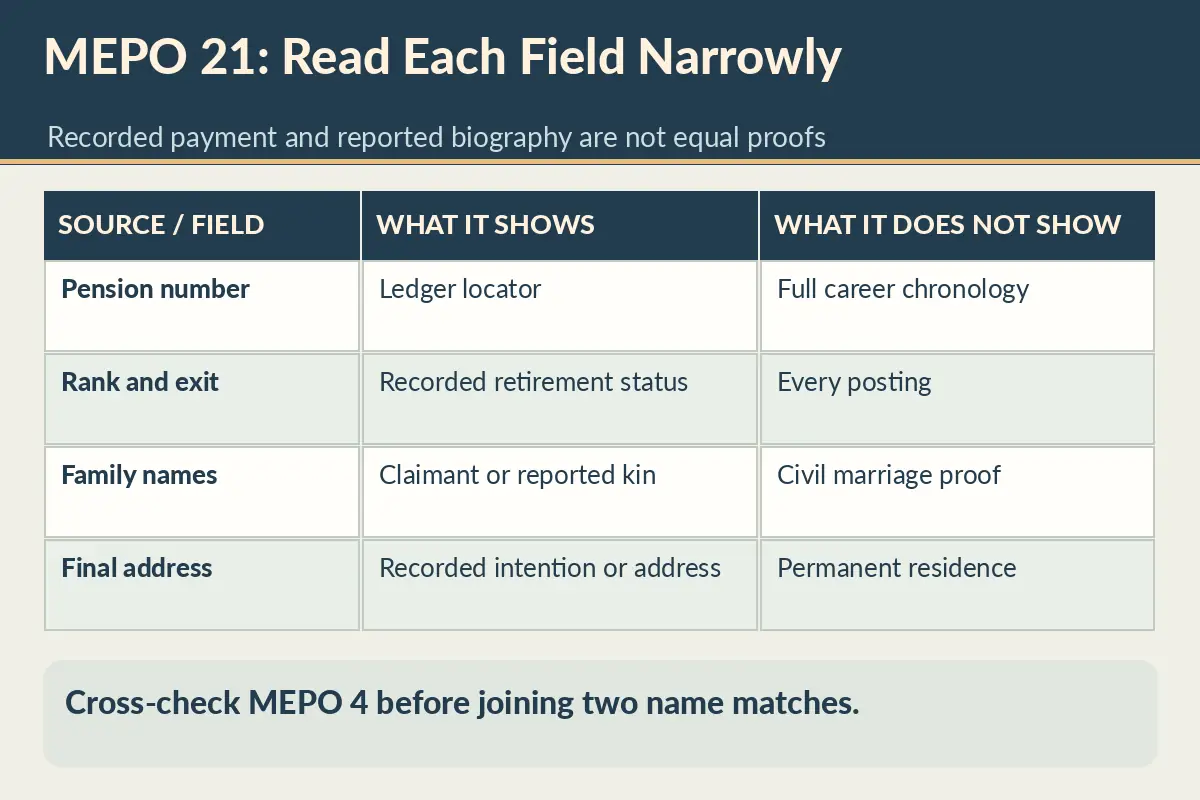
Record the pension number, piece reference, retirement or resignation date, rank and relevant notes. An apparent birthday, spouse or parent is a statement entered for pension administration; confirm it with contemporary vital or household records. If no result appears, vary spelling and initials, inspect neighboring entries, and investigate whether the officer left without qualifying for a pension.

Route Later Pensions by Date and Number
For post-1932 MEPO 21, the Archives says the material is not online in the same indexed form. MEPO 21/67–210 can be browsed by retirement date and pension number, making a leaver date essential when a name search fails. This is a different retrieval task from entering a surname into a digitized catalogue.
Records in MEPO 21/100–139 covering 1957–1993 are closed, and the Archives directs researchers to the formal Freedom of Information request option on the catalogue page. A closed item must not be treated as missing or circumvented. Avoid publishing personal detail about potentially living people from a pension file without a legitimate reason and appropriate privacy review.
Use MEPO 4 to Obtain the Warrant Number
The joiners, leavers and attestation material in MEPO 4 supplies the identity key that a pension search may lack. Registers of joiners include MEPO 4/333–338, leavers MEPO 4/339–351, and attestation ledgers MEPO 4/352–360. The Archives also points to 1889–1909 certificates of service in MEPO 4/361–477. These are not all identical documents.
Transcribe the warrant number exactly and note changes in rank and division. Test whether the leaver date agrees with a MEPO 21 ledger. An apparent discrepancy may indicate another officer with the same name, an administrative amendment or an incorrectly indexed year; it should lead to a targeted recheck, not an invented transfer.
Read Family Details as Reported Information
Some pension entries name a spouse, next of kin or parent; the fields and depth vary by period. An address intended for retirement is not proof that the person actually lived there for the rest of life. Family details can guide a search for a marriage or death, but the pension office was not recording a civil registration event.
Create a small claim ledger with columns for recorded wording, informant or source, confidence, and independent verification. For a spouse’s name, seek the original marriage register; for birth place, compare a civil certificate or census; for a service date, seek the MEPO 4 entry. Do not assign an unnamed child to a family from an aggregate count.
Keep Pension Entitlement Distinct From Employment
An officer might resign, be dismissed, transfer or die while serving. A pension result is therefore a selected end-of-service signal, not a census of everyone who wore the uniform. Similarly, a widow’s pension names a claimant in a financial relationship; inspect its own heading to learn whether it is a survivor benefit or the former officer’s award.
If a pension search is blank, log what was searched: index coverage, surname variations, earliest and latest retirement years, reference ranges and whether the material was open. Consider MEPO 4, police orders in MEPO 7 and relevant civil records instead of describing the absence as proof the person never joined.
Test Two Similar Officers Against Independent Events
Two men named John Brown could appear in the records of a large force in the same decade. Prefer stable warrant numbers and coordinated join/leave dates over surname alone. Compare division postings, rank and dates alongside independent civil birth or marriage information. An exact given name is weaker evidence than an exact warrant number tied to a dated register.
When the pension ledger and MEPO 4 disagree, retain both observations in the research log. Check original handwriting, adjoining pages, amendments and whether a late annotation was added after retirement. Resolve the contradiction openly or leave two candidates separate; never repair an uncertain link by rewriting a date.
Cite One Pension Entry and the Source That Tests It
A complete research note gives the pensioner’s name and role, MEPO 21 piece, pension number, image or folio and date, plus the companion MEPO 4 reference. Say whether you inspected an original digitization, a transcription or an archive description. Explain the limits of each claim rather than presenting a list of plausible family facts as established lineage.
An example conclusion may state that a specific ledger records retirement for a constable with warrant number X and a stated place of birth. It should not proclaim that the person in an unrelated census is the same man until independently matched. Attach a next-step source for any unresolved birth, marriage or household claim.
How We Research Historical Archive References
We checked the principal archival research guide and a second repository or related-source guide on 28 October 2026. We compared the dates and type of record, the intended purpose of each series, available finding aids, and the limits of individual identification. No fictional example is represented as a genuine historical person. The illustrations explain source relationships and are not original archive scans. A negative catalogue search is not proof that an event never occurred.
More Records and Archives Guides
Source Citations and Ethical Research Boundaries
The sources establish: MEPO 21 pension registers: 1852–1932 name search; later retirement-date and number search; closed 1957–1993; MEPO 4 service registers. Related documentation adds: Digitized 1852–1932 police pension image collection sourced from MEPO 21, including pension-number and family fields. A complete citation needs the repository, series, piece, original date, page or folio, role of the named individual, and access format. Note when only a secondary description or an index was read. Keep sensitive living-person information private where necessary. Read the GenHis affiliate disclosure; none of the links here implies a paid endorsement.
No. Digitized name searching principally covers 1852–1932; later ledgers require date and number routing.
Compare the warrant number, rank and retirement date against MEPO 4 joiner or leaver entries.
MEPO 21/100–139 are closed; use the formal access process described by the custodian.
It reports family information, but an original marriage record is stronger proof of the ceremony.
The person may not have qualified or the relevant register may be inaccessible or incomplete.