
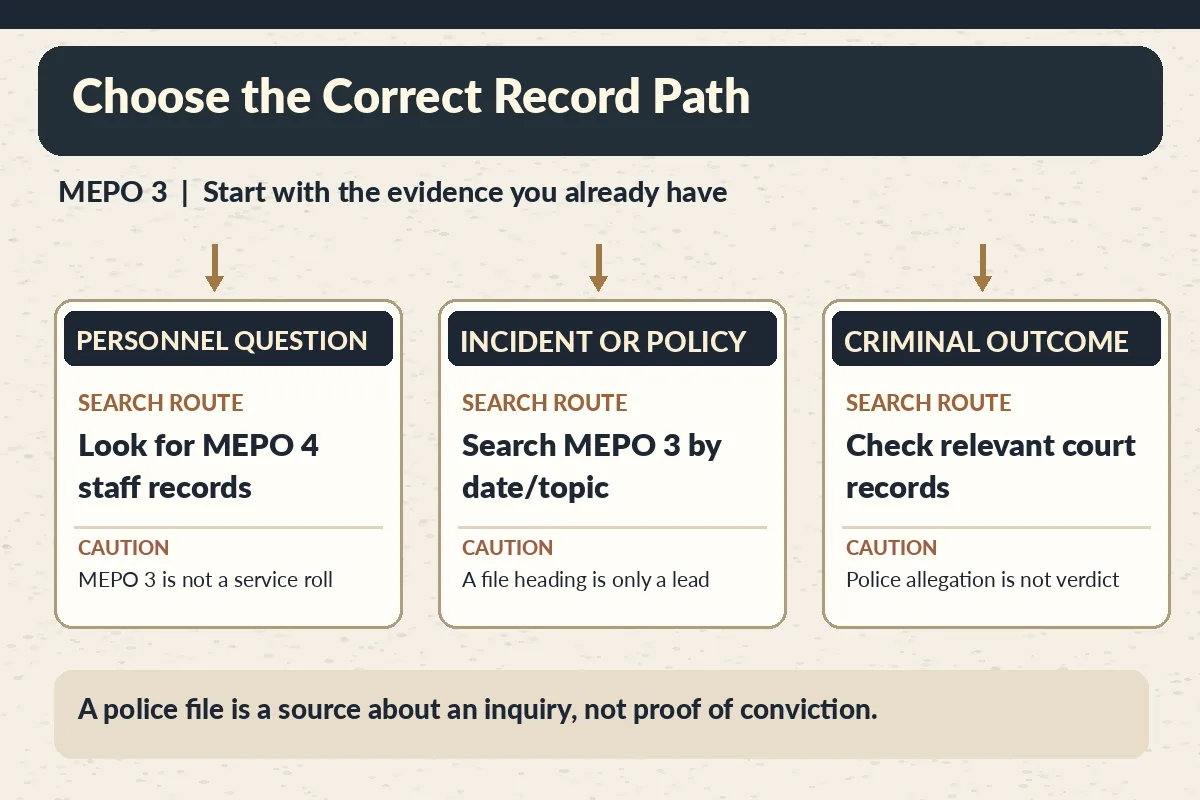
MEPO 3 holds special correspondence and papers associated with the Metropolitan Police Commissioner, including aspects of police work and investigations. It is not a comprehensive criminal register, a substitute for court records or a complete file for every alleged offense in London. Start with an approximate date, incident, place or subject, and then identify the exact MEPO 3 reference and the kind of papers that survive. A police report may record allegations and operational decisions without proving a person’s guilt. The National Archives Metropolitan Police guide helps distinguish investigative records from staff registers and other MEPO series.
Select an Incident or Policy Question Before a Person
Start with a dated incident, station, neighborhood, legislation or policing policy. MEPO 3 includes correspondence and special files about particular matters, so the catalogue may be more usefully searched by subject than by a victim’s or suspect’s surname. A file title can name an issue discussed over many months, with attachments on several people. Avoid turning that administrative filing unit into a personal case history without checking the actual documents. Note the place of the incident separately from the headquarters that handled the papers.
Record whether your question concerns institutional policy, a complaint against an officer, a reported offense or an individual’s later life. Different evidence answers each. For officer careers, the National Archives directs researchers to personnel series such as MEPO 4, not merely MEPO 3. For an alleged crime, a court record or local record may be necessary to establish formal charges and disposition. A policy letter mentioning a person does not make that person a police employee or a defendant.
Distinguish a Report From an Investigative Finding
Police files can contain reports, internal memoranda, witness statements, correspondence and copies of other documents. A reporter’s assertion is not the same as a confirmed observation or a court finding. Create a source ledger with author, recipient, date, information source and the action requested. When a complaint is forwarded without investigation papers, describe it as forwarded, not sustained. An undated copy may have been filed long after the event; keep document creation date distinct from filing date.
A Metropolitan Police file about behavior in public spaces illustrates this difficulty. The National Archives uses MEPO 3/937 as an example of correspondence involving early twentieth-century allegations and policing practices. The presence of a document shows that an issue attracted official attention. It does not establish that everyone mentioned was charged, that a prosecution succeeded or that the language of the police report was an unbiased description of events.
Check Police Jurisdiction and the Period
The Metropolitan Police began in 1829 and its jurisdiction changed over time. The City of London Police had a different force, with records held elsewhere. Before using MEPO 3 for an incident, check whether the place fell within Metropolitan Police responsibility at the relevant date. The National Archives’ jurisdiction notes include changing divisional boundaries and responsibilities for certain royal dockyards and military stations. The modern word ‘London’ is too broad a geographical test.
Identify the approximate police division or station when known, but avoid assuming that a later station boundary also applied decades earlier. A case that involves another force could appear in correspondence sent to the Commissioner without having been investigated by Metropolitan Police officers. Note any transferred inquiry, attached report or reference to Home Office files. Evidence of correspondence between offices proves contact, not which institution established the facts.
Search MEPO 3 Without Confusing Other Series
Use Discovery’s reference filter to constrain a subject search to MEPO 3, then apply date, incident terminology, address and names. Browse adjacent references if the catalogue gives only a generic title. The National Archives lists MEPO 2, MEPO 3 and MEPO 4 as police work and investigation material, while MEPO 20 is a distinct register of murders and violent deaths and MEPO 6 relates to habitual criminals. Those series are alternatives for specific questions, not interchangeable indexes into one universal file.
Record the exact file reference, catalogue title, covering dates and access status. Many original police files are not viewable online; an archive visit or copying request may be needed. A description that mentions an ‘investigation’ is a finding aid and says little about a final result. If relevant files are closed or missing, preserve the limitation rather than guessing what they contain. A useful answer may be a fully cited institutional file with no person-level resolution.

Test a Worked Example of a Neighborhood Complaint
Imagine a family story that a shopkeeper was ‘in a police file’ during the 1910s. Suppose MEPO 3 contains correspondence about a local complaint mentioning the shop address. First locate the exact letter, check who is being described and separate reported conduct from what officers actually observed. Search for any accompanying response or note of further action. If the paper merely forwarded a citizen’s allegation, it does not demonstrate that the shopkeeper was arrested, tried or convicted.
To establish the person’s identity, compare a business directory, civil register or contemporary address source with the file. To establish a formal outcome, seek an appropriate magistrates’ or criminal court record, where surviving, or a clearly documented discontinuance. Keep the police file’s viewpoint visible: officials may have used language about class, gender, ethnicity or sexuality that does not accurately describe the individual. Responsible research quotes carefully and avoids repeating prejudicial labels as factual judgments.
Publish a Cautious and Reproducible Conclusion
Cite MEPO 3 with the piece number, folio or page when available, document date and name of the author. Distinguish an original report from a later typed summary or an internal note added years after the event. Keep a separate line for every claim: a complaint was received, inquiries were authorized, officers reported observations, a case was referred or a court reached a result. Those are different propositions with different supporting records.
The defensible final statement might be ‘the Metropolitan Police discussed the complaint; no court outcome has been established from the sources checked.’ If the record points to another institution, document the referral instead of implying an arrest. Protect living people’s privacy if a file contains twentieth-century personal details, and follow the actual repository’s access rules. A transparent limitation is better than an invented crime or a false family stigma.

More Records and Archives Guides
How We Research and Verify This Archive Series
Our source check starts with The National Archives research guidance and a second reference, this complementary finding aid. We record the original series, piece or item, date, creator and access method before making a personal or legal inference. Documented statements and independently corroborated outcomes are separate categories. Where a file is missing, unindexed, closed or not inspected, we say so rather than manufacturing negative evidence. A cited catalogue lead does not mean we have seen every folio. For disclosure of any commercial relationships, see our affiliate disclosure.
No. It is a selected series of correspondence and special papers, not a universal crime register.
No. Reports and allegations must be distinguished from charges and court outcomes.
No. Their historical jurisdictions and record custody differ.
Use relevant Metropolitan Police personnel records such as MEPO 4 where appropriate.
Find an explicit police disposition or an independent court record with matching identifiers.