
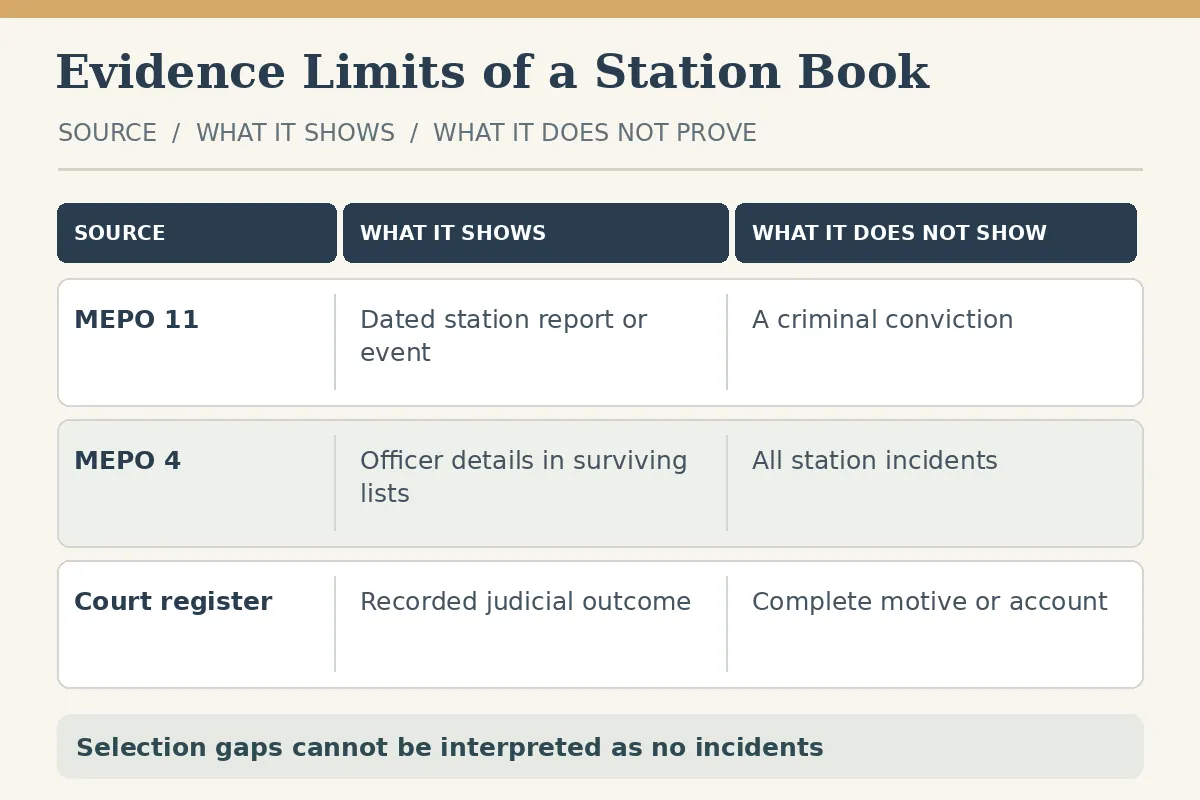
Metropolitan Police occurrence books can preserve a station-level account of events in a London neighborhood. MEPO 11 is not a complete run of every incident log: The National Archives describes it as representative books and records from police units, selected in part because of their historical interest. An entry may report an allegation, a call, an officer’s action or an occurrence at a particular hour. It is not, without further evidence, proof that the allegation was true, that the named person was convicted or that the entire incident was investigated.
The correct search begins with the station, period and event question rather than an ancestor’s surname alone. Station names, policing districts and jurisdiction changed, while many routine books were destroyed or retained outside the public archive. The record is also an account written from an institutional point of view. Treat the identity of the author, the person reporting and the person accused as separate roles; this is especially important for common names and sensational claims in family stories.
Identify the Station Before Searching MEPO 11
First establish whether the event occurred within the Metropolitan Police area. The City of London Police is a separate force, and records for other borough or county forces commonly belong in local repositories. Use an address in a dated directory, census, court report or contemporary map to place the incident, then look for a station or division associated with that period. Do not map a modern borough label backwards without checking the historic boundaries and station names.
Search the archive catalog within the MEPO collection by station name, neighborhood and approximate date. An occurrence book may be described by a date range or unit rather than by all names it contains. A catalog result is therefore a lead to a volume, not proof that a specific person is inside. Preserve the reference, producing unit, dates and access notes; if a result is closed or stored elsewhere, do not assume it can be read online or bypass access restrictions.

Understand Why Only Some Books Survive
The National Archives’ Metropolitan Police selection policy is unusually helpful because it explains the survival issue. MEPO 11 includes representative unit records and occurrence books whose local detail illuminates the work of a station and its neighborhood. The policy also states that quality varies, that books became less informative as alternative recording methods developed, and that some material was destroyed or kept by the police historical store. This is a selection history, not a promise of universal coverage.
Keep a source-survival note next to each search. If the archive has a book covering nearby years but not the target year, note the gap without constructing an incident from silence. If a police journal is held but does not mention the name, consider that the event might not have been reported to that station, may appear under a street or date, or may have been recorded elsewhere. An absent occurrence entry is weak negative evidence unless coverage and practice are well established.
Extract the Entry as a Report, Not a Verdict
When you consult the original entry, transcribe the date and time as written. Note the reporting officer or clerk if identifiable, the words used for the incident, the physical location, and every person’s described role. Distinguish a complainant, witness, person detained, officer on duty and injured party. A surname can appear in more than one role, and a short note about someone being “brought in” cannot be translated into conviction or punishment.
Avoid modernizing the text into a neat legal narrative. Terms for conduct, occupation or identity may differ from today’s usage, while colonial or discriminatory descriptions may be offensive. Quote only what is needed to explain the historical record, attribute its perspective, and do not repeat unsupported accusations about living people. The strongest record note preserves ambiguous wording and clearly labels any editorial interpretation. An occurrence time can also be later than the incident itself.
Find an Independent Record for the Alleged Outcome
If the book reports that a person was charged, ask which legal or administrative step followed. A police allegation is not a conviction, and a referral to a magistrate is not evidence of a particular sentence. Depending on date, jurisdiction and case type, a court register, newspaper report, prison record or later police order might help test an outcome. Do not assume that all such related documents survive or that the same person must appear in them.
For identity, use several independent anchors: a street address, age, occupation, household members, date and, if relevant, a warrant number for an officer. MEPO 4 contains different personnel registers; the official London Metropolitan Police guide explains that even its name indexing is incomplete. Do not treat an officer’s presence in a station occurrence book as proof of the entire police career. Keep the operational episode and the personnel timeline as separate evidence chains.
Worked Example: A Disputed Incident on One Street
Imagine a family story says an ancestor was arrested after a disturbance in a named London street. A surviving occurrence book mentions a person with the same surname and a report of shouting at that address. The strongest immediate claim is only that the station recorded the described event. Before identifying the person, compare the forename, date, address and household with independent records. Before describing an arrest or prosecution, inspect the specific wording and the relevant court record if one can be located.
Your case worksheet could contain four columns: entry wording, person or location named, what it directly shows, and next source. An address match alone might refer to a namesake or tenant. A later newspaper story may have its own errors and should be assessed independently, not treated as automatic corroboration because it repeats the same allegation. The outcome can remain unresolved while the occurrence entry remains valuable evidence for the atmosphere and routines of a neighborhood.

More Records and Archives Guides
How We Research Police Station Records
Our source check starts with the London Metropolitan Police research guide for jurisdiction and catalog procedure. We then use TNA Operational Selection Policy 29, especially Annex C, to understand that MEPO 11 is a selective set rather than a universal log. Policy language helps describe why an unsuccessful search may reflect preservation rather than the absence of an incident.
The original record, if accessible, is evaluated as a dated account from a particular station or unit, with exact transcription and any named roles distinguished. We record whether evidence of the reported event is first-hand, hearsay or unclear, and seek independently created records for identity and outcome. Uncertain information stays uncertain. Where modern privacy or access restrictions apply, we respect them rather than proposing workarounds.
Editorial and access disclosure: archive catalog links are research references rather than paid endorsements. Please read the GenHis affiliate disclosure. Check each archive’s current copying and access conditions before ordering, and do not assume an index result is the full source.
No. An occurrence book is a station record. A conviction needs evidence from an appropriate court or other authoritative outcome record.
No. MEPO 11 is a representative selection; the official preservation policy describes destroyed and differently held records.
No. Catalogue entries may identify volumes rather than people, and occurrence books were not resident registers.
The City of London force is separate; start with its own repository rather than assuming an MEPO reference.
Quote cautiously, identify who made the report, check independent records and avoid presenting an unproven accusation as fact.