
Find the Notice Before Reconstructing the Career
Metropolitan Police orders in MEPO 7 are dated administrative notices, not complete personnel files. The National Archives describes the series as running from 1829 to 1989 and including staff news, promotions, awards, retirements and dismissals. A notice can establish that an event was announced on a stated day; it cannot, by itself, establish an officer’s birth, every posting or the precise date a disciplinary change took effect. Start with one narrow question, such as whether a constable was promoted during a known month.
The official Metropolitan Police research guide recommends browsing MEPO 7 when the approximate date of the event is known. Write that date, the person’s name and a possible warrant number before opening a volume. Do not assume a modern keyword search reaches all individual notices: some volumes are indexed, others require reading by date. A surname-only result should be regarded as an unconfirmed candidate.
A working record has columns for notice date, effective date if explicitly given, rank, division, warrant number where shown, notice wording and source reference. That structure stops a common mistake: reporting the date a personnel order was printed as the date someone joined a division. If the order says that a promotion is to take effect later, record the two dates separately and test later implementation through another source.
Route the Search by Event and Availability
There is a practical gate before the search: MEPO 7 material is subject to a 50-year closure rule. For later records, inspect the exact catalogue entry and access condition rather than treating the historic series end date as an assurance that every volume is open. Do not propose circumventing access restrictions to identify living people. For older open notices, select the volume covering the event date and note whether it is a general order, confidential notice or index.
Different questions point to different evidence. A promotion or transfer notice calls first for MEPO 7, whereas a start-of-service identity question may require an attestation or register in MEPO 4. A retirement that resulted in a pension can be compared with MEPO 21, but a pension file is not guaranteed for every person and may record later administrative dates. Record any date disagreements without silently choosing one.
A policeman’s warrant number can be an especially useful identity control because two men of the same name may have served in London at overlapping times. Compare number, rank, division, period of service and later entries, where available. The City of London Police was a separate force and is not covered as though it were a division of the Metropolitan Police. That jurisdiction distinction matters even when both officers worked inside London.

Read Staff Notices as Limited Evidence
A transfer order can identify a named officer and an intended or announced change of division, but it is not a daily duty roster. A disciplinary entry may say that an individual was dismissed or reduced in rank; read the exact words and effective date and do not infer the allegation, hearing procedure or subsequent appeal without a separate file. The identity of the named officer must be established before such a sensitive event is associated with a family member.
The evidence table compares MEPO 7 notices with MEPO 4 service records and MEPO 21 pensions. MEPO 4 may contain attestation, joining or leaving details depending on volume and period; it does not automatically document every street assignment. MEPO 21 can record pension administration and sometimes personal details, yet an award of a pension is not a literal date-of-death record. Different record purposes create legitimate differences in dates and personal information.
Use a fictional example to discipline an inference: a ‘J. Smith’ promoted in a police order and a ‘John Smith’ in a later pension register are not automatically the same constable. If warrant numbers disagree or one division is unexplained, retain two possible identities. If the numbers align and the dates and ranks form a coherent sequence, write a qualified match and cite each original entry separately.

Check the Announcement Against a Second Record
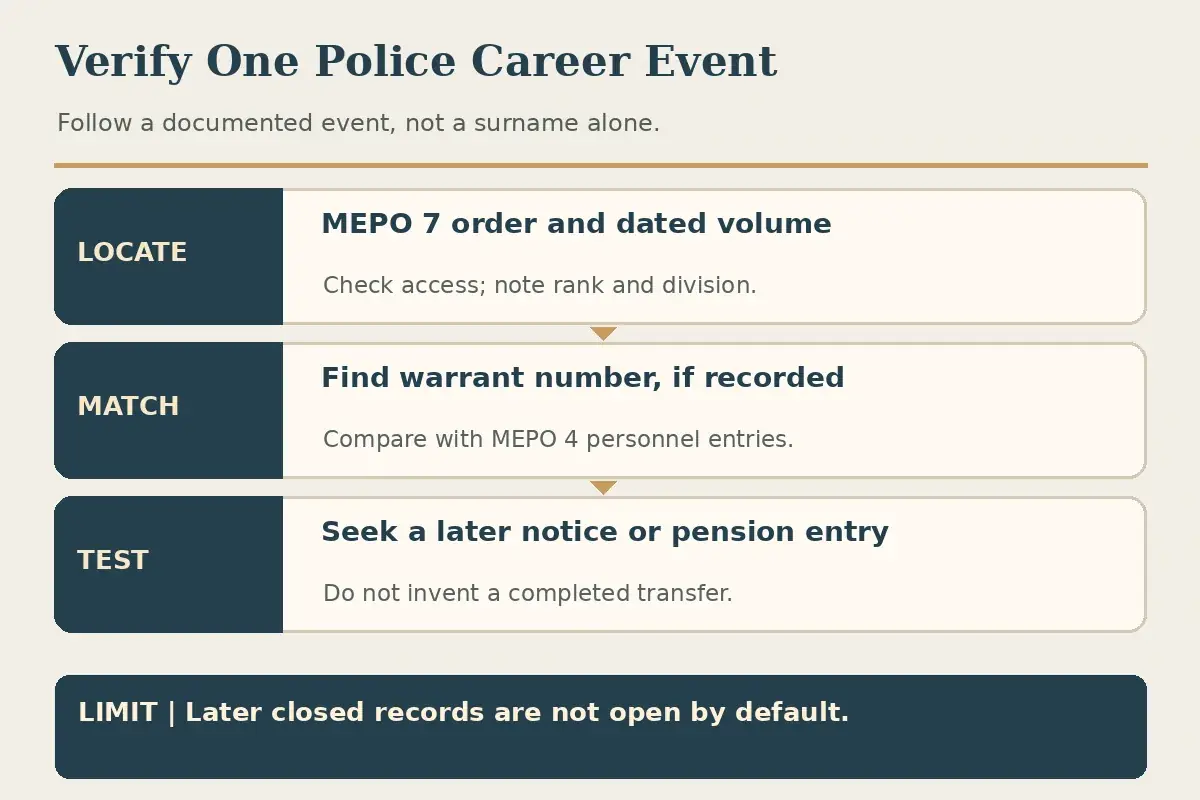
Build a conditional trail: find the dated order, copy the specific rank or division statement, then test it in a service or retirement record. A later document need not exist. If no follow-up survives, the correct result may be that an administrative instruction or announcement is documented but the complete outcome remains unknown. A blank name index is especially weak negative evidence because indexes and series survival are incomplete.
For an award notice, The National Archives notes that the King’s Police Medal was introduced in 1909, and points to MEPO 22/2 for officers under consideration as well as relevant Home Office papers and notices in The Gazette. A name listed as considered for an award is not the same as a confirmed recipient. Distinguish nomination, approval and the public announcement rather than collapsing those stages into one biography.
Preserve the record exactly: repository, MEPO 7 piece, date of order, printed heading, page if present and the person’s identifying particulars. Note whether you consulted the original or a separate transcription. If the officer’s file mentions a spouse or child, use that direct source for the relationship; do not infer family members from the names of neighbors, colleagues or other officers in the same divisional notice.
More Records and Archives Guides
How We Research Metropolitan Police Personnel Notices
Our method begins with a dated event and an explicit access check. We use the National Archives catalogue to identify MEPO 7 material within the relevant time window and determine whether it can lawfully be consulted. The explanatory illustrations are modern representations of the research process, not images of real police orders. The role of the diagram is to keep an order, an attestation and a pension record visibly different.
We also check the force and the name. Metropolitan Police officers can be confused with City of London officers, while spelling, initials and rank may change across records. We do not label one official as an ancestor merely because a surname matches. Dates of issue and effective dates, personnel numbers, divisions and separately dated attestations provide a more rigorous basis for evaluating identity.
Our affiliate disclosure explains how commercial recommendations are handled. Official catalogues and access terms determine the research route, not a paid database result. Keep the original reference, record what was consulted and state the remaining uncertainty. The strongest responsible finding may be no more—and no less—than a dated promotion, transfer, award or retirement notice.
The National Archives series of Metropolitan Police orders, 1829–1989, with dated personnel and administrative notices.
No. MEPO 7 is subject to a 50-year closure rule; consult the exact catalogue entry for access.
No. It establishes what the order recorded; separate service or duty evidence is needed for precise actual attendance.
Compare warrant number, rank, division, event dates and independent personnel entries.
Not by itself. Use a source explicitly identifying the relationship and test that person’s identity.