
Identify an Order, Not a Soldier’s Footsteps
The National Archives describes WO 5 as British Army marching orders covering 1683–1852. An order can establish what an authority directed a unit to do, but it does not alone show that every man completed the journey. For family history, start with a regiment and a limited period, and distinguish the date of the instruction from the dates of any later arrival.
A household tradition might say that a soldier marched north during the Jacobite rising. Before placing him on a map, ask which regiment he belonged to, when the order was issued, what destination or route the wording specifies, and whether a contemporary muster places him with that unit. A surname remembered centuries later is not enough to bridge those stages.
The records are useful even when the ancestor is unknown: they can explain an otherwise puzzling movement of troops, an abrupt shift in garrison requirements or an administrative response to unrest. State precisely that the archive preserves a military instruction, not a personal diary or a roll of everyone who obeyed it.
Use the WO 5 Date Gate and Find the Correct Unit
The National Archives army-operations guide gives WO 5 the range 1683–1852. The range is a series-level description, not a promise that every day, regiment and dispatch is preserved. Search Discovery by date and military unit where the catalogue permits, and browse relevant piece titles when broad name searching returns nothing.
Unit names can change and regiments can be known by colonel, number or later title. Make a name-variant table grounded in dated sources rather than projecting a nineteenth-century name into an eighteenth-century order. Distinguish the regiment, detachment, company, garrison and commander: an instruction to one element should not automatically be assigned to the whole formation.
For the 1715 and 1745 Jacobite risings the archive explicitly directs researchers to WO 5 for marching and militia orders. The same guide also points to WO 4 and WO 7 out-letters as adjacent but different administrative sources. Consult them only when the question warrants a decision or dispatch trail, not as if they were required pages of every WO 5 file.

Separate Intended, Reported and Demonstrated Movement
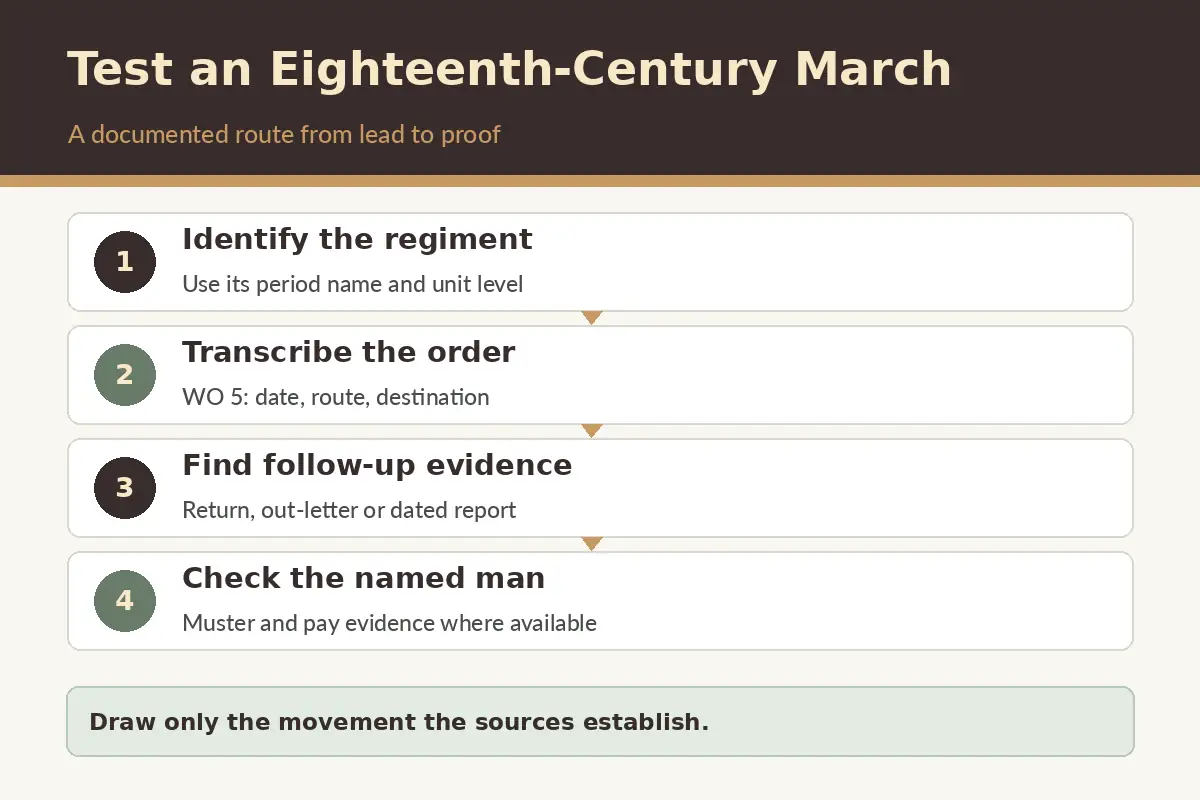
Write a movement ledger with three evidence statuses. First, “ordered”: the destination and timing specified by WO 5. Second, “reported”: a separate contemporary return, letter or other record describing what happened. Third, “person confirmed”: a dated muster or pay list supporting the presence of a particular soldier in the relevant unit at a relevant time.
The National Archives army-operations guide identifies WO 17 as monthly returns for 1754–1866, WO 27 as inspection returns for 1750–1912, and other unit series with different date spans. These show why one cannot substitute every troop-return series for WO 5 across 1683–1852. A WO 17 search in 1720 is outside the listed WO 17 coverage.
A soldier’s muster appearance may still require comparison with another individual of the same name. Confirm rank, company, enlistment or discharge information when present and check adjacent dates. A pay entry at one garrison cannot by itself establish presence throughout a whole campaign, let alone an unrecorded battle or family migration.

Map Orders With Historical Place Names and Boundaries
An order may describe travel between garrisons, rendezvous locations or stopping points using contemporary spelling. Transcribe those place names before modernizing them. Record whether a map line depicts a stated destination, a proposed route, or an independently established march. Different line styles and a dated key prevent a striking map from overstating the evidence.
For each order, save the issuer, recipient if legible, exact wording, issue date, requested action and reference. If a copy appears among outgoing correspondence, note whether it is a duplicate of the same instruction rather than independent evidence that the command was carried out. A recipient’s acknowledgement, if one survives, may still stop short of proving arrival.
Consider a fictional 1745 order to send a detachment to a northern town. The date of issuance can support the government’s intention; a later return might establish that a detachment was there. Only evidence naming Private Thomas Webb in that relevant formation could support his presence. Keep those conclusions separate until each has documentary support.
Test the Ancestor With Personnel Sources Where They Survive
The archive’s guide to soldiers up to 1913 emphasizes that early personnel records are uneven and that researchers often need a chain of muster books, pay lists and discharge or pension papers. Where those records survive, identify the regiment and date before searching by name. The absence of a pension entry is especially weak evidence about a man who died in service or never received one.
A modern military history may describe where a regiment served, but it is secondary context for a named ancestor. Cite a WO 5 piece for an order and a separate muster piece for an individual. If the pay list records a temporary absence, use that qualification rather than describing a continuous march with the unit.
Your final narrative can present an evidence-based timeline with alternative explanations: unit ordered away; subsequent unit presence established or not established; soldier present, absent, or unverified. This is more informative than a confident battle story built from a regimental name and a family surname alone.
More Records and Archives Guides
How We Research Army Movement Orders
We derive the WO 5 dates and movement-series distinctions from The National Archives guide to British Army operations. Its soldier research guide explains how musters, pay lists and pension evidence support individual identity; its Jacobite research guide supplies a documented example of WO 5’s role.
The 1745 order and Private Webb are illustrative fiction. We do not assert an actual historical march from that example. For third-party research or record-copy costs read our affiliate disclosure. Record the original WO 5 reference and date before considering any specific family claim.
The National Archives gives 1683–1852 as the series-level range for marching orders.
No. It documents the instruction; look for a return, correspondence or another contemporary source.
An officer or correspondent may be named, but WO 5 is not a comprehensive soldier-by-soldier service list.
WO 17 monthly returns are described from 1754, so not for that year.
Use a dated regiment-specific muster or pay list, and distinguish same-name soldiers.