
What T 173 Actually Records
T 173 contains records associated with the post-First World War Tomlin Commission, established in 1919 to consider claims by inventors who believed government wartime use of their inventions merited compensation. That premise defines the research problem: an inventor made a claim. A file’s presence cannot, by itself, prove an invention was novel, used by an armed service or compensated.
The National Archives describes these large claims files as variable. Some contain correspondence and argument; others contain technical drawings, specifications or additional documentation. Do not promise that every claimant has a blueprint, a patent, a payment schedule or an ultimate determination. Inspect the actual file’s contents and separate what the claimant asserted from what reviewers recorded.
A family story may say an ancestor “invented a device for the Navy.” Turn that into three testable questions: did the person submit a claim, what product or process did the claim describe, and what evidence exists of government use or compensation? These are different questions with different documentary answers.
Search by Inventor, Company or Technical Subject
The archive’s Royal Navy research guidance recommends searching T 173 using an inventor’s personal name or company name and notes a subject index that can include ships, torpedoes, submarines and seaplanes. Search variants of names, company suffixes and historically plausible descriptions. An invention may be indexed under a function rather than the family’s preferred brand name.
Keep an alias table for the inventor and any firm: initials, full name, partnership, employer and addresses from dated sources. A technical idea might have been submitted through a manufacturer rather than the person whose name survives in family memory. Conversely, a company named in a claim does not prove that every employee helped design the disputed mechanism.
For a subject-led search, begin with the broad area—such as submarine equipment—then refine it by technical terms shown in contemporary sources. Record which headings and date windows were tested. Avoid retroactively assigning twenty-first-century product terms to a document whose original vocabulary may be different.
Distinguish the Two Postwar Commissions
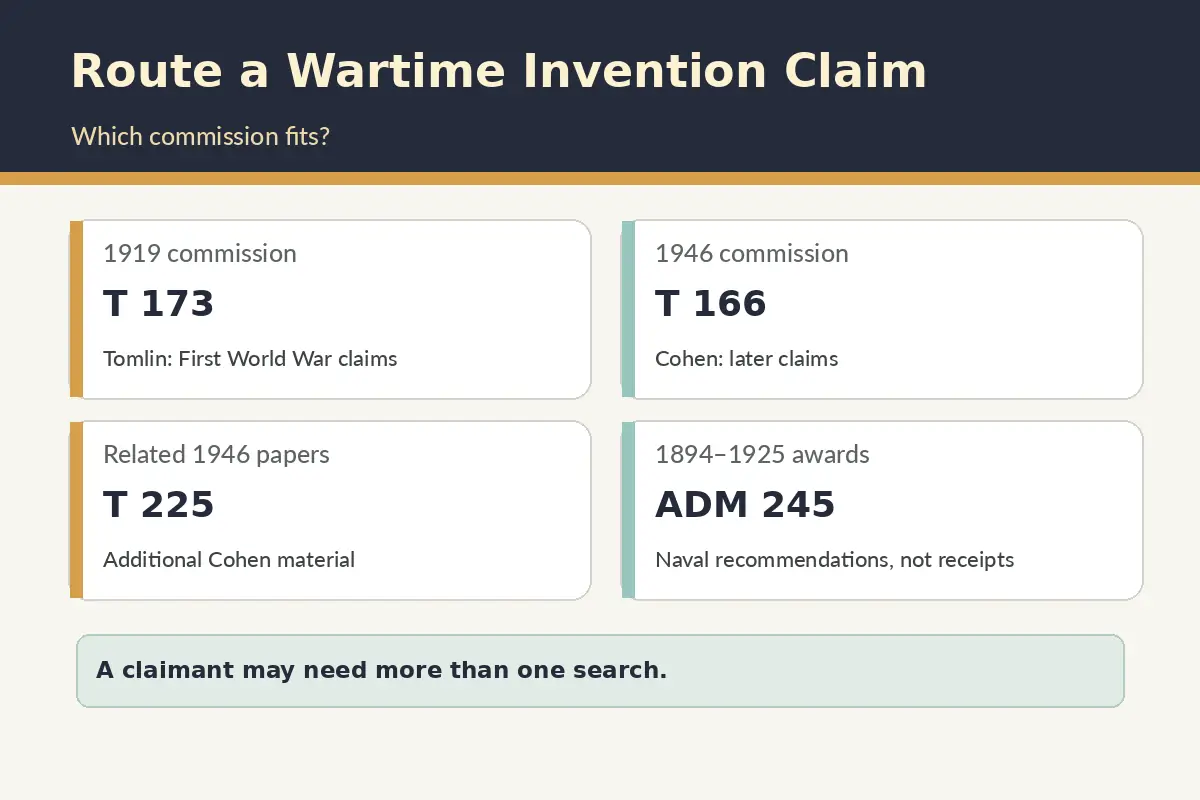
The Tomlin Commission belongs to the aftermath of the First World War and its claims are associated with T 173. The archive points to a separate commission appointed in 1946, the Cohen Commission, whose records are in T 166, with related papers in T 225. These are alternative historical routes, not sequential stages that every inventor passed through.
If a claim refers specifically to wartime activity in the 1940s, do not move it into T 173 just because the person was an inventor. Begin with the historical conflict, claimant identity and filing context. A person or company active in both periods could require two independently described searches; one commission’s silence does not negate possible contact with the other.
Government technology files can also show technical evaluation, procurement or recommendations to reward an inventor. The Royal Navy guidance identifies ADM 245 for recommendations to inventors dated 1894–1925. A recommendation there is not itself proof that money was paid, and neither should it be treated as a mandatory index for every T 173 claimant.

Build a Four-Column Compensation Evidence Ledger
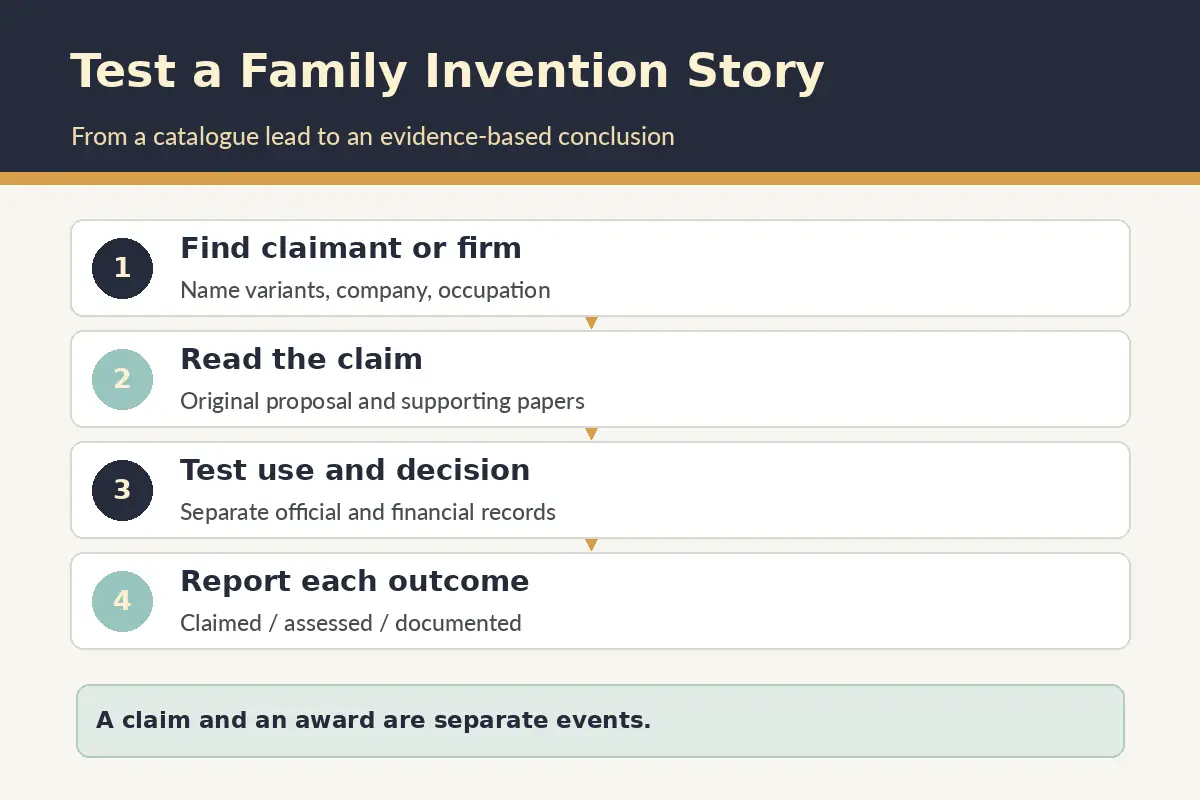
Use columns for claimant or firm, invention as described, evidence of government exploitation, and documented financial outcome. In each cell include the source and document date. A claim form establishes what was requested; an official evaluation records how that request was considered; payment evidence must be sought where the records actually contain it.
For example, a hypothetical firm called Miller & Co. might claim a naval safety apparatus. The claim may supply a drawing and correspondence with officials but no receipt proving that an award was paid. Your conclusion should be “a claim was made for this apparatus,” not “Miller’s invention was adopted by the Navy.” Search procurement or engineering records separately to test any allegation of use.
Treat a family patent story as an additional lead. A patent, a registered useful design and compensation for government wartime use belong to different legal and archival processes. Compare dates, inventors, assignees and specifications before joining them. A shared title or description alone is weak evidence of identical intellectual property.
Check Ownership, Dates and Missing Decisions
Claims may involve an employee, business partner, assignee or manufacturer. The applicant named on a cover sheet might not be the sole inventor. Read any assignment statements, employment arrangements and disputed identities in their original context. For genealogical work, use addresses, occupations and contemporary civil records to separate namesakes before attaching the claim to a family tree.
The mere survival of a T 173 file does not ensure that a complete hearing transcript or award decision survives in the same file. If the outcome is not there, search within the relevant collection and allied administrative records without implying that silence means rejection. Mark your outcome field “not established from the files inspected.”
When planning a visit or copy request, save full T 173 piece identifiers and verify access from the catalogue. Technical drawings and bulky attachments may require special handling; do not promise online images. Record which originals, digitized descriptions or secondary summaries you actually viewed, and preserve the distinction in the article citation.
More Records and Archives Guides
How We Research Inventor Claims
Our period split and series names come from the National Archives guides to Royal Navy research and development and Army research and development. They identify T 173, T 166 and the maritime subject search, but they do not certify an individual claimant’s success.
The Miller & Co. example is fictional. For a real claimant, copy the exact catalog reference, claim label, date, institutional name and vocabulary used by the record. Quote technical terms carefully and avoid substituting a modern device name unless you can cite a source that actually makes that identification.
We separate archive guidance from the factual claims of a case and we do not treat paid access as proof of authority. Read our affiliate disclosure before any commercial recommendation. Next, search a documented name or technical subject and record the unanswered outcome question.
A commission appointed in 1919 to investigate claims of government wartime exploitation of inventions.
No. A claim file may contain evidence and correspondence without establishing a final payment.
The National Archives describes a subject index, including naval topics; try contemporary technical terms.
The later Cohen Commission uses T 166, with related material in T 225.
No. Patent registration, claimed government use and compensation are different propositions.